
Agentic AI vs Generative AI: Key Differences, Use Cases, and Future
The simple guide to what each one does, where they fit, and how to choose the right AI approach for real business work.
Agentic AI vs Generative AI
Quick Navigation
Introduction
The search for agentic AI vs generative AI is growing because people are trying to understand a real shift in artificial intelligence. A few years ago, most AI tools were judged by how well they could write, summarize, design, or code. Today, the bigger question is different. Can AI complete the work, not just create the first draft?
That is the cleanest way to understand the topic. Generative AI creates content. Agentic AI works toward a goal. Generative AI can write an email. Agentic AI can decide when that email should be sent, pull customer context from a CRM, send it through the right tool, and log the result.
This does not make one better than the other. They solve different problems. In many modern systems, they work together. Generative AI gives the system language, creativity, and reasoning. Agentic AI gives it planning, tool use, memory, and action.
What is generative AI?
Generative AI is artificial intelligence that creates new content from a prompt. The content may be text, images, code, video, audio, summaries, product descriptions, reports, or answers to questions.
IBM describes generative AI as AI that can create original content such as text, images, video, audio, or software code in response to a user prompt. Red Hat also explains that generative AI is reactive. It needs a prompt before it produces a response, and it does not set its own goals or act independently.
A simple example is a marketer asking an AI tool to write a product description for a smartwatch. The AI writes the description. The marketer still decides whether to edit it, approve it, publish it, or reject it. The model created the content, but the human handled the next step.
What is agentic AI?
Agentic AI is artificial intelligence that can plan and act toward a goal with limited human help. It can understand a task, break it into steps, use tools, check progress, and adjust when something changes.
Google Cloud defines agentic AI as AI focused on autonomous decision making and action. IBM explains that agentic AI can use large language models, machine learning, and natural language processing to perform tasks on behalf of a user or another system.
Think about a support workflow. A generative AI tool can draft a reply to a customer. An agentic AI system can read the ticket, check order data, decide whether the case needs a refund or replacement, send the update, and record the action. That is the move from content to outcome.
The main difference
The main difference between agentic AI vs generative AI is this. Generative AI answers your request. Agentic AI tries to complete your goal.
Databricks explains that generative AI usually produces content in response to prompts, while agentic AI can manage multi step workflows, keep memory across steps, and call external tools to complete tasks. Red Hat gives a similar example with a sales follow up email. Generative AI writes the draft. Agentic AI can handle more of the process around that draft.
A good mental model is simple. Generative AI is the creator. Agentic AI is the doer.
Comparison table
| Feature | Generative AI | Agentic AI |
|---|---|---|
| Main purpose | Create content | Complete goals |
| Working style | Reactive | Proactive |
| Input needed | Prompt for each output | Goal, tools, and rules |
| Memory | Often limited | Can keep state across steps |
| Tool use | May suggest next steps | Can call tools and APIs |
| Best for | Writing, design, code, summaries | Automation, monitoring, workflows |
| Human role | Review and decide | Set goals, approve, supervise |
| Main risk | Wrong content | Wrong action |
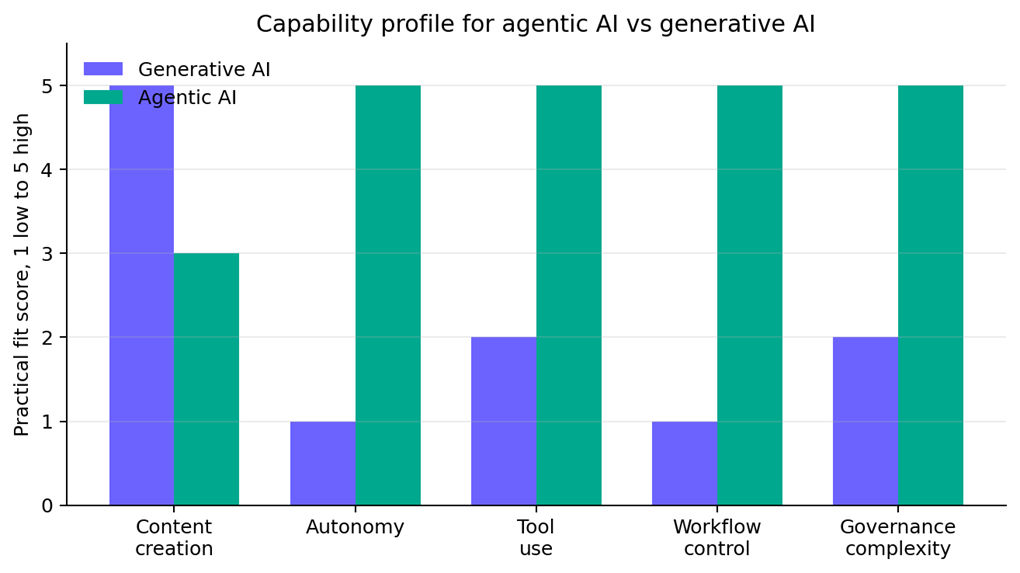
Figure 1. Capability profile for agentic AI vs generative AI.
How generative AI works
Generative AI models learn patterns from huge amounts of data. When you enter a prompt, the model predicts what output is likely to be useful. This is why it can write paragraphs, generate code, summarize a PDF, or create image ideas.
The strength of generative AI is speed. It can help people move from a blank page to a useful draft in seconds. The weakness is that the result still needs human review. The model can sound confident even when it is wrong, outdated, biased, or missing important context.
Generative AI works best when the task is creative, text based, research based, or exploratory, and when a person will check the result before it is used.
How agentic AI works
Agentic AI usually works through a loop. It perceives the situation, reasons about the goal, creates a plan, takes action through tools, checks the result, and improves the next step.
Google Cloud lists perception, reasoning, planning, action, and reflection as key parts of agentic AI. Red Hat describes agentic AI as a system that can perceive, plan, and act, then perform a sequence of actions from one request.
This is why agentic AI needs stronger safety controls. It may use APIs, send messages, update records, run tests, or make changes in live systems. A wrong answer is a problem. A wrong action can be a bigger problem.
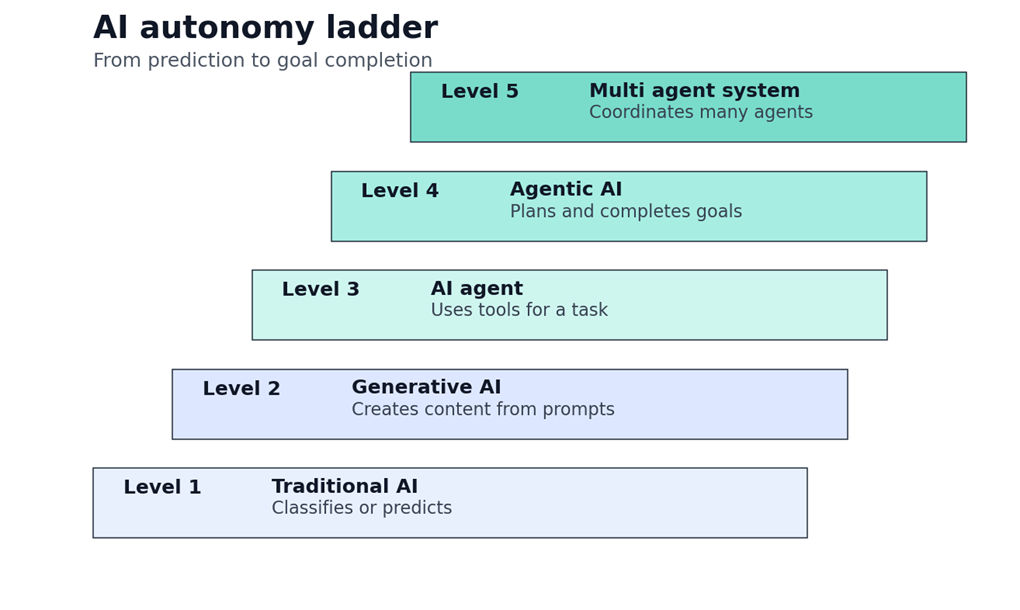
Figure 2. AI autonomy ladder.
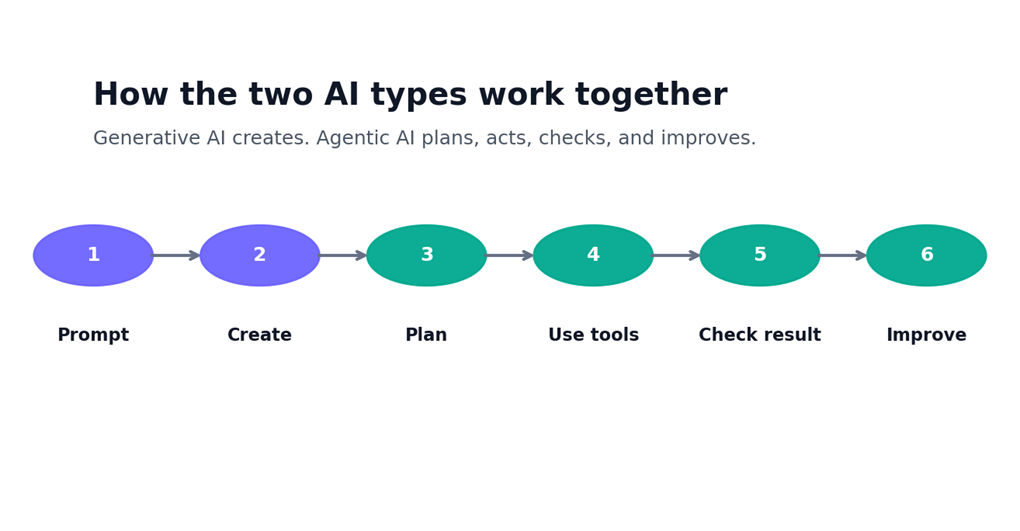
Figure 3. How generative AI and agentic AI work together.
Real world use cases
In marketing, generative AI can write blog posts, social media captions, ad copy, and product pages. Agentic AI can manage a campaign, test variants, schedule posts, track results, and suggest the next move.
In customer support, generative AI can draft replies. Agentic AI can check account data, understand the issue, take an approved action, and close or escalate the ticket. McKinsey has reported that gen AI enabled customer service agents increased issue resolution by 14 percent per hour and reduced time spent handling issues by 9 percent in one studied setting.
In software development, generative AI can write code and test ideas. Agentic AI can create a plan, run tests, fix failures, open a pull request, and keep checking whether the build works. Virtuoso QA describes this clearly in the software testing space, where generative AI can create tests while agentic AI can execute and adapt testing workflows.
In finance, generative AI can summarize reports and explain trends. Agentic AI can monitor signals, trigger alerts, and support risk workflows. In healthcare, generative AI can summarize notes, while agentic AI may support care coordination and monitoring, but only with strong human review and governance.
Use case heat table
| Industry | Generative AI value | Agentic AI value |
|---|---|---|
| Marketing | Creates blogs, ads, captions | Runs campaigns, tests, tracks results |
| Customer support | Drafts replies | Checks systems and resolves tickets |
| Software testing | Creates test cases | Runs and adapts test workflows |
| Finance | Summarizes reports | Monitors risk signals |
| Healthcare | Summarizes notes | Supports care coordination with review |
| Education | Explains topics | Builds guided learning paths |
Benefits of generative AI
Generative AI is useful because it is easy to start. A user can open a tool, type a request, and get a draft, summary, idea, or explanation. It helps teams create faster and think through options.
The main benefits are faster content creation, better brainstorming, easier code support, quick summaries, personalized drafts, and lower entry cost for teams that are new to AI.
Generative AI is a strong choice when a human still wants to control the final decision.
Benefits of agentic AI
Agentic AI is useful when a task has several steps and the goal is clear. It can reduce repeated manual work, connect tools, follow a workflow, check progress, and continue until the job is done or until it needs human approval.
The main benefits are workflow automation, faster task completion, better use of business systems, real time monitoring, and scale for repeated processes.
Agentic AI is not a shortcut for weak processes. It works best when goals, data, permissions, and rules are clear.
Risks and governance
The risk profile is different for both types of AI. Generative AI creates information risk. It may produce false, biased, unclear, or unsafe content. Agentic AI creates operational risk because it can act inside real systems.
NIST released a Generative AI Profile for its AI Risk Management Framework in July 2024. It is meant to help organizations include trustworthiness in the design, development, use, and evaluation of AI systems.
For generative AI, teams should review outputs, check facts, protect sensitive data, and watch for bias. For agentic AI, teams also need tool access limits, human approval for high impact actions, audit logs, monitoring, and a clear way to stop the system when needed.
Governance checklist
| Control | Why it matters |
|---|---|
| Human approval | Require approval before high impact actions |
| Access limits | Give AI only the tools and data it needs |
| Audit logs | Record prompts, tool calls, outputs, and actions |
| Fact checks | Verify important claims before publishing |
| Data protection | Avoid exposing private or sensitive data |
| Fallback plan | Allow humans to stop, correct, or override the system |
When to choose each one
Choose generative AI when the work is about creating, rewriting, summarizing, explaining, brainstorming, or coding with human review. It is a good fit for writers, marketers, analysts, teachers, researchers, designers, and developers.
Choose agentic AI when the work is about completing a process. It is a good fit for customer support workflows, IT tickets, sales follow ups, testing pipelines, supply chain monitoring, and research operations where the steps are known and the system has safe tool access.
For many businesses, the best answer is not agentic AI vs generative AI as a battle. The best answer is using both in the right place.
Future of agentic AI vs generative AI
The future is a blend. Generative AI will keep improving content quality and reasoning. Agentic AI will keep improving planning, tool use, memory, and workflow control.
Google Cloud explains that agentic AI can use generative AI as a tool to achieve its goals. Databricks also describes this pairing, where generative AI handles bounded content creation and agentic AI handles sequencing, state, and execution.
This means the strongest AI systems will not only answer questions. They will help people complete work, with the right level of human control.
Conclusion
The easiest way to remember agentic AI vs generative AI is this. Generative AI creates. Agentic AI acts.
Generative AI is best for content, ideas, drafts, summaries, and code support. Agentic AI is best for goals, workflows, monitoring, and tool based action.
Used together, they can turn AI from a smart writing helper into a real productivity system. The key is not to chase the newest label. The key is to choose the AI pattern that matches the job, then govern it carefully.
Agentic AI vs generative AI comparison table
This table gives a clear side by side view for readers and search engines.
This is an editorial scoring plot from 1 low to 5 high. It is meant to explain fit, not to report a lab benchmark.Frequently asked questions
What is the main difference between agentic AI and generative AI?
Generative AI creates content from prompts. Agentic AI plans and acts toward a goal. Generative AI answers. Agentic AI completes steps.
Is ChatGPT generative AI or agentic AI?
ChatGPT is mainly known as generative AI because it creates text and other outputs from prompts. Some modern AI assistants also include agentic features such as tool use, search, memory, and task workflows.
Can generative AI become agentic AI?
Not by itself. It needs planning, memory, tool access, execution logic, feedback loops, and governance controls to become truly agentic.
Which one should a business use first?
Most teams should start with generative AI for quick wins, then add agentic AI where repeatable workflows, clear goals, and safe tool access already exist.
Are agentic AI systems riskier?
They can be. The risk is higher when an AI system can take action in live tools. Strong access controls, approval steps, and audit logs are important.
Sources and further reading
- Databricks: Agentic AI vs Generative AI: Comparing Autonomy, Workflows, and Use Cases
- Red Hat: Agentic AI vs. generative AI
- Virtuoso QA: Agentic AI vs Generative AI: Detailed Breakdown
- Google Cloud: What is agentic AI?
- IBM: Agentic AI vs. Generative AI
- McKinsey: What is an AI agent?
- NIST: Artificial Intelligence Risk Management Framework: Generative Artificial Intelligence Profile