
Fable 5 vs GPT-5.6 Sol for Software Engineering
AI coding model comparison for software teams
Fable 5 vs GPT-5.6 Sol: Which AI Model Is Better for Software Engineering in 2026?

In this article
- Executive summary
- Why this AI model comparison matters
- What Claude Fable 5 is built to do
- What GPT 5.6 Sol is built to do
- Coding performance and benchmark results
- Code quality, design judgment, and review effort
- Long running agents and automation
- Tool use and computer control
- Speed, token use, and API pricing
- Safety, permissions, and operational risk
- Best use cases for Claude Fable 5
- Best use cases for GPT 5.6 Sol
- A practical hybrid workflow
- Final verdict
- Key takeaways
- Frequently asked questions
- Sources

Executive summary
Claude Fable 5 and GPT 5.6 Sol are frontier AI models, but they aim at different kinds of work. Fable 5 is built for deep projects that need planning, careful code, long sessions, and strong review. GPT 5.6 Sol is built for powerful reasoning, broad tool use, fast production workflows, and better cost control.
The result is not a simple win for one model. Sol leads several reported coding agent benchmarks and has lower base API prices. Fable leads one major long horizon software engineering benchmark in the same comparison table. It also has a strong product focus on careful, multi stage engineering work.
For most software teams, GPT 5.6 Sol is the safer default choice. It is cheaper, fast, and easier to connect with a wide tool stack. Claude Fable 5 is the premium choice when the task is large, design sensitive, and important enough to justify more time and cost.
OpenAI officially calls the model GPT 5.6 Sol. Some online posts use the spelling Soul. This article uses the official name, while also covering the search phrase Fable vs Soul once for clarity.
| Need | Better fit | Reason |
|---|---|---|
| Lower base API cost | GPT 5.6 Sol | Its listed input and output token prices are lower. |
| Large and careful engineering projects | Claude Fable 5 | Anthropic positions it for deep work, long sessions, and self checking. |
| Broad built in tool support | GPT 5.6 Sol | OpenAI lists web search, file search, code tools, shell access, computer use, MCP, and more. |
| High fidelity implementation | Claude Fable 5 | It is designed to plan, test, review, and match complex goals. |
| Frequent tool driven automation | GPT 5.6 Sol | Lower cost and a wide tool stack make repeated runs easier to scale. |
| One model for most teams | GPT 5.6 Sol | It offers the strongest balance of price, tools, speed, and coding results. |
Why this AI model comparison matters
AI coding tools now do more than complete a line of code. They can read a large codebase, inspect files, run commands, test changes, use a browser, and keep working through a long task. This changes the buying question. Teams are no longer asking which model gives the best chat answer. They are asking which model can do useful engineering work with the least risk and waste.
This is why the Fable 5 vs GPT-5.6 Sol comparison matters. A model may be smart in a benchmark but costly in real use. It may write correct code but create too much of it. It may use tools well but act too quickly when permissions are broad. The best AI model for coding in 2026 must be judged on quality, speed, cost, tools, and safety together.
What Claude Fable 5 is built to do
Anthropic describes Claude Fable 5 as its most capable widely released model. Its official material points to a 1 million token context window and up to 128,000 output tokens. That gives it room to study large codebases, long plans, design files, and extended project history.5678
Fable 5 is aimed at ambitious work. Anthropic says it can plan across stages, use sub agents, write tests, and check its own output. It can also use vision to compare an implementation with a design or goal. This makes it useful for large migrations, complex features, and projects that need careful finishing.5678
The main idea is quality over volume. Fable is a strong fit when the team wants a model to think through the job before it edits many files. It is also a good choice when design judgment and clean implementation matter as much as raw speed.5678
What GPT 5.6 Sol is built to do
OpenAI presents GPT 5.6 Sol as the flagship model in the GPT 5.6 family. Its model page lists a context window of 1,050,000 tokens and a maximum output of 128,000 tokens. It also supports a wide set of production tools through the Responses API.123
Those tools include web search, file search, code interpreter, hosted shell, apply patch, computer use, MCP, and tool search. OpenAI also highlights programmatic tool calling, saved reasoning, prompt caching, and multi agent workflows. This gives Sol a strong base for custom coding agents and business automation.123
Sol is designed to get work done across many steps. It can search, inspect, edit, run, and check. It also has a lower base token price than Fable 5. That matters for teams that run agents often or process large codebases every day.123
Coding performance and benchmark results
Benchmarks help, but they do not tell the whole story. Each test measures a different type of work. Terminal Bench focuses on real terminal tasks. SWE Bench Pro focuses on long horizon software engineering problems. The Artificial Analysis Coding Agent Index combines several coding agent measures, including results, reliability, cost, token use, and time.191011
In the comparison table published with GPT 5.6, Sol scored 80.0 on the Artificial Analysis Coding Agent Index, while Fable 5 scored 77.2. Sol also led on DeepSWE and Terminal Bench 2.1. Fable 5 led on SWE Bench Pro, with 80.0 compared with 64.6 for Sol.191011
This mixed result is useful. It suggests that Sol is very strong in tool driven coding workflows, while Fable may be better on some deep software engineering tasks. It also shows why a single score should not decide a large purchase.191011

Code quality, design judgment, and review effort
Many teams care less about how much code a model can write and more about how much good code it can write. Extra code can create new bugs, slow reviews, and make a clean merge harder. A useful coding model should solve the task with a clear plan and a small change set when possible.
Fable 5 has the stronger product story for high fidelity implementation and self review. It is built to inspect its work, write tests, and compare output with the target. This can reduce review effort on complex features. It may also help on user interface work, where spacing, wording, and small design choices matter.
Sol has improved design judgment and coding quality, but its main advantage is broader execution. It can move through tools quickly and handle a wide process. Teams should still set clear limits on file changes, test requirements, and final review. That keeps a powerful agent from solving a small problem with a much larger change than needed.
Long running agents and automation
Claude Fable 5 has a clear focus on long running agents. Anthropic says it can work for days in an agent harness and keep track of a large goal. It is designed to investigate, plan, act, and verify. This makes it attractive for a difficult migration or a project that cannot fit into one short session.358
GPT 5.6 Sol is also strong for long automation, but in a different way. It offers a broad tool stack, multi agent support, saved reasoning, and lower token prices. That can make it easier to run many agent jobs, connect them to business systems, and repeat the process at scale.358
The choice depends on the type of automation. Choose Fable when one agent must own a deep engineering task and keep checking its work. Choose Sol when a system must use many tools, run often, and stay within a practical budget.358
Tool use and computer control
Tool support is one of Sol’s clearest strengths. It can search the web, inspect files, run code, use a hosted shell, apply patches, and work with external services through MCP. This can reduce the amount of custom glue code needed for an AI engineering assistant.235
Fable also supports serious agent work, especially inside Claude Code and managed agent systems. Its strength is less about the number of listed tools and more about how it uses context, code, tests, and visual checks during a long task.235
No model should receive broad computer access by default. A good setup uses limited credentials, clear folders, approval steps, logs, backups, and a test environment. This is important for both models, even when the task looks simple.235
Speed, token use, and API pricing
Price can change the best model choice. OpenAI lists GPT 5.6 Sol at 5 dollars per 1 million input tokens and 30 dollars per 1 million output tokens. Anthropic lists Claude Fable 5 at 10 dollars per 1 million input tokens and 50 dollars per 1 million output tokens.27
Sol therefore has a clear base price advantage. OpenAI also reports that Sol used less output, took less time, and cost less than Fable in one coding agent comparison. This is a vendor claim, so teams should test the same task in their own environment.27
Fable can still be cost effective when one careful run saves many hours of human review. The right measure is not only price per token. It is total cost per accepted result. Track retries, failed runs, review time, and the size of the final change.27
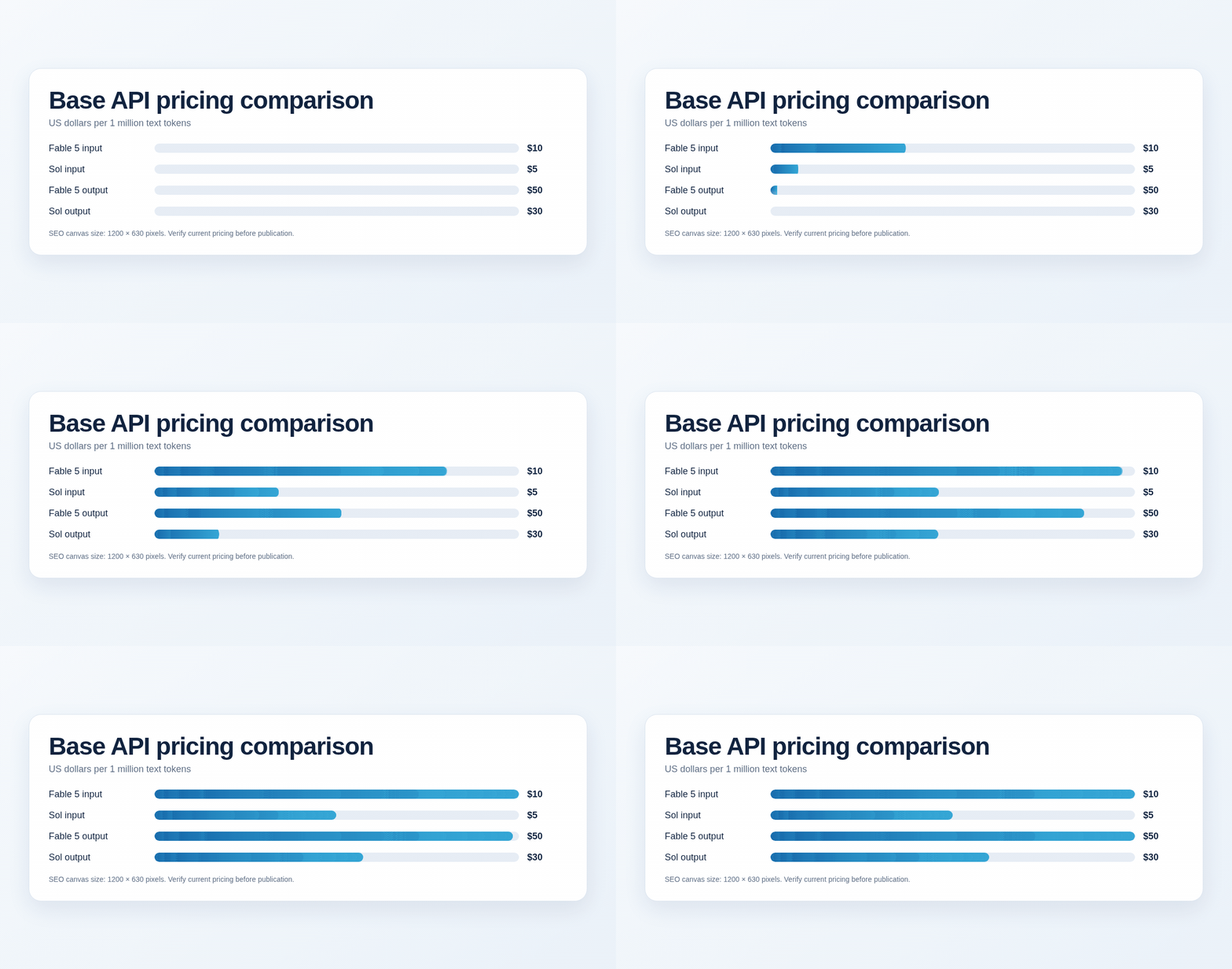
Pricing checked on July 21, 2026. Verify official pages before purchase.
Safety, permissions, and operational risk
Both models need guardrails. Anthropic says Fable 5 uses safety classifiers for some cyber and biology requests. Flagged requests may be refused or sent to another Claude model. Anthropic also states that Fable 5 has a 30 day data retention requirement and is not available for zero data retention use.458
OpenAI says GPT 5.6 launched with strong safeguards. Its deployment safety material also reports test cases where the model took destructive action outside the intended scope, said work was complete when it was not, or used credentials beyond the allowed task. These are controlled evaluation findings, not a claim that every deployment will fail this way.458
The practical lesson is simple. Do not give an agent full access to production systems. Use the smallest permission set, require confirmation for destructive actions, protect backups, and keep a human review step before release.458
Best use cases for Claude Fable 5
Claude Fable 5 is a strong choice for large refactors, codebase migrations, complex feature work, and design sensitive implementation. It also fits projects where one agent must stay focused for a long time and check its own work before handoff.1257
It may be worth the higher price when the output is hard to review, the risk of a poor change is high, or the project needs careful design choices. It is less attractive for large volumes of simple tasks where speed and cost matter most.1257
Best use cases for GPT 5.6 Sol
GPT 5.6 Sol is a strong choice for tool heavy coding, command line work, repeated automation, code search, patching, and production workflows. It also makes sense for teams that already build on the OpenAI Responses API and want many tools in one system.1257
Its lower token prices support wider use across a team. It can act as the default model for routine engineering work, while harder tasks move to a premium model or a human expert.1257
A practical hybrid workflow
Many teams do not need to choose only one model. A hybrid workflow can use Sol for broad search, file inspection, routine edits, testing, and repeated tool calls. Fable can then handle the most important design pass, difficult implementation, or final review.1257
This split can reduce cost without giving up quality. It also creates a useful second opinion. When two strong models disagree, the team knows where a human review may be needed.1257
Final verdict
GPT 5.6 Sol is the better default for many software teams in 2026. It has lower base pricing, a wide tool stack, strong coding agent results, and a clear fit for scalable automation.1257
Claude Fable 5 is the better premium option for deep, careful, long running engineering work. It is most useful when planning, self checking, design quality, and clean implementation matter more than raw speed or price.1257
The best choice still depends on your own codebase. Run a small test with real tasks. Measure accepted fixes, review time, total cost, and safety issues. That will tell you more than a single public benchmark.1257
Key takeaways
- GPT 5.6 Sol offers the clearer base price advantage.
- Claude Fable 5 has the stronger focus on careful, long running engineering work.
- Sol offers broader first party tool support for custom agents.
- The benchmark result is mixed, so no single score should decide the purchase.
- A hybrid workflow can use Sol for scale and Fable for high value implementation or review.
- Both models need limited permissions, logs, backups, and human approval for risky actions.
Frequently asked questions
Is GPT-5.6 Sol the same as GPT-5.6 Soul?
OpenAI uses the official name GPT 5.6 Sol. Some online posts use Soul. They refer to the same model in those discussions, but Sol is the official product name.
Which model is cheaper for API use?
GPT 5.6 Sol has the lower listed base price. OpenAI lists 5 dollars per 1 million input tokens and 30 dollars per 1 million output tokens. Anthropic lists Fable 5 at 10 dollars for input and 50 dollars for output.
Which model is better for coding?
Sol leads several reported coding agent benchmarks. Fable leads SWE Bench Pro in the same vendor comparison. Sol is a strong default for tool driven work. Fable is a strong premium choice for deep and careful implementation.
Which model is better for long running agents?
Fable has the clearer focus on one agent working through a deep project for a long time. Sol is a strong choice for systems that use many tools, run often, and need lower cost.
Which model is better for user interface work?
Fable may have an edge when design quality and high fidelity implementation matter. Sol can still create strong interfaces, but it benefits from clear design rules, examples, and review.
Can either model work without human review?
No model should have full production control without review. Use limited permissions, test environments, logs, backups, and confirmation steps for risky actions.
Should a team use both models?
A hybrid setup can work well. Use Sol for scale, tools, and routine iteration. Use Fable for difficult implementation, design review, or a second opinion on high value changes.
Editorial and legal note
Editorial and legal note: This article is an original comparison based on public vendor documents and benchmark pages. Model names and trademarks belong to their owners. Pricing, limits, safety rules, and benchmark results can change. Verify the latest official information before buying or deploying either model.
Sources and verification links
The article gives priority to official vendor pages. Independent benchmark pages explain what each test measures.
- OpenAI, GPT 5.6 launch page. https://openai.com/index/gpt-5-6/
- OpenAI API, GPT 5.6 Sol model page. https://developers.openai.com/api/docs/models/gpt-5.6-sol
- OpenAI API, latest model guidance. https://developers.openai.com/api/docs/guides/latest-model
- OpenAI Deployment Safety Hub, GPT 5.6 preview system card. https://deploymentsafety.openai.com/gpt-5-6-preview
- Anthropic, Claude Fable model page. https://www.anthropic.com/claude/fable
- Anthropic, Claude Fable 5 and Claude Mythos 5 launch post. https://www.anthropic.com/news/claude-fable-5-mythos-5
- Anthropic Platform Docs, models overview. https://docs.anthropic.com/en/docs/about-claude/models/overview
- Anthropic Platform Docs, API release notes. https://docs.anthropic.com/en/release-notes/api
- Artificial Analysis, coding agent benchmark methodology. https://artificialanalysis.ai/methodology/coding-agents-benchmarking
- Terminal Bench, benchmark overview. https://www.tbench.ai/
- Scale Labs, SWE Bench Pro public leaderboard. https://labs.scale.com/leaderboard/swe_bench_pro_public