
Multi-Agent Systems: How They Work, Benefits and Uses
Research article
Multi-Agent Systems: How AI Agents Coordinate Complex Work
Multi-agent systems divide complex work among coordinated AI agents, but the benefits must be measured against added cost, latency, security exposure, and coordination failure.
Contents
- What Are Multi-Agent Systems in Simple Terms?
- Why Multi-Agent Systems Matter for Complex AI Workflows
- How Does a Multi-Agent System Work?
- What Are the Main Components of a Multi-Agent System?
- Single-Agent vs Multi-Agent Systems: What Is the Difference?
- Common Multi-Agent System Architectures Explained
- Cooperative, Competitive, and Hybrid Multi-Agent Systems
- When Should You Use a Multi-Agent System?
- When Is a Multi-Agent System the Wrong Choice?
- Benefits and Limitations of Multi-Agent Systems
- The Reality Layer: Theory vs Actual Implementation
- How to Design and Build a Multi-Agent System
- Multi-Agent System Frameworks and Technologies
- Real-World Applications of Multi-Agent Systems
- Security, Governance, and Human Oversight
- Are Multi-Agent Systems Worth Using?
- Actionable Next Steps
What Are Multi-Agent Systems in Simple Terms?
Multi-agent systems are AI architectures in which two or more autonomous or semi-autonomous agents coordinate, exchange information, and act toward a shared or related goal. They can divide complex work among specialists, run independent tasks in parallel, and isolate tools or permissions.
Their limitation is equally important: every extra agent creates communication, cost, and failure paths. For a narrow or predictable task, a well-designed single agent or deterministic workflow may be faster, cheaper, and easier to verify.
An AI agent is more than a text generator. It normally combines a model with instructions, state, tools, and rules for choosing actions. A multi-agent system coordinates several such units so that one agent can plan, another can retrieve evidence, and another can review the result.
Why Multi-Agent Systems Matter for Complex AI Workflows
A single general-purpose agent can become overloaded when it must manage many tools, large amounts of context, conflicting requirements, or several independent workstreams. Multi-agent design addresses this by separating responsibilities.
Specialization is useful when tasks genuinely require different data, prompts, models, permissions, or evaluation criteria. Parallel execution can also reduce elapsed time when subtasks do not depend on one another.
Verified fact: NIST launched an AI Agent Standards Initiative in February 2026 that includes research on secure human-agent and multi-agent interactions, agent identity, interoperability, and security evaluation.[1] This does not mean multi-agent systems are standardized or risk-free; it shows that evaluation and interoperability are active engineering concerns.How Does a Multi-Agent System Work?
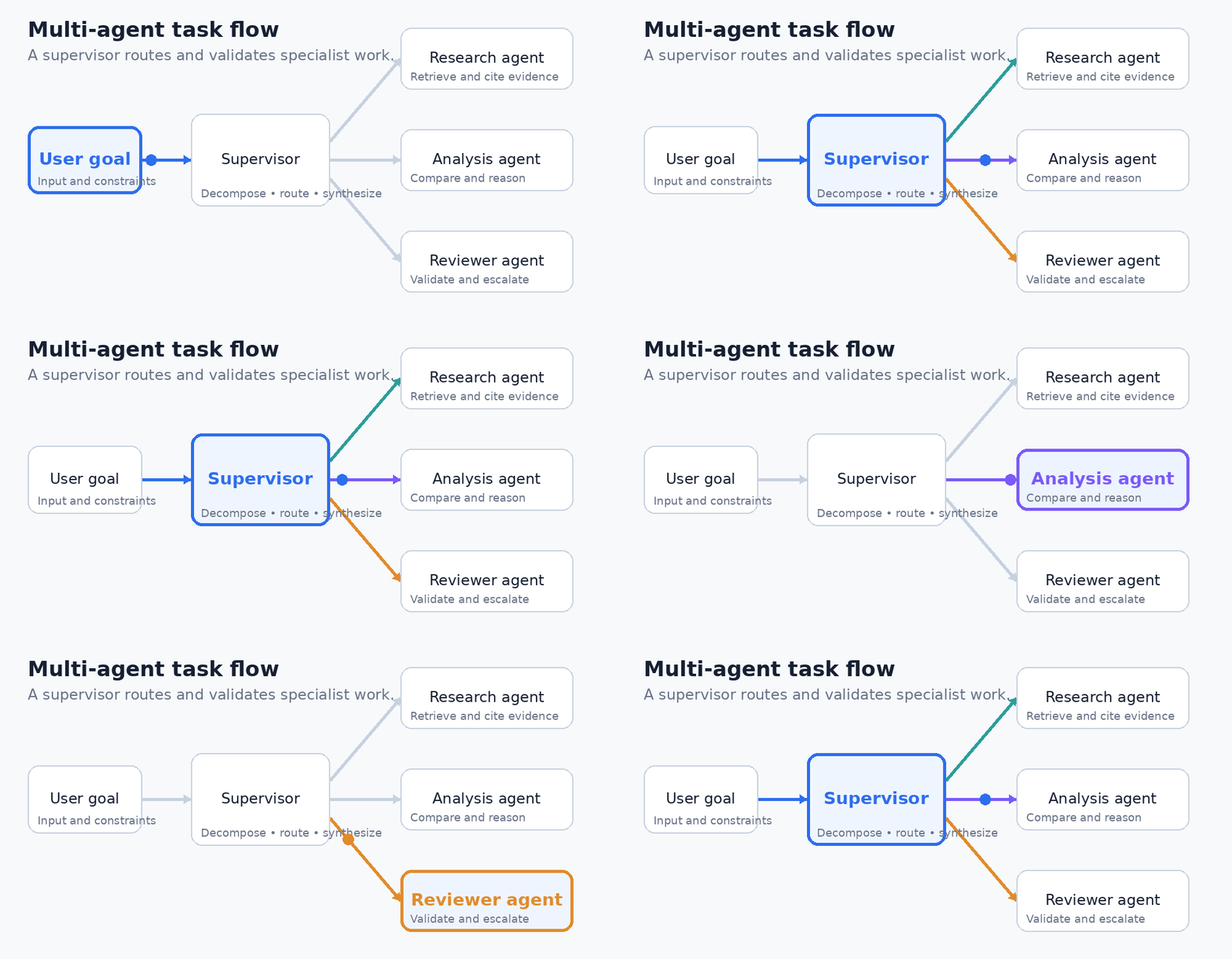
Most systems follow a recurring lifecycle: receive an objective, decompose the work, assign tasks, let agents act through tools, exchange results, validate the combined output, and stop or escalate.
- Define the objective, constraints, and completion conditions.
- Break the objective into tasks and identify their dependencies.
- Route each task to an agent with suitable tools and permissions.
- Store intermediate results in messages, shared state, or a knowledge base.
- Check quality, resolve conflicts, and combine the outputs.
- Stop when acceptance criteria are met, or send the case to a human reviewer.
The final two steps are often the hardest. A system must know whether an answer is correct enough, whether another iteration will help, and whether the agents are repeating the same mistake.
What Are the Main Components of a Multi-Agent System?
The visible agents are only one layer. Production systems also need an environment, tools, memory, message contracts, orchestration, monitoring, and human oversight.
- Agents: role instructions, model access, decision logic, and allowed actions.
- State and memory: task status, previous messages, evidence, and unresolved issues.
- Tools and data: APIs, databases, search systems, code execution, or physical devices.
- Communication: structured messages, queues, events, or shared workspaces.
- Orchestration: routing, retries, limits, termination, and result synthesis.
- Governance: permissions, audit trails, approval checkpoints, and incident response.
Single-Agent vs Multi-Agent Systems: What Is the Difference?
The choice is not between basic and advanced AI. It is a system-design decision about where complexity should live.
| Factor | Single-agent system | Multi-agent system |
|---|---|---|
| Best fit | Clear, bounded workflows | Distinct but connected workstreams |
| Context | One primary working context | Role-specific context can be isolated |
| Execution | Usually simpler and often sequential | Can run independent tasks in parallel |
| Cost | Usually lower | Usually higher because of extra calls and messages |
| Debugging | Fewer interactions to inspect | Failures can cross agent boundaries |
| Control | Simpler permissions and termination | Requires routing, conflict resolution, and limits |
A multi-agent design is strongest when responsibilities are meaningfully different. Splitting one homogeneous reasoning task among several copies of the same model may only multiply token use and coordination overhead.
Common Multi-Agent System Architectures Explained
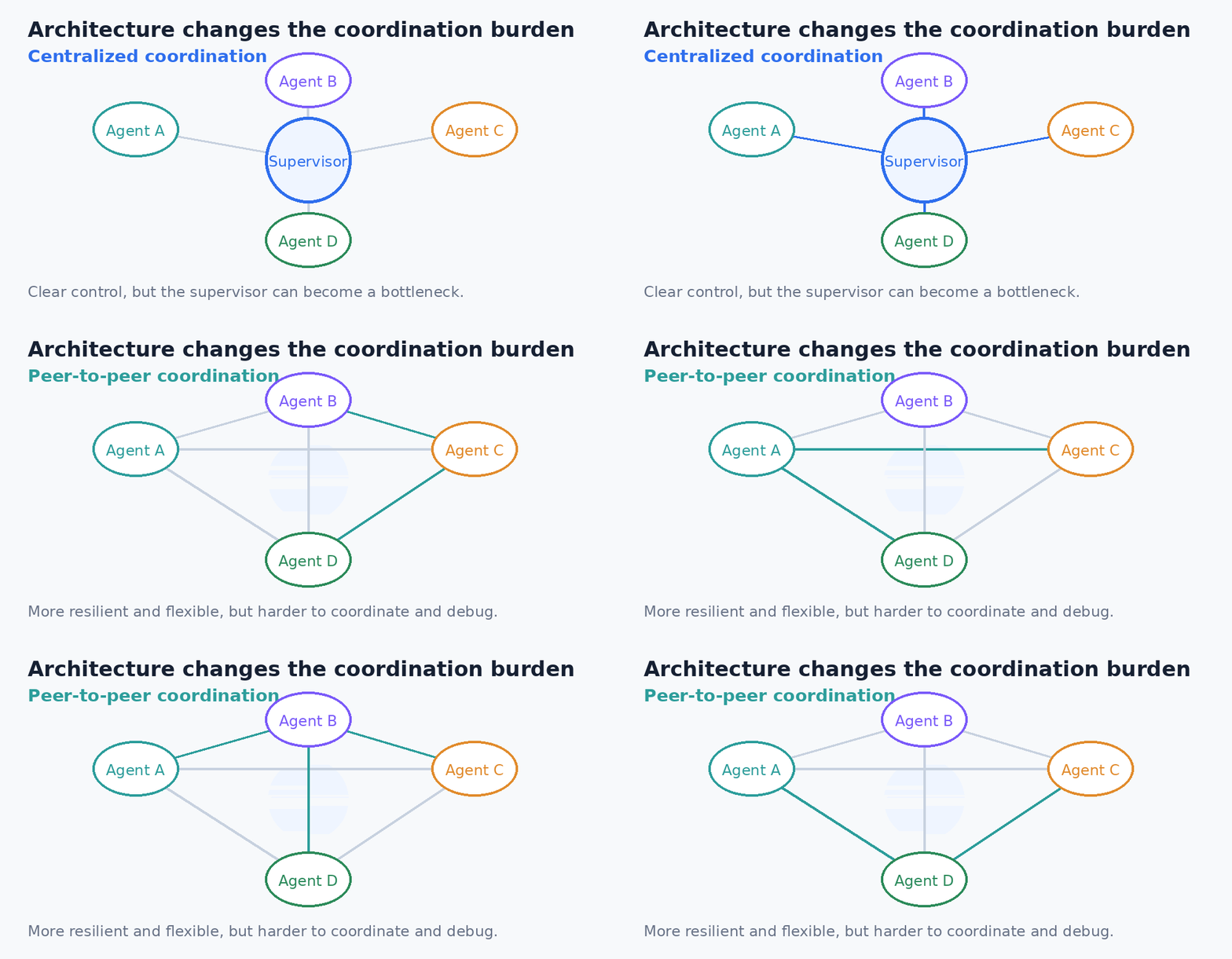
Centralized systems use a supervisor to delegate and synthesize work. They provide clear control, but the supervisor can become a bottleneck or single point of failure.
Hierarchical systems add layers of supervisors and workers. Decentralized or peer-to-peer systems let agents coordinate directly, improving flexibility while making global behavior harder to inspect.
Graph-based systems represent agents, tools, and deterministic functions as nodes connected by conditional paths. LangGraph, for example, models stateful workflows as graphs and supports branching, persistence, and human-in-the-loop control.[3]
Holonic, coalition, team, and swarm structures are also used in robotics, simulation, and distributed control. These patterns matter when membership, authority, or local coordination changes over time.
Cooperative, Competitive, and Hybrid Multi-Agent Systems
Cooperative agents share a goal and divide work. Competitive agents pursue different objectives or propose rival solutions. Hybrid systems may let agents compete during generation and cooperate during review or final planning.
Competition can improve diversity, but it needs a reliable selection method. Otherwise, the system simply produces several plausible answers without knowing which one is correct.
When Should You Use a Multi-Agent System?
Use multiple agents when the workflow contains distinct responsibilities, parallel work, separate permission boundaries, independent verification, distributed resources, or negotiation between different objectives.
Good candidates include research pipelines, software delivery, supply-chain planning, cybersecurity monitoring, document review, robotics, simulations, and enterprise workflows that combine several systems.
When Is a Multi-Agent System the Wrong Choice?
A single agent or conventional program is usually preferable when the task is linear, low-risk, latency-sensitive, inexpensive, or governed by stable rules. Multi-agent orchestration is also a poor choice when there is no baseline, no evaluation dataset, or no team available to maintain tracing and access controls.
Nuanced insight: more agents do not inherently create more intelligence. A 2026 controlled study found that single-agent systems matched or outperformed multi-agent systems on tested multi-hop reasoning tasks when reasoning-token budgets were held constant.[9] The result is task-specific, but it shows why comparisons must control for extra compute.Benefits and Limitations of Multi-Agent Systems
Potential benefits include specialization, parallel execution, modularity, permission isolation, and the ability to place an independent reviewer between generation and action.
The costs include additional model calls, message traffic, latency, duplicate work, complex debugging, inconsistent shared state, and new attack surfaces. Agents built on the same model may also share the same blind spots.
Research by Cemri and colleagues analyzed more than 200 tasks across seven multi-agent frameworks and identified 14 failure modes grouped around specification problems, inter-agent misalignment, and task verification.[8] This is evidence of recurring design challenges, not proof that every system will fail.
Theory vs Actual Implementation
Theoretical advice often recommends creating a specialist agent for every responsibility. In implementation, excessive specialization can fragment context, create handoff errors, and increase maintenance without improving outcomes.
Parallel work helps only when tasks are genuinely independent. Reviewer agents help only when they have independent evidence, explicit acceptance criteria, and permission to reject or escalate. Shared memory helps coordination, but it also requires conflict resolution, retention rules, and access controls.
Teams often underestimate the effort required for test datasets, tracing, tool authentication, retry limits, cost controls, model updates, and incident handling. Results vary with task structure, model quality, data access, latency limits, and the reliability of external tools.
Theoretical advice is therefore conditional: separate agents when the separation produces measurable value, not merely because the workflow can be drawn as a team diagram.
How to Design and Build a Multi-Agent System
- Define a bounded objective and the failures that must not occur.
- Build a deterministic or single-agent baseline first.
- Add an agent only for a distinct role, permission boundary, or parallel task.
- Use structured input and output contracts between components.
- Set retry, time, token, and tool-call limits before deployment.
- Create validation rules and human escalation paths.
- Test missing data, contradictory evidence, tool failures, loops, and malicious inputs.
- Measure task success, latency, cost, retries, and human intervention against the baseline.
NIST’s 2026 work on evaluation probes emphasizes visibility into tool use, gathered evidence, and multi-step execution.[2] That principle is practical: evaluation should inspect the workflow, not only the final answer.
Multi-Agent System Frameworks and Technologies
Framework selection should follow the desired control pattern. LangGraph is suited to explicit stateful graphs and mixed deterministic-agent workflows.[3] Microsoft AutoGen provides APIs and patterns for message-based agent applications and team conversations.[4] CrewAI organizes agents, tasks, crews, and flows, with features for memory, guardrails, and observability.[5]
The Model Context Protocol, or MCP, is not a multi-agent framework. It is an open protocol for connecting AI applications to external data and tools.[6] MCP can standardize integrations, but it does not solve task decomposition, validation, permissions, or agent coordination.
No framework removes the need for architecture decisions. Evaluate control, state management, observability, integration effort, security, deployment model, and maintenance before comparing feature lists.
Real-World Applications of Multi-Agent Systems
Multi-agent systems can coordinate transportation networks, warehouse robots, supply chains, security monitoring, research, simulations, gaming, and multi-step enterprise operations.
Hypothetical example: a supply-chain workflow could assign demand forecasting, inventory, logistics, and risk analysis to separate agents. A supervisor would combine their recommendations. The design should be tested against a centralized optimizer or single-agent baseline using fulfillment rate, cost, delay, and human review time. This is an illustrative scenario, not a reported case study.AI-assisted discovery is another relevant use. A research agent may decompose a question, retrieval agents may search different sources, and an evaluator may check citations before a synthesis agent writes the answer. This can improve coverage, but it does not guarantee inclusion in generative search results or recommendation systems.
Security, Governance, and Human Oversight
Each agent, tool, message, and memory store creates a trust boundary. OWASP highlights prompt injection, tool abuse, privilege escalation, data leakage, and insecure inter-agent communication as important agent risks.[7]
Practical controls include least-privilege credentials, tool allowlists, input and output validation, isolated execution, short-lived tokens, audit logs, approval for consequential actions, and a reliable stop mechanism.
Human review should be risk-based. Medical, financial, legal, security, and operational actions require reviewers who can inspect the evidence and block execution, not merely approve a polished summary.
Are Multi-Agent Systems Worth Using?
They are worth considering when specialization, parallel work, permission isolation, or independent review produces a measurable improvement over a simpler system. They are not justified by the number of agents, the popularity of a framework, or a visually impressive demonstration.
The decision should account for task complexity, error cost, latency, model and infrastructure expense, data access, security, maintainability, and available engineering skill.
The strongest starting point is a controlled pilot with two or three clearly differentiated components, a fixed test set, explicit failure limits, and a single-agent comparison. Add another agent only when the measurements show that the new role improves quality, speed, control, or resilience enough to justify its cost.
Actionable Next Steps
- Choose one bounded workflow and document its current performance.
- Build the simplest workable baseline.
- Identify one responsibility that genuinely benefits from specialization or isolation.
- Run both designs on the same inputs.
- Compare accuracy, completion rate, latency, cost, retries, and review time.
- Keep, revise, or remove the additional agent based on the evidence.
You May Also Like Agentic RAG
FAQs
What is a multi-agent system?
A multi-agent system is an AI system in which several autonomous or semi-autonomous agents coordinate, exchange information, or divide tasks to achieve a shared objective.
Why are multi-agent systems used?
Multi-agent systems are used when a task contains distinct workstreams that benefit from specialization, parallel execution, independent review, or separate tool permissions.
How does a multi-agent system work?
A planner or orchestrator typically divides an objective into subtasks, routes them to specialist agents, collects their outputs, and applies validation or human approval before producing the final result.
What is the main benefit of using multiple AI agents?
The main benefit is specialization: each agent can focus on a narrower role, context, or toolset. This can improve control and scalability when the work is genuinely decomposable.
What is the main limitation of multi-agent systems?
Coordination creates additional failure points, including lost context, conflicting outputs, repeated work, excessive communication, and failure to stop at the correct time.
Do multi-agent systems cost more than single-agent systems?
They usually require more model calls, infrastructure, monitoring, testing, and maintenance than a comparable single-agent workflow. The additional cost is justified only when measurable improvements outweigh the coordination overhead.
What is the best use case for a multi-agent system?
A strong use case contains separate tasks that require different expertise, tools, permissions, or parallel processing, such as research, analysis, validation, and final synthesis.
When should a multi-agent system not be used?
A multi-agent system is usually unnecessary for short, linear, predictable tasks that can be handled reliably by deterministic software or one well-configured agent.
What security risks do multi-agent systems create?
Each agent, tool, message, and memory store adds a potential trust boundary. Risks include prompt injection, excessive permissions, malicious tool output, data leakage, and unsafe actions passed between agents.
Which framework should be used to build a multi-agent system?
The choice depends on the required architecture: LangGraph suits stateful graph workflows, Microsoft AutoGen supports message-based agent collaboration, and CrewAI focuses on role-based teams and structured processes. Framework selection should follow the system requirements rather than determine them.
What is required to implement a reliable multi-agent system?
A reliable implementation requires defined agent roles, structured message formats, controlled permissions, shared-state rules, termination conditions, failure testing, observability, measurable baselines, and human escalation for high-risk decisions.
Are multi-agent systems better than single agents?
Not universally. A multi-agent design is better only when distributing the work produces measurable gains in quality, speed, control, or resilience after cost, latency, and maintenance are considered.
Sources and Editorial Disclosures
Citation notes: numbered references correspond to the sources below. Product capabilities and standards were reviewed against official documentation available on the review date.
- NIST AI Agent Standards Initiative
- NIST: Building Evaluation Probes into Agentic AI
- LangGraph overview and Graph API
- Microsoft AutoGen documentation
- CrewAI documentation
- Model Context Protocol specification, 2025-11-25
- OWASP AI Agent Security Cheat Sheet
- Cemri et al., Why Do Multi-Agent LLM Systems Fail?
- Tran and Kiela, Single-Agent LLMs Outperform Multi-Agent Systems under Equal Token Budgets