
NVIDIA Rubin 45°C Liquid Cooling: How It Works
Learn how NVIDIA Rubin uses 45°C liquid cooling to reduce cooling demand, limit water use, and support denser AI data centers.
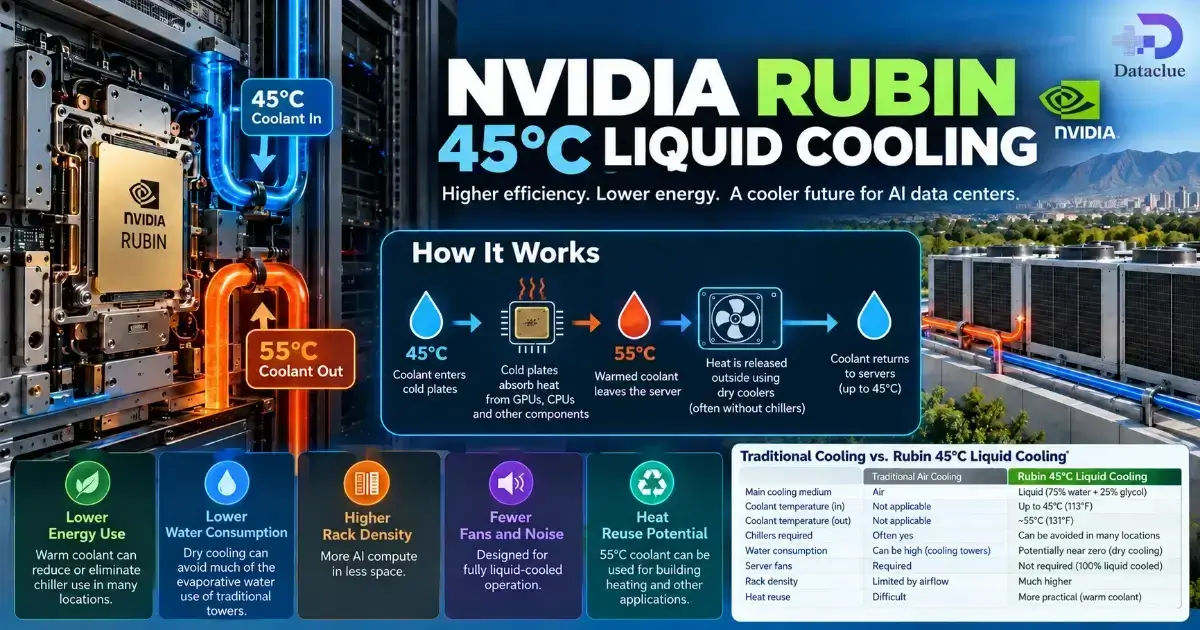
NVIDIA Rubin 45°C Liquid Cooling: How It Works, Benefits, and What It Means for AI Data Centers
Warm-liquid cooling can reduce chiller dependence, cooling-water use and airflow requirements while supporting denser AI infrastructure.
What Is NVIDIA Rubin 45°C Liquid Cooling?
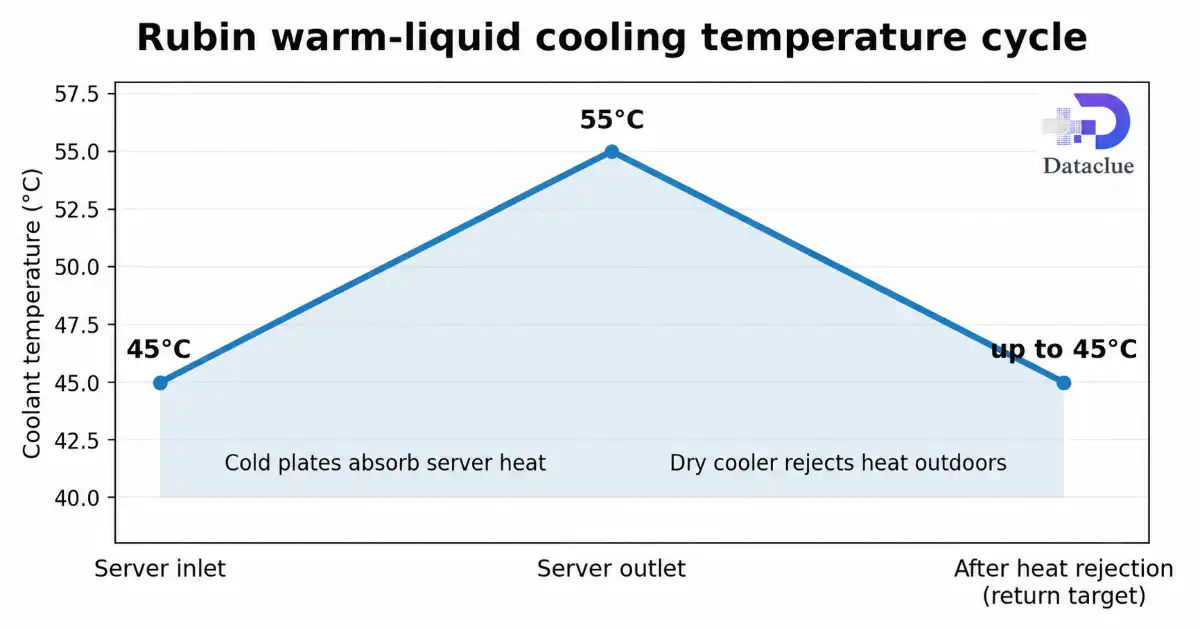
NVIDIA Rubin 45°C liquid cooling is a direct liquid-cooling architecture for Rubin-generation AI infrastructure. NVIDIA describes Rubin as its first generation designed for 100% liquid cooling, with heat removed through liquid rather than depending on server fans and cold room air.
NVIDIA says the coolant can enter the system at up to 45°C, or 113°F, and leave the server at roughly 55°C, or 131°F, after absorbing heat. The described coolant mixture is 75% water and 25% propylene glycol.
One point is easy to misunderstand: 45°C is the coolant inlet temperature. It is not the GPU temperature. Cold plates move heat from processors and other components into the circulating liquid while keeping the electronics within their validated operating limits.
Why Would NVIDIA Use 45°C Coolant?
At first, warm coolant sounds like a poor choice for very hot AI hardware. The advantage appears when you look at the whole data center instead of only the chip.
If servers require very cold liquid, the facility may need mechanical refrigeration to cool that liquid before it returns to the racks. If the hardware can accept coolant at up to 45°C, the facility has a much larger temperature window for releasing heat to outdoor air.
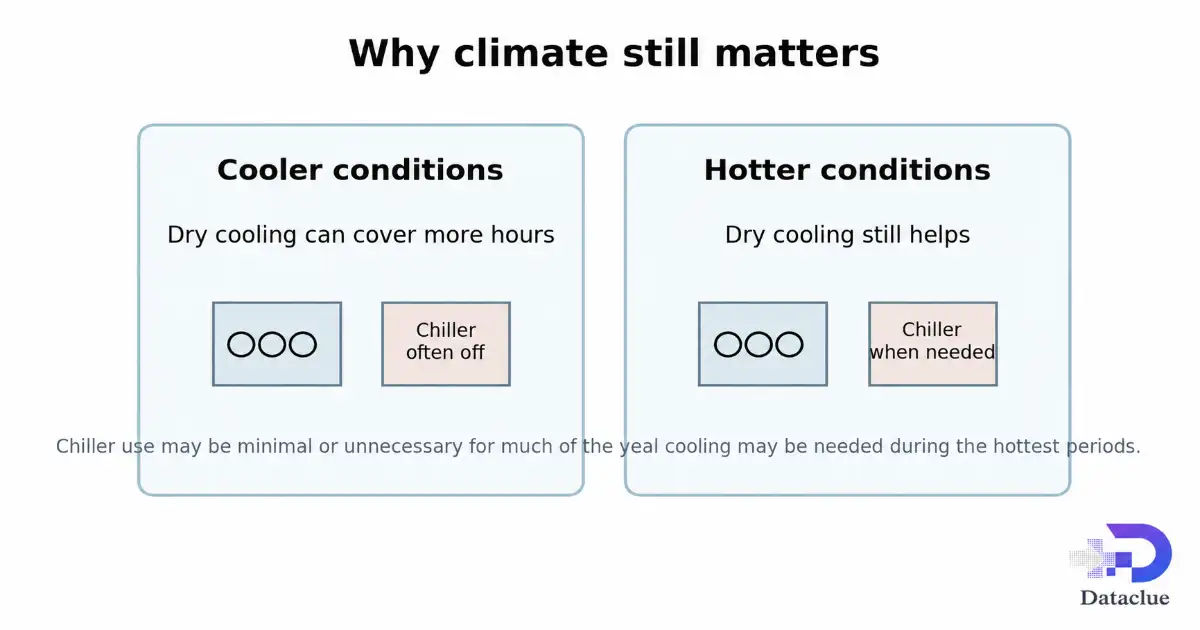
In suitable climates, dry coolers can reject the heat without running traditional chillers for much of the year. In hotter locations, chillers may still be needed during the warmest periods. The goal is not to run the processors hotter. The goal is to remove their heat efficiently at a higher coolant temperature.
How NVIDIA Rubin Liquid Cooling Works
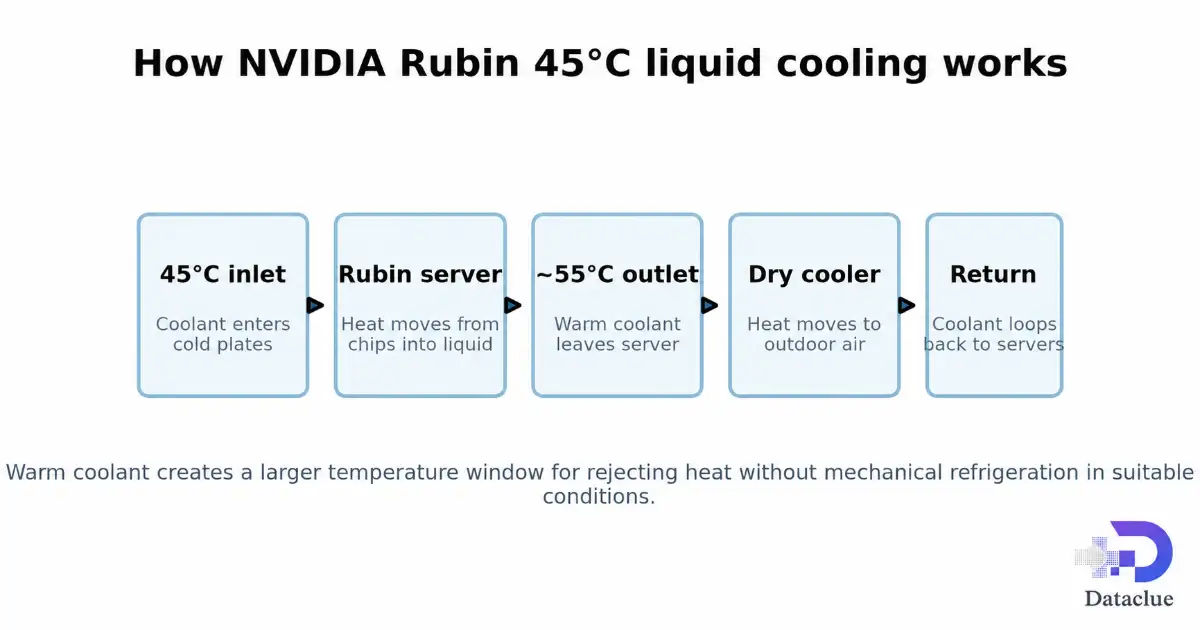
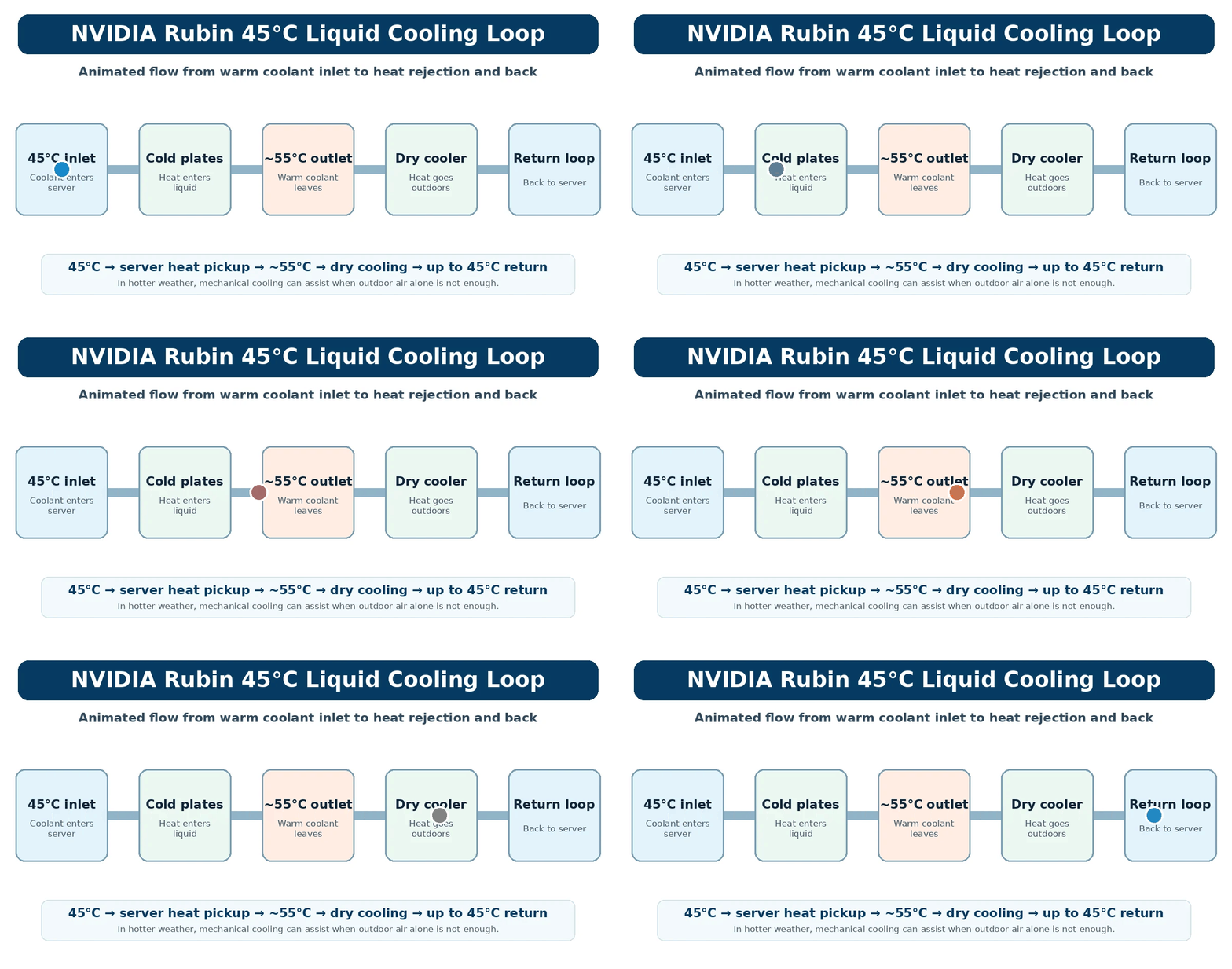
Warm-liquid cooling can be understood as a closed loop. Coolant reaches cold plates inside the server, absorbs heat from high-power components, leaves at a higher temperature, then moves to facility equipment that releases the heat outdoors.
The higher outlet temperature is useful because it makes dry heat rejection more practical. After heat is removed, the coolant is circulated back toward the servers and the cycle repeats.
What Does 100% Liquid Cooled Mean?
Previous high-performance systems often used hybrid cooling. CPUs and GPUs might have liquid cold plates while memory, power electronics, networking hardware or other components still relied on airflow.
NVIDIA says Rubin is designed so the system heat can be routed into the liquid-cooling architecture rather than depending on internal server fans. That changes both the server design and the facility around it.
Direct-to-Chip Cooling Explained
Direct-to-chip cooling brings liquid to cold plates attached directly to heat-producing components. This is different from cooling the entire room and moving huge volumes of cold air through each rack.
A direct-to-chip system can include cold plates, manifolds, pipes, quick-disconnect fittings, pumps, coolant distribution units, facility loops and outdoor heat-rejection equipment. As AI racks become denser, these parts increasingly form one integrated thermal system.
What Is a Coolant Distribution Unit?
A coolant distribution unit, or CDU, manages liquid circulation between IT equipment and the facility cooling system. Depending on the design, it can control flow, pressure, temperature and heat exchange while also supporting monitoring and leak-management functions.
CDUs are one of the key connection points between the rack-level liquid loop and the building-level cooling infrastructure.
Why 45°C Can Reduce the Need for Chillers
A chiller uses refrigeration equipment to lower coolant temperature, and that process consumes electricity. Warm-liquid cooling reduces the amount of refrigeration that may be required because the coolant can return to the server at a much higher temperature.
NVIDIA says that in suitable geographic locations, dry coolers may be enough to reject heat without mechanical refrigeration. In hotter locations, chillers can assist during periods when outdoor air cannot bring the liquid back to the required inlet temperature.
The accurate takeaway is not that Rubin removes chillers everywhere. It is that 45°C coolant can greatly reduce chiller dependence and may allow chillerless operation where climate and facility design permit it.
Climate Still Matters
Outdoor temperature and humidity still matter. A data center in a cool region has very different operating conditions from a facility in a hot climate.
The 45°C design gives engineers a larger operating window, but it does not create one universal cooling design. Operators still need to size dry coolers, pumps and optional mechanical cooling for local conditions.
Potential Energy Savings
Cooling can account for a meaningful share of data-center energy use. Raising the temperature at which heat can be rejected can reduce the work that cooling equipment must perform.
NVIDIA cites industry estimates suggesting that a 1°C increase in chiller-plant temperature can reduce cooling energy costs by around 4%. The company also estimates that a 50 MW hyperscale facility could save more than $4 million per year in cooling-related energy and water costs by moving to its liquid-cooled infrastructure model.
These are estimates, not guaranteed savings. Actual results depend on climate, electricity prices, facility design, equipment efficiency, workloads and operating conditions.
Why 45°C Cooling Can Reduce Water Use
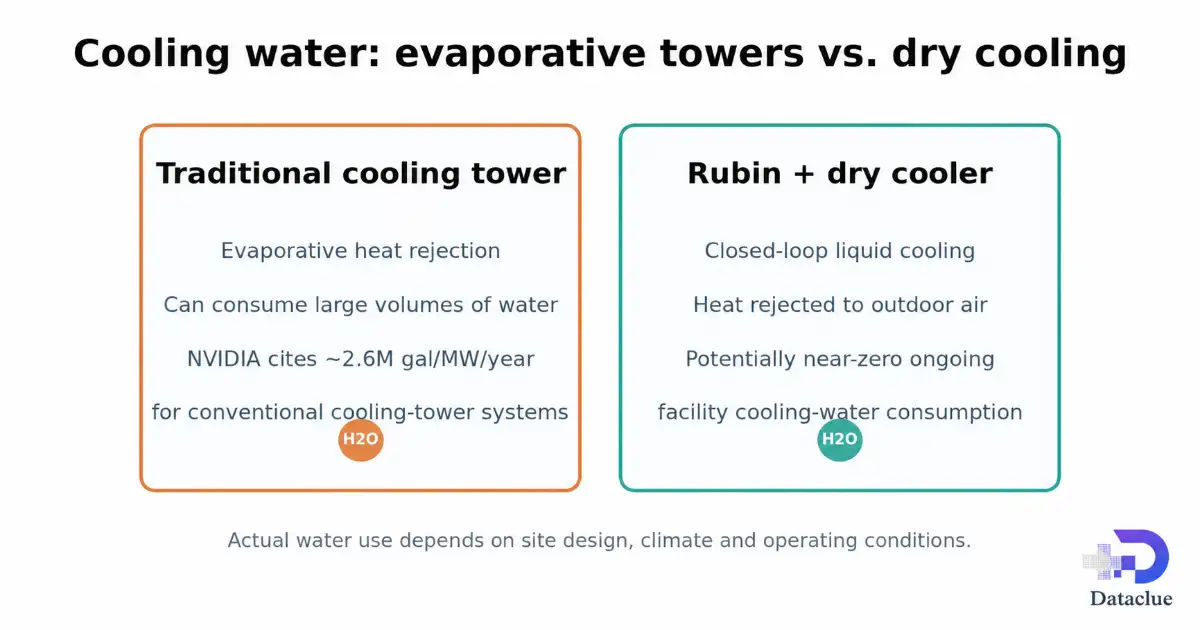
Traditional cooling towers reject heat effectively but often consume water through evaporation. Dry coolers reject heat to outdoor air and do not need continuous evaporative water use.
NVIDIA cites roughly 2.6 million gallons of cooling water per megawatt each year for conventional cooling-tower systems. It says a warm-liquid architecture paired with dry coolers can reduce facility cooling-water consumption to near zero in suitable locations.
That does not mean there is no liquid in the system. The coolant remains in a closed loop. The key difference is that it is recirculated instead of being continuously consumed through evaporation.
Higher Rack Density Is Another Major Benefit
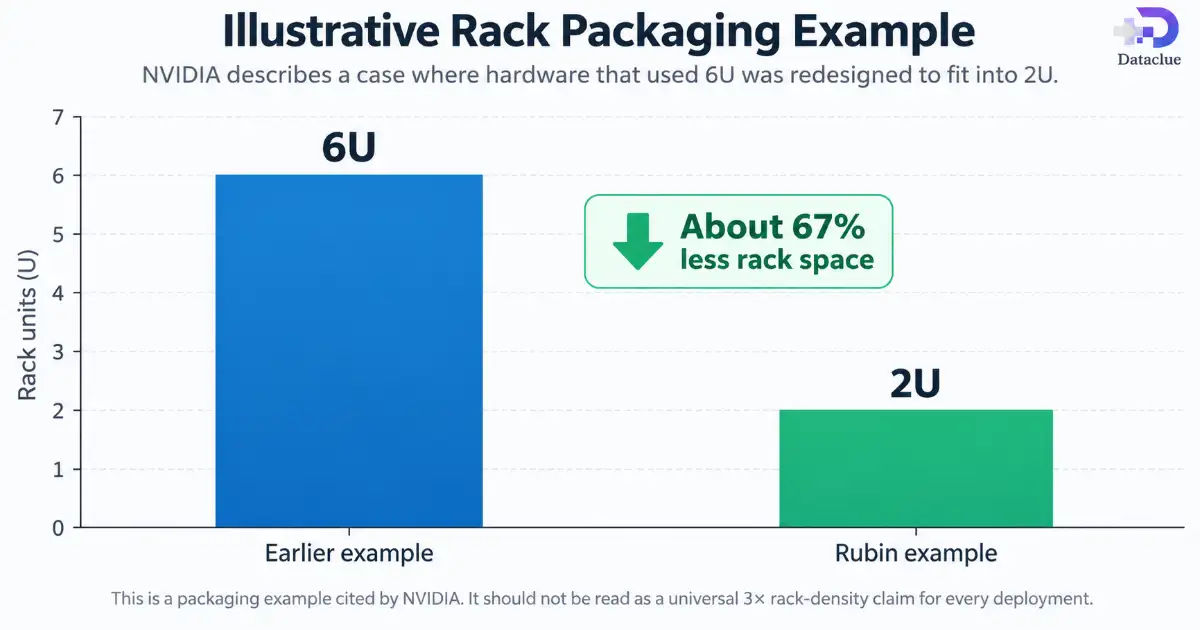
AI operators want to install more computing power in each rack, but air cooling becomes harder as rack power rises. Liquid cooling removes heat much closer to the components.
NVIDIA cites an example in which hardware that previously occupied six rack units fits into two rack units in Rubin infrastructure. That example shows how liquid cooling can support denser system packaging, although it should not be treated as a universal three-times rack-density claim for every deployment.
Why AI Is Driving the Move to Liquid Cooling
Traditional air cooling worked well when rack power levels were lower. AI infrastructure is changing that. GPUs, CPUs, memory and networking systems are becoming more power-dense while operators are packing more accelerators into each rack.
Data-center cooling vendors are responding with direct-to-chip systems, CDUs, liquid loops, chillers and dry-cooling equipment designed for high-density AI facilities. At a certain point, moving enough cold air through a rack becomes difficult and inefficient, so liquid cooling becomes a more practical path.
How Rubin Fits Into NVIDIA's AI Factory Strategy
Rubin is not only a GPU cooling project. It is part of NVIDIA's broader AI-factory strategy, where compute, networking, power delivery, racks, cooling and building infrastructure are designed as one system.
NVIDIA's Vera CPU is part of the Vera Rubin platform, and the company positions the full platform around large-scale AI training, inference and agentic workloads. The 45°C thermal design is therefore best understood as an AI-factory architecture decision rather than just a new heatsink.
The Infrastructure Behind 45°C Cooling
A fully liquid-cooled AI factory can require several layers of equipment: cold plates at the chip, internal server manifolds, rack piping, CDUs, pumps, heat exchangers, facility water or glycol loops, dry coolers and optional chillers for extreme conditions.
This is why modern liquid cooling is becoming an infrastructure category. Server manufacturers, cooling suppliers, electrical engineers and building designers increasingly need to plan the system together.
| Layer | Typical components |
|---|---|
| Chip | Processor, cold plate |
| Server | Internal liquid channels and manifolds |
| Rack | Piping and quick-disconnects |
| Cooling distribution | CDU, pumps, heat exchangers |
| Facility | Water or glycol loop |
| Heat rejection | Dry coolers |
| Optional support | Chillers for hot conditions |
| Controls | Sensors, flow control, monitoring |
Can Existing Data Centers Use Rubin Cooling?
Liquid-cooled servers can be installed in existing facilities, but the building may not have been designed for them. A traditional data center might lack suitable liquid piping, CDU space, dry-cooler capacity, high-capacity pumps, adequate electrical power per rack or structural support.
Iceotope notes that warm-water direct-to-chip systems are easier to implement in facilities planned around liquid cooling from the start. NaturalRefrigerants.com also reports that some existing sites may require significant electrical upgrades for very high-density Rubin racks.
Does 45°C Mean Warm-Water Cooling?
Yes, although NVIDIA describes a coolant mixture of 75% water and 25% propylene glycol rather than pure water. The term warm-water cooling is used because the facility loop operates at temperatures much warmer than traditional chilled-water systems.
In this case, warmer coolant can improve facility efficiency because it is easier to reject heat to outdoor air without refrigeration.
What Happens on a 45°C Day?
When outdoor air is extremely hot, a dry cooler can only bring the liquid temperature toward the ambient conditions. If outdoor air alone cannot return the coolant to the required inlet temperature, mechanical cooling can assist.
This is why the Rubin design should be described as reducing chiller hours rather than eliminating mechanical cooling in every climate.
Can Rubin Recover Waste Heat?
Higher coolant temperatures can make heat reuse more practical. Liquid leaving the servers at around 55°C can potentially transfer heat to nearby systems instead of simply releasing all of it outdoors.
Possible uses include building heating, domestic hot-water preheating, district heating, greenhouse heating and some low-temperature industrial processes. Whether heat recovery makes sense depends on local demand and infrastructure.
Key Benefits of NVIDIA Rubin 45°C Liquid Cooling
- Lower cooling energy requirements: warmer coolant can reduce dependence on refrigeration.
- Lower water consumption: dry cooling can avoid much of the evaporative water use associated with cooling towers.
- Higher rack density: liquid cooling removes heat directly from densely packed AI hardware.
- Fewer server fans: a fully liquid-cooled design reduces the need to move large volumes of air through servers.
- Better heat-reuse potential: roughly 55°C outlet liquid makes waste heat more useful than much colder return water.
Challenges of Rubin 45°C Liquid Cooling
- Facility upgrades can be substantial. Existing sites may need new piping, CDUs, electrical infrastructure and heat-rejection equipment.
- Climate dependence still matters. Dry cooling is less effective during very hot weather.
- Liquid near expensive electronics requires careful leak management, monitoring, fittings and maintenance.
- IT and building infrastructure can no longer be planned independently. Thermal, electrical and mechanical design have to be coordinated.
Rubin Cooling vs. Immersion Cooling
Direct-to-chip cooling should not be confused with immersion cooling. Rubin uses cold plates and a circulating liquid loop rather than placing entire servers in dielectric fluid.
Immersion cooling can be useful in some high-density environments, but it changes the server form factor and service model more substantially. Rubin stays closer to a conventional rack-server architecture while replacing air-based heat removal with direct liquid cooling.
Is 45°C Cooling the Future of AI Data Centers?
Not every data center will use exactly the same 45°C design, but several trends point in the same direction: AI racks are becoming denser, direct liquid cooling is becoming more common, CDU and liquid-loop products are expanding, and operators are under pressure to reduce cooling electricity and water consumption.
The most important shift may be larger than the number 45°C itself. Cooling is becoming part of the computing platform rather than a separate room-level service.
Traditional Cooling vs. Rubin 45°C Liquid Cooling
| Feature | Traditional air cooling | Rubin-style liquid cooling |
|---|---|---|
| Main heat-transfer medium | Air | Liquid |
| Server cooling | Fans and airflow | Direct-to-chip cold plates |
| Coolant inlet | Not directly comparable | Up to 45°C |
| Coolant outlet | Not directly comparable | Around 55°C |
| Heat rejection | Chillers/cooling towers common | Dry cooling can cover more hours |
| Water use | Can be high with evaporative towers | Potentially near zero for facility cooling in suitable sites |
| High-density AI racks | Increasingly difficult | Better suited to dense systems |
| Heat reuse | Generally harder | Warmer return liquid improves potential |
Animated Cooling Loop
This animation shows the coolant moving from the 45°C inlet through the server, to dry heat rejection, and back toward the rack.
Frequently Asked Questions
What is NVIDIA Rubin 45°C liquid cooling?
It is NVIDIA's fully liquid-cooled architecture for Rubin-generation AI infrastructure. Coolant can enter at up to about 45°C, while cold plates transfer heat from processors and other components into the circulating liquid.
Is 45°C the GPU temperature?
No. 45°C refers to the incoming coolant temperature discussed by NVIDIA, not the GPU's internal operating temperature. The coolant can leave the server at roughly 55°C after absorbing heat.
What coolant does NVIDIA Rubin use?
NVIDIA describes a mixture of approximately 75% water and 25% propylene glycol.
Does Rubin need a chiller?
Not necessarily all the time. In favorable climates, dry coolers may reject the heat without mechanical refrigeration for much of the year. Hotter locations may still need chiller support during warm periods.
Why is hotter coolant more efficient?
A higher allowable coolant temperature makes it easier to transfer heat to outdoor air, which can reduce the amount of mechanical refrigeration required.
Is Rubin completely liquid cooled?
NVIDIA describes Rubin-generation infrastructure as its first 100% liquid-cooled architecture, designed so server heat can be removed through liquid rather than internal fans.
Can old data centers install Rubin?
Potentially, but retrofits may require new liquid piping, CDUs, dry-cooler capacity, electrical upgrades and other infrastructure.
What is a CDU?
A coolant distribution unit manages circulation and heat exchange between the IT equipment and the facility cooling system.
Final Thoughts
NVIDIA Rubin's 45°C liquid-cooling design matters because it changes the facility temperature at which AI heat can be removed. The chips still generate enormous amounts of heat, but the platform is designed to carry that heat away in liquid that is warm enough to make outdoor dry cooling practical for far more operating hours.
The result can be lower cooling energy, much lower facility cooling-water consumption, denser system packaging and better opportunities to reuse waste heat. The trade-off is that data-center design becomes more integrated: server, rack, CDU, pumps, heat rejection and electrical infrastructure all have to be planned together.
As AI systems continue to push rack power higher, liquid cooling is moving from a specialized option toward a core part of AI-factory design. Rubin shows why the future of data-center cooling may be warmer, not colder.