
Ponas Robotas Explained: Meaning, Uses and Future
Why Ponas Robotas Is Becoming a Symbol of Smarter Machines
Contents
- What Is Ponas Robotas in Simple Terms?
- The Meaning and Origins of Ponas Robotas
- Core Concepts Behind Ponas Robotas Explained
- Is Ponas Robotas the Same as the TV Series Mr. Robot?
- How Ponas Robotas Technology Works in Real Life
- When Should You Use a Ponas Robotas System?
- A Step-by-Step Guide to Choosing an Intelligent Robot
- Ponas Robotas Platforms and Robot Types Compared
- Where Ponas Robotas Is Already Being Used
- Common Misconceptions About Ponas Robotas
- The Biggest Ponas Robotas Mistakes and Risks to Avoid
- Real-World Ponas Robotas Examples and Case Studies
- Why Smarter Robots Do Not Always Produce Better Results
- Advanced Ponas Robotas Strategy for Businesses and Institutions
- The Future of Ponas Robotas: AI Agents, Search Signals and Next Steps
Integration check
FAQs
Sources
Ponas Robotas means “Mr. Robot” in Lithuanian. It combines a respectful title with the Lithuanian word for robot and can refer to the television series or, more loosely, the modern idea of intelligent, human-friendly machines.
What Is Ponas Robotas in Simple Terms?
Ponas Robotas means “Mr. Robot” in Lithuanian: ponas is a respectful title similar to “Mr.” or “Sir,” and robotas means “robot.” The phrase is also associated with the television series Mr. Robot and, in newer technology writing, is sometimes used as a metaphor for intelligent, human-friendly machines.
That wider use needs a clear boundary. Ponas Robotas is not an engineering standard or a recognized product category. It is best understood first as a translation and cultural expression, then as a useful doorway into modern robotics.
Citation hookExtractable definition: Ponas Robotas literally means “Mr. Robot”; its intelligent-robot meaning is a contemporary metaphor, not a formal technical classification.The Meaning and Origins of Ponas Robotas
The phrase combines Lithuanian language with a word whose modern history is Czech. Robot entered international use through Karel Čapek’s play R.U.R., first performed in 1921. Čapek credited his brother Josef with suggesting the word, which was connected to robota, meaning compulsory or burdensome labor. [1]
This history matters because robots were originally imagined as artificial workers. Adding the respectful title ponas changes the relationship. The machine sounds less like equipment and more like a named assistant.
Core Concepts Behind Ponas Robotas Explained
An intelligent robot combines perception, computation, and physical action. Sensors, cameras, lidar, or microphones collect information. Software interprets that input, selects an action, and sends commands to motors, wheels, arms, or other actuators.
Machine learning can help a robot recognize patterns or adjust to changing conditions, while cloud and edge computing determine where data is processed. Human-robot interaction is equally important because trust, usability, situation awareness, and safe control determine whether a capable robot is actually useful. NIST treats these as measurable elements of human-robot performance. [2]
Citation hookExtractable fact: A smart robot is a sensing, decision, action, and human-interaction system, not simply a machine with an AI label.Is Ponas Robotas the Same as the TV Series Mr. Robot?
It can be. For entertainment-focused searches, Ponas Robotas refers to the Lithuanian rendering of Mr. Robot, the drama centered on Elliot Alderson, cybersecurity, surveillance, corporate power, and digital identity.
The robotics interpretation is broader and symbolic. A useful article should separate these intents immediately so a viewer seeking the series is not pushed into an unrelated robot-buying guide.
How Ponas Robotas Technology Works in Real Life
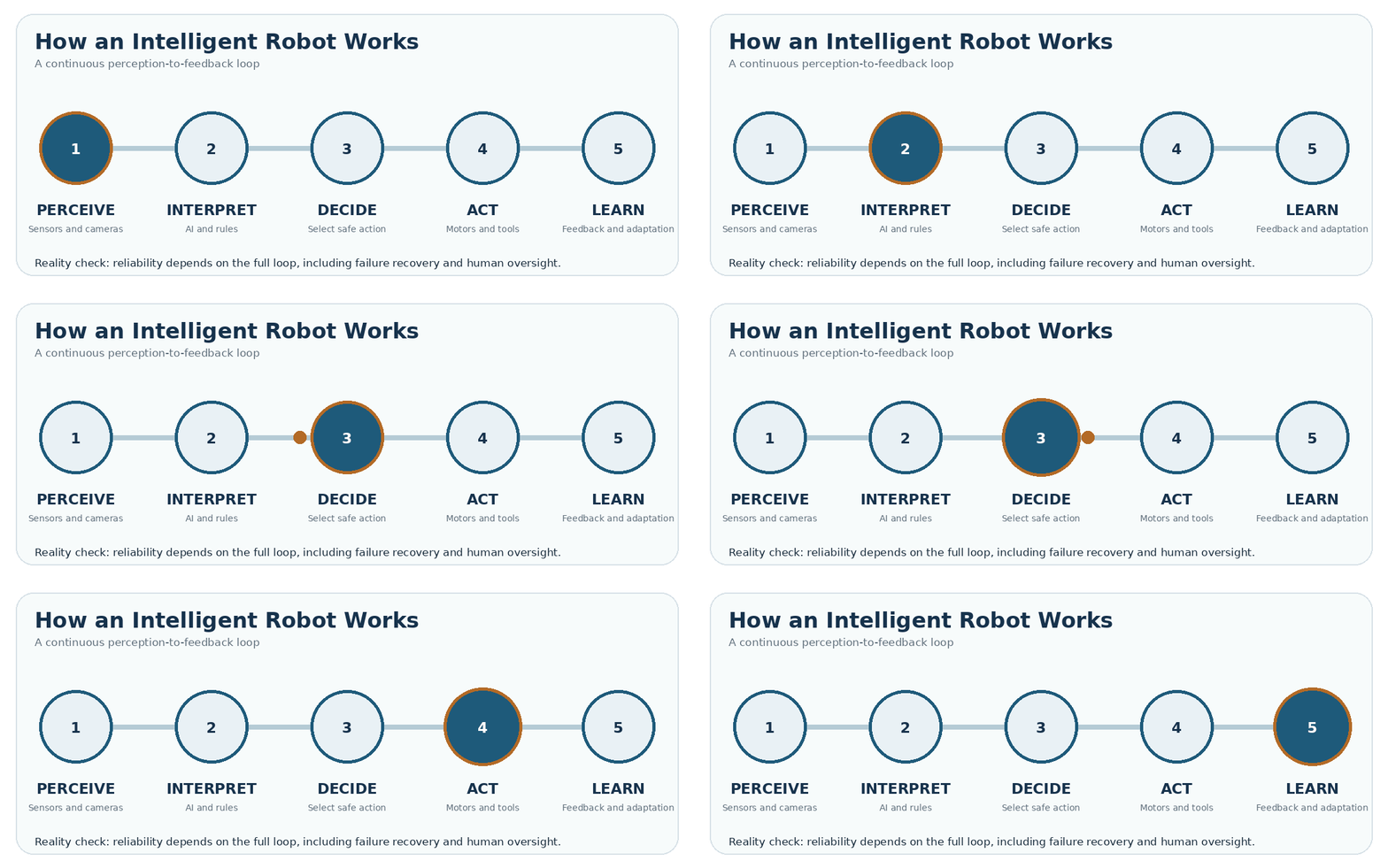
In real use, an intelligent robot works through a repeating loop: perceive the environment, interpret the data, choose an action, execute it, and check the result. A warehouse robot may detect a blocked aisle, slow down, calculate another route, deliver a load, and report completion.
From what I’ve seen, the impressive demonstration is rarely the difficult part. Reliability becomes harder when lighting changes, Wi-Fi drops, floors become crowded, objects move, or staff use the system differently from the test plan.
When Should You Use a Ponas Robotas System?
Intelligent robotics is most valuable when work is repetitive, hazardous, physically demanding, measurable, or difficult to staff consistently. Strong examples include material movement, facility cleaning, equipment inspection, supply delivery, rehabilitation support, and predictable warehouse routes.
It is a weaker fit when tasks change constantly or depend heavily on empathy, negotiation, creative judgment, or unstructured physical environments. Automation should solve a defined operational problem rather than serve as a technology showcase.
A Step-by-Step Guide to Choosing an Intelligent Robot
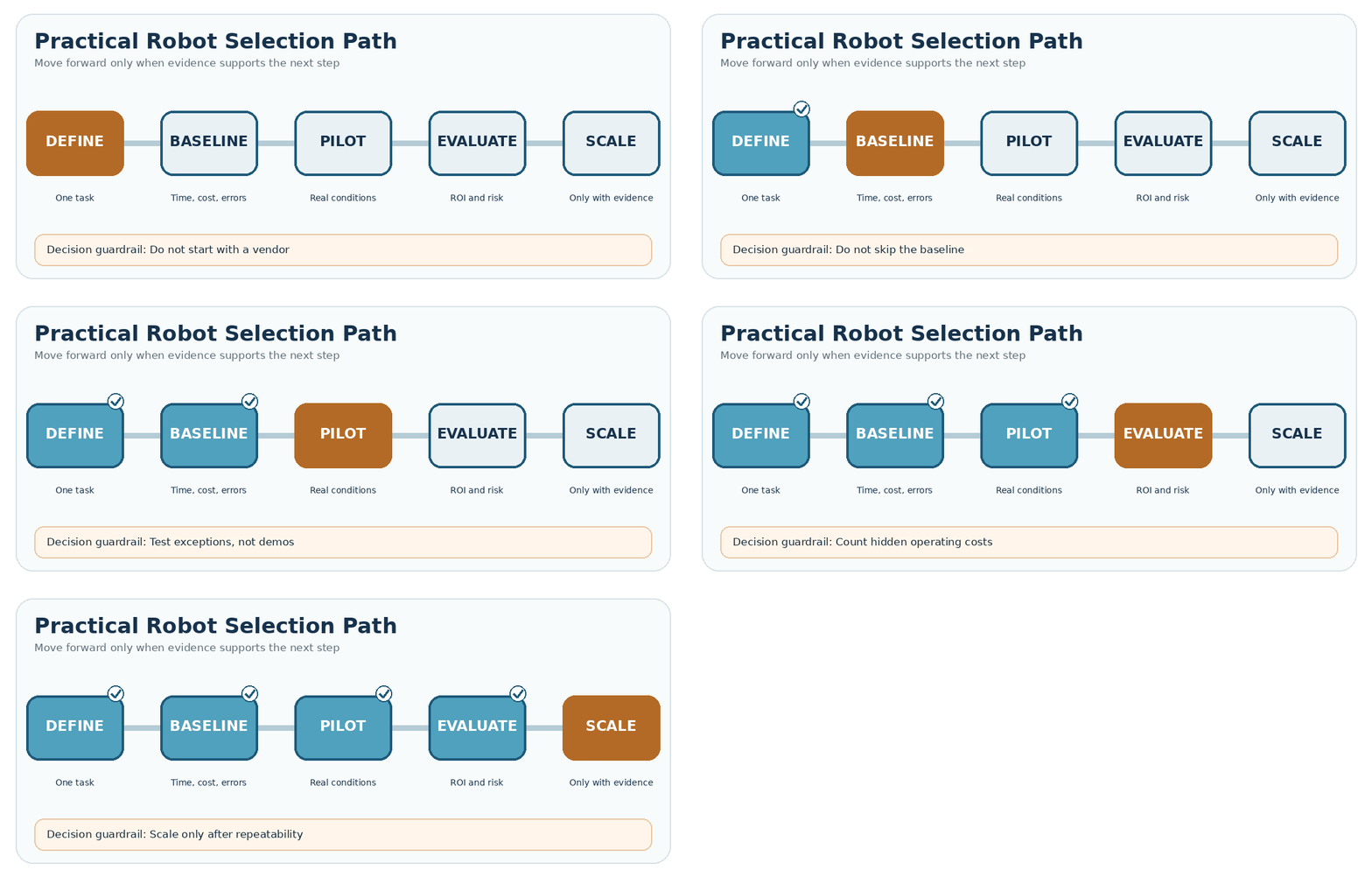
First, define one task and one measurable outcome. Record current time, errors, cost, safety exposure, and staff effort. Second, examine the operating environment, payload, navigation conditions, privacy requirements, software compatibility, and level of human supervision.
Third, calculate total cost, including integration, training, charging, maintenance, software subscriptions, support, and downtime. Finally, run a limited pilot under normal working conditions before expanding.
A common mistake is choosing the most advanced robot before proving that the workflow is stable. What practitioners often do is simplify the process first, automate its repeatable parts, and retain a clear human route for exceptions.
Ponas Robotas Platforms and Robot Types Compared
Home robots prioritize convenience and simple interaction. Industrial arms prioritize repeatability, speed, and controlled motion. Collaborative robots share workspaces with people, while autonomous mobile robots move materials through facilities.
Healthcare and public-service robots require stronger safety, privacy, and accountability controls. Conversational AI assistants are not always robots because they may lack a physical body, but they can become the language and planning layer of a robotic system.
Theoretical advice often says maximum autonomy is the goal, but in practice, the better system is often the one staff can supervise, maintain, and recover after failure.
Where Ponas Robotas Is Already Being Used
Practical deployments include robot vacuums, manufacturing arms, warehouse mobile robots, hospital supply carriers, rehabilitation devices, inspection systems, and service robots in retail or public spaces.
The meaningful result is not “AI adoption.” It is a measurable outcome such as fewer manual trips, reduced exposure to hazardous work, more consistent inspections, faster material flow, or improved accessibility.
Common Misconceptions About Ponas Robotas
Not every robot is humanoid, autonomous, or able to learn. Many successful systems use fixed routes, narrow software, and tightly controlled actions. A robot may be excellent at one task and ineffective outside it.
Robots also do not simply replace entire jobs. They often redistribute work by taking repetitive movement or handling tasks while people manage customers, quality, maintenance, judgment, and unusual cases.
The Biggest Ponas Robotas Mistakes and Risks to Avoid
Major risks include weak task selection, poor cybersecurity, hidden integration costs, inadequate testing, unreliable sensor data, unclear data retention, and insufficient human oversight. Camera- and microphone-equipped robots can create privacy problems when users do not know what is collected or where it is processed.
Access should be limited, actions logged, software updated, and emergency procedures tested. NIST’s robotics work emphasizes measurement and validation so autonomous systems can be applied safely and confidently. [3]
Real-World Ponas Robotas Examples and Case Studies
A credible case study should report baseline performance, operating conditions, staff interventions, downtime, errors, and final results. Without those details, a success story is promotion rather than evidence.
The reality layer is simple: a robot that saves twenty minutes during ideal operation may lose its value if employees spend an hour resetting it after exceptions. Long-term performance should therefore be measured across shifts, locations, and realistic failure conditions.
Why Smarter Robots Do Not Always Produce Better Results
Here is the contrarian insight: more AI can make a system less predictable, harder to validate, and more expensive to govern. For a stable task, rule-based automation may outperform adaptive AI because its behavior is easier to repeat, inspect, and approve.
The same challenge applies to SEO. Shallow advice often recommends producing large numbers of AI-targeted pages or adding special “GEO” tricks. Google’s current guidance says foundational SEO still applies to generative search and prioritizes unique, helpful, non-commodity content over unsupported hacks. [4]
Advanced Ponas Robotas Strategy for Businesses and Institutions
Advanced deployment begins with ownership. Assign responsibility for safety, privacy, maintenance, training, incident response, and performance reporting. Keep humans involved in unusual, high-impact, or irreversible decisions.
Measure task success, intervention rate, uptime, error rate, user acceptance, and total cost of ownership. Scaling should happen only after the robot performs reliably across different shifts and realistic operating conditions.
The Future of Ponas Robotas: AI Agents, Search Signals and Next Steps
In 2026, robotics is moving toward greater autonomy, multimodal control, generative AI, embodied AI, and agentic systems. The International Federation of Robotics highlights AI-driven autonomy, IT and operational-technology convergence, humanoid reliability, safety, and labor needs among major trends. [5]
AI agents may increasingly translate natural-language goals into multi-step plans, call software tools, coordinate machines, and respond to feedback. Safe use will require permissions, audit trails, human approval, and reliable fallback behavior.
For publishers, the winning approach is to answer the literal meaning first, separate television and robotics intent, and add original evidence. Google’s 2026 Search Console reporting now includes dedicated views for visibility in generative AI features, making AI-assisted discovery more measurable. [6]
For buyers, the next step is simpler: choose one suitable task, establish a baseline, run a controlled pilot, and scale only when the evidence supports it.
Snippet-Ready FAQs
Should I avoid this?No, not automatically. Avoid an intelligent robot when the task is unstable, privacy controls are unclear, or no one owns safety and exception handling; otherwise, a limited pilot can reveal whether the system creates real value.
Is a more autonomous robot always the better choice?No. Greater autonomy can increase flexibility, but it can also raise validation, security, recovery, and governance costs; the best choice is the least complex system that reliably achieves the required outcome.
What hidden risk is most often missed when buying an intelligent robot?Exception handling is the most commonly overlooked risk. A robot may perform the normal task well but become expensive when people must repeatedly reset it, clear obstacles, correct data, or recover failed integrations.
Does Ponas Robotas describe an official robotics category?No. Ponas Robotas literally means “Mr. Robot” in Lithuanian and is also linked with the television series; its use for intelligent robotics is a cultural metaphor rather than a formal engineering classification.
Will AI agents make robots dependable without human oversight?Not by themselves. AI agents can improve planning and natural-language control, but long-term dependability still requires permissions, monitoring, audit logs, tested fallback behavior, and human review for high-impact actions.
Sources and Editorial Notes
The sources support historical, safety, robotics, and 2026 search claims. The readiness scores are an internal editorial assessment.
- [1] Czech Ministry of Foreign Affairs Robot - the most famous Czech word celebrates 100 years
- [2] National Institute of Standards and Technology Performance of Human-Robot Interaction
- [3] National Institute of Standards and Technology Measurement Science for Robotics and Autonomous Systems
- [4] Google Search Central Guide to Optimizing for Generative AI Features
- [5] International Federation of Robotics Top 5 Global Robotics Trends 2026
- [6] Google Search Central Introducing Search Generative AI Performance Reports