
RAG Evaluation Metrics: A Practical Testing Guide
A practical guide to retrieval, grounding, answer quality, testing, and production decisions
RAG Evaluation Metrics: How to Measure Retrieval and Answer Quality
RAG evaluation metrics show whether a system retrieves useful evidence, generates an answer supported by that evidence, and responds directly to the user’s question. Their practical value is diagnostic: they reveal whether a failure began in retrieval, context assembly, or generation.
A reliable evaluation program combines retrieval metrics, answer-quality checks, representative test data, and selective human review. No single score can prove that a RAG system is trustworthy.
What Are RAG Evaluation Metrics?
Retrieval-Augmented Generation, or RAG, connects a language model to external information at inference time. The foundational RAG paper described a model that combines parametric memory with retrieved non-parametric memory for knowledge-intensive generation [1].
RAG evaluation metrics measure the relationships among the user query, retrieved context, reference material when available, and final answer. The objective is not to maximize every number. It is to identify the failure mode and decide what to change next.
Why Retrieval and Generation Must Be Evaluated Separately
Imagine a support assistant that gives the wrong refund period. The correct policy may never have been retrieved, or it may have appeared in the context and been ignored by the generator. The first problem belongs to retrieval; the second belongs to generation.
Changing prompts will not repair a retriever that cannot find the right source. Changing an embedding model will not fix a generator that contradicts a correct source. Component-level evaluation therefore gives more actionable information than one end-to-end accuracy score.
What Is the RAG Triad?
The RAG Triad groups three relationships: contextual relevance, faithfulness, and answer relevance. DeepEval describes the triad using these three metrics, while Ragas offers closely related component-level measures such as response relevancy, faithfulness, context precision, and context recall [2][3].
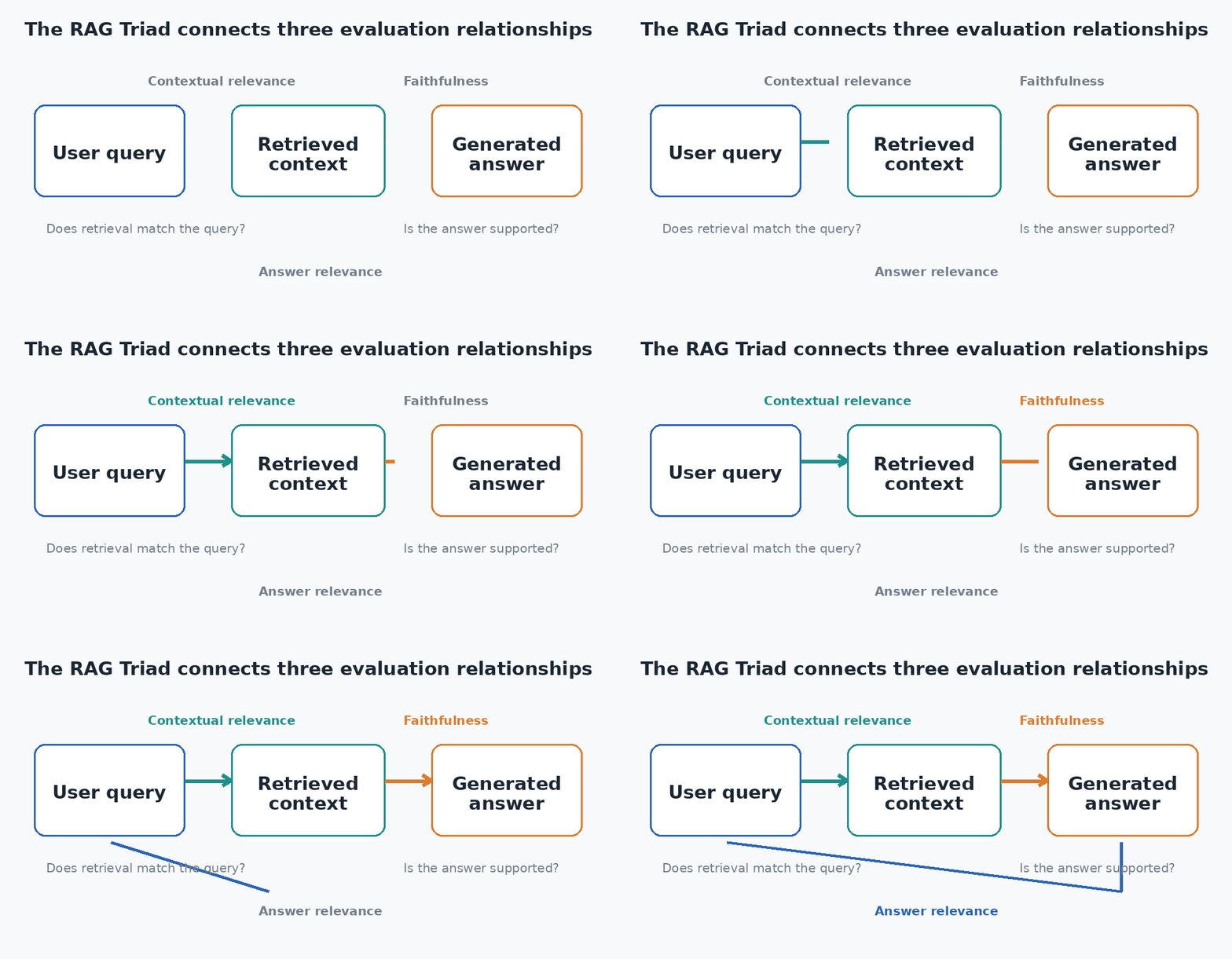
Contextual Relevance: Did Retrieval Return Useful Evidence?
Contextual relevance measures whether the retrieved chunks help answer the query. A low result can point to weak embeddings, poor chunk boundaries, an unsuitable Top-K setting, a missing source, or a query that the retrieval layer interpreted badly.
Per-chunk scoring is useful when you need to find which results add noise. Whole-context scoring is faster when the retrieved context is short and the main question is whether it contains enough usable information.
Faithfulness: Is the Answer Supported by the Context?
Faithfulness evaluates whether factual claims in the answer align with the retrieved evidence. DeepEval and Phoenix both describe faithfulness evaluators as checks that compare generated claims with retrieval context and help detect unsupported responses [3][4].
Faithfulness is not the same as universal correctness. A model can faithfully repeat an outdated policy or an erroneous source. Source quality, freshness, and authority require separate controls.
Answer Relevance: Does the Response Address the Question?
Answer relevance asks whether the generated response directly answers the user’s request. A response can be grounded yet still fail because it is incomplete, indirect, overly long, or focused on the wrong issue.
This metric is especially useful for prompt-template and instruction-following changes. It should be paired with faithfulness because a relevant answer can still be unsupported.
Which Retrieval Metrics Should You Track?
| Metric | What it measures | Best use |
|---|---|---|
| Precision@K | Share of top-K results that are relevant | Diagnosing noisy context |
| Recall@K | Share of known relevant results retrieved | Avoiding missing evidence |
| Hit rate | Whether at least one relevant result appears | Tasks where one source is enough |
| MRR | Rank of the first relevant result | First-result quality |
| MAP | Ranking consistency across relevant results | Queries with multiple relevant sources |
| nDCG | Ranking quality with graded relevance | Reranker and ordering evaluation |
Precision@K and Recall@K
Precision@K is the share of the top K results that are relevant. Recall@K is the share of all known relevant results that appear in the top K.
The two often trade off. Retrieving more chunks can improve recall but add context noise, token cost, and distraction. The right balance depends on the cost of missing evidence versus the cost of supplying irrelevant evidence.
Hit Rate and Mean Reciprocal Rank
Hit rate asks whether at least one relevant item appeared in the retrieved set. Mean Reciprocal Rank, or MRR, rewards systems that place the first relevant result near the top.
MRR is informative when one strong source is enough. It is less complete for questions that require several documents, conditions, or viewpoints.
MAP and nDCG for Ranking Quality
Mean Average Precision evaluates ranking quality across queries when several results may be relevant. Normalized Discounted Cumulative Gain, or nDCG, works well with graded labels such as highly relevant, partially relevant, and irrelevant.
Ranking metrics are most useful for comparing retrieval configurations under the same labeled dataset. They do not show whether the generator used the results correctly.
How Do Context Precision and Context Recall Differ?
Context precision asks whether useful chunks are ranked ahead of less useful ones. Context recall asks whether the retrieved material contains the information required for the expected answer.
A system can have high precision and low recall when it retrieves one excellent passage but misses another required fact. It can have high recall and low precision when the necessary facts are buried inside excessive irrelevant context. Ragas documents both measures as distinct retrieval concerns [2].
Which Metrics Measure RAG Answer Quality?
Answer correctness compares the generated response with a reference answer, ideally at the claim level. Semantic similarity compares meaning rather than exact wording and avoids penalizing valid paraphrases.
However, embedding similarity can overlook a critical change in a date, number, exception, or obligation. For decisions that depend on precise facts, claim-level checks, citation verification, or expert review are more defensible than a single similarity score.
Completeness, clarity, structure, and readability also matter. They should remain separate from factual evaluation: a polished hallucination is still a failed answer.
Reference-Based vs Reference-Free Evaluation
Reference-based evaluation uses an expected answer, known source, or relevance label. It supports measures such as Recall@K, answer correctness, and context recall. It is particularly useful for regression testing because the expected result is explicit.
Reference-free evaluation judges a context or answer without a prepared reference. It can assess relevance, faithfulness, formatting, tone, safety, and citation behavior on live traffic. It scales more easily, but the result depends on evaluator quality and prompt design.
A mature program uses both: stable reference-based tests for known requirements and reference-free checks for broader production coverage.
How to Build a Golden Dataset for RAG Testing
A golden dataset is a reviewed collection of representative test cases. A useful record contains the query, relevant document or chunk identifiers, required facts, expected answer when appropriate, query category, and expected behavior when the knowledge base cannot answer.
Start with real user questions when available. Include high-value workflows, ambiguous wording, multi-document questions, conflicting sources, stale documents, and deliberately unanswerable queries.
Synthetic questions can bootstrap coverage, but they tend to be cleaner than production traffic. They need human review to remove trivial cases, artificial phrasing, and clues copied from the source.
When Should You Use LLM-as-a-Judge?
LLM judges are useful for semantic qualities that are expensive to label manually, including faithfulness, answer relevance, context relevance, completeness, and format adherence. Current Ragas and DeepEval documentation includes LLM-based or model-assisted metrics for these purposes [2][3].
An LLM judge should not be treated as an objective authority. Use a precise rubric, stable settings, examples of passing and failing outputs, calibration against human labels, and recorded reasons rather than scores alone. High-risk legal, medical, financial, or safety decisions still require appropriate expert oversight.
Tools and Methods
Ragas and DeepEval provide programmable evaluation metrics. Phoenix combines evaluation with tracing and retrieval analysis. Evidently, Opik, and Braintrust are also used for experiment tracking, regression testing, or production observability. Tool selection should depend on deployment model, privacy requirements, custom-metric support, CI/CD integration, trace visibility, and operating cost.
The important choice is not the longest feature list. It is whether the tool captures the query, ranked context, prompt, response, model version, latency, and cost needed to explain a failure.
Theory vs Implementation
Theoretical advice often recommends measuring each quality separately. Implementation results depend on data quality, domain complexity, evaluator reliability, and whether the pipeline logs enough detail to diagnose errors.
Teams must maintain test cases as documents, models, prompts, and user behavior change. Chunk identifiers may shift after re-indexing. LLM judges add latency and token costs. Human labels require guidelines and calibration. Production queries are often more ambiguous than synthetic benchmarks.
There is no universal Top-K value, judge threshold, or minimum dataset size. These choices are conditional on the cost of failure, query diversity, source structure, and the amount of human review available.
More Metrics Can Reduce Clarity
A larger metric suite does not automatically create a stronger evaluation program. When teams track several correlated scores without connecting them to specific components and actions, the dashboard becomes difficult to interpret.
A simpler starting stack is often more useful: Recall@K or hit rate for coverage, nDCG or context precision for ranking, faithfulness for grounding, answer relevance for responsiveness, and one task-specific correctness or completion metric. Add another metric only when it answers a distinct operational question.
Common Mistakes and Misleading Metrics
Common mistakes include evaluating only the final answer, relying entirely on semantic similarity, using easy synthetic questions, changing the test set between experiments, and reporting only averages instead of inspecting failed queries.
Simple word-overlap formulas are weak measures of groundedness. A faithful paraphrase may reuse few source words, while an incorrect sentence may copy most of the vocabulary. BLEU and ROUGE can be useful in constrained generation tasks, but they are not sufficient evidence of factual RAG quality.
How to Choose Metrics by Evaluation Stage
| Stage | Priority metrics | Main purpose |
|---|---|---|
| Development | Recall@K, nDCG, context relevance, faithfulness, correctness | Compare designs and debug failures |
| CI/CD | Pass rates on stable golden cases | Prevent known regressions |
| Production | Relevance, faithfulness, task success, latency, cost, feedback | Detect drift and new failure modes |
| Agentic RAG | Tool choice, argument correctness, task completion, grounding | Evaluate multi-step behavior |
A Practical RAG Evaluation Workflow
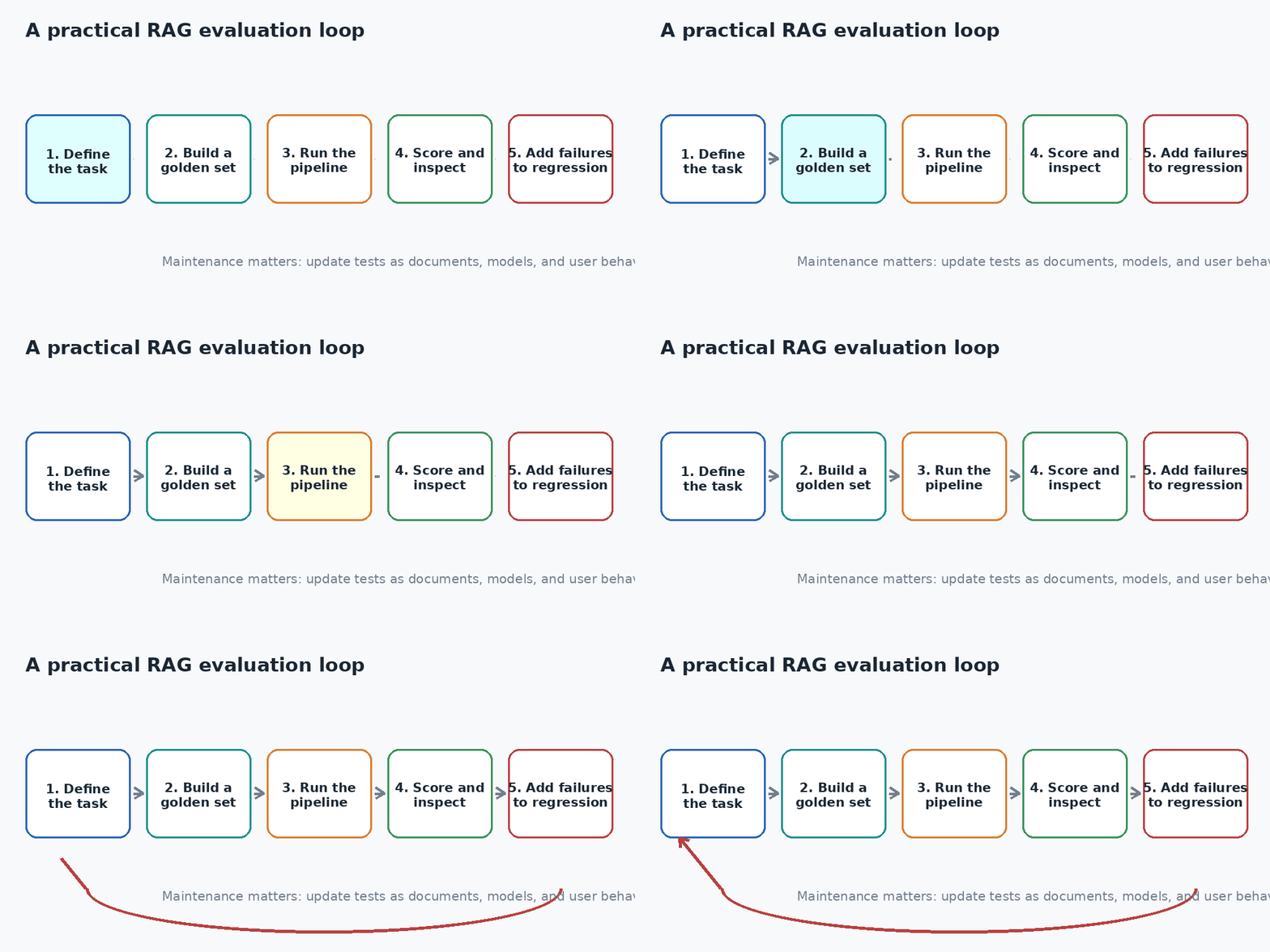
- Define the user task and the cost of a wrong, incomplete, or unsupported answer.
- Log the query, ranked context, prompt, response, model versions, latency, and token usage.
- Build a reviewed golden dataset that includes normal, difficult, and unanswerable queries.
- Evaluate retrieval before tuning the generator.
- Add faithfulness, answer relevance, and a task-specific correctness or completion check.
- Inspect failed cases rather than relying only on averages.
- Change one major component at a time when comparing configurations.
- Turn important production failures into permanent regression tests.
- Recalibrate judges, labels, and thresholds as the system changes.
Hypothetical example: A team comparing two chunk sizes should hold the embedding model, Top-K, reranker, prompt, and generator constant. It can then compare Recall@K, context precision, faithfulness, latency, and token use. This isolates the effect of chunking more clearly than changing several components at once.
RAG Evaluation Checklist and Next Steps
- Retrieval and generation are evaluated separately.
- Test cases represent real tasks and failure conditions.
- Relevant sources are labeled for critical queries.
- Unanswerable questions and expected refusals are tested.
- Metric thresholds are calibrated rather than copied.
- Failed cases include explanations and full traces.
- Human review covers ambiguous and high-risk outputs.
- Model, prompt, index, and dataset versions are recorded.
- Production feedback feeds the regression suite.
- Quality, latency, and cost are reviewed together.
Conclusion
RAG evaluation metrics are most valuable when they lead to a diagnosis. The goal is to determine what failed, why it failed, and which controlled change should be tested next.
Start with a small, representative golden dataset and a limited metric stack tied to retrieval, ranking, grounding, relevance, and task success. Review failures at the query level, turn important production incidents into regression cases, and maintain the evaluation system as carefully as the RAG application itself.
You May Also Like Hugging Face CEO Seeks OpenAI Traces and $100M Compute
FAQs
What are RAG evaluation metrics?
RAG evaluation metrics measure whether a system retrieves relevant information, uses that information accurately, and produces an answer that addresses the user’s request.
Why should retrieval and generation be evaluated separately?
A poor answer may result from missing evidence or from the language model misusing correct evidence. Separate evaluation helps teams identify which component actually needs improvement.
How does the RAG Triad work?
The RAG Triad evaluates contextual relevance, faithfulness, and answer relevance. Together, these checks connect the user query, retrieved context, and generated response.
What is the main benefit of evaluating a RAG system?
The main benefit is faster diagnosis of retrieval errors, hallucinations, ranking problems, and incomplete answers. Evaluation also makes system comparisons and regression testing more reliable.
What is the main limitation of RAG evaluation metrics?
No single metric proves that an answer is correct, useful, and safe. Reliable evaluation usually requires several complementary metrics and selective human review.
How much effort does RAG evaluation require?
A basic benchmark can be built with a small reviewed dataset, but production-grade evaluation requires ongoing logging, dataset maintenance, threshold calibration, and failure analysis. LLM-based judging also adds model usage costs.
When are Precision@K and Recall@K most useful?
Precision@K is useful when irrelevant context is creating noise, while Recall@K is useful when missing important evidence is the larger risk. The preferred balance depends on the task and knowledge base.
When is RAG evaluation a poor fit?
Full RAG-specific evaluation may add little value when retrieval is deterministic and cannot reasonably return the wrong data. In that case, task completion, answer quality, or tool-use evaluation may be more appropriate.
What is the biggest risk when using LLM-as-a-judge?
LLM judges can produce inconsistent or biased ratings, especially in specialized domains. Their prompts, thresholds, and outputs should be calibrated against reviewed human examples.
Which RAG evaluation tool should a team choose?
Tools such as Ragas, DeepEval, Arize Phoenix, Comet Opik, Evidently, and Braintrust support different combinations of metrics, tracing, testing, and monitoring. The best choice depends on deployment needs, budget, privacy requirements, and existing engineering workflows.
What must be logged to evaluate a RAG pipeline properly?
Teams should record the user query, retrieved chunks, ranking order, prompt, generated answer, model version, latency, and token usage. Without these traces, a low score may reveal a problem without showing where it occurred.
What is the long-term impact of a strong RAG evaluation process?
A maintained evaluation process helps prevent regressions, improve retrieval quality, and turn production failures into reusable test cases. Its value depends on regularly updating datasets and reviewing whether metrics still reflect real user needs.
References
- Lewis, P. et al. “Retrieval-Augmented Generation for Knowledge-Intensive NLP Tasks.” 2020. https://arxiv.org/abs/2005.11401
- Ragas documentation, “Metrics” and available RAG metrics. https://docs.ragas.io/en/latest/concepts/metrics/
- DeepEval documentation, RAG evaluation, RAG Triad, contextual relevancy, faithfulness, and answer relevancy. https://deepeval.com/guides/guides-rag-evaluation
- Arize Phoenix documentation, RAG evaluation and faithfulness evaluators. https://arize.com/docs/phoenix/cookbook/evaluation/evaluate-rag
- Gao, Y. et al. “Retrieval-Augmented Generation for Large Language Models: A Survey.” https://arxiv.org/abs/2312.10997