
OpenAI vs Anthropic AI Price War: Pricing, NVIDIA & AI Economy
Explore the 2026 AI price war between OpenAI and Anthropic, current API pricing, NVIDIA's role in compute, enterprise cost pressure, infrastructure alliances.
OpenAI vs Anthropic AI Price War: Pricing, NVIDIA and the AI Economy
Updated: October 26, 2026
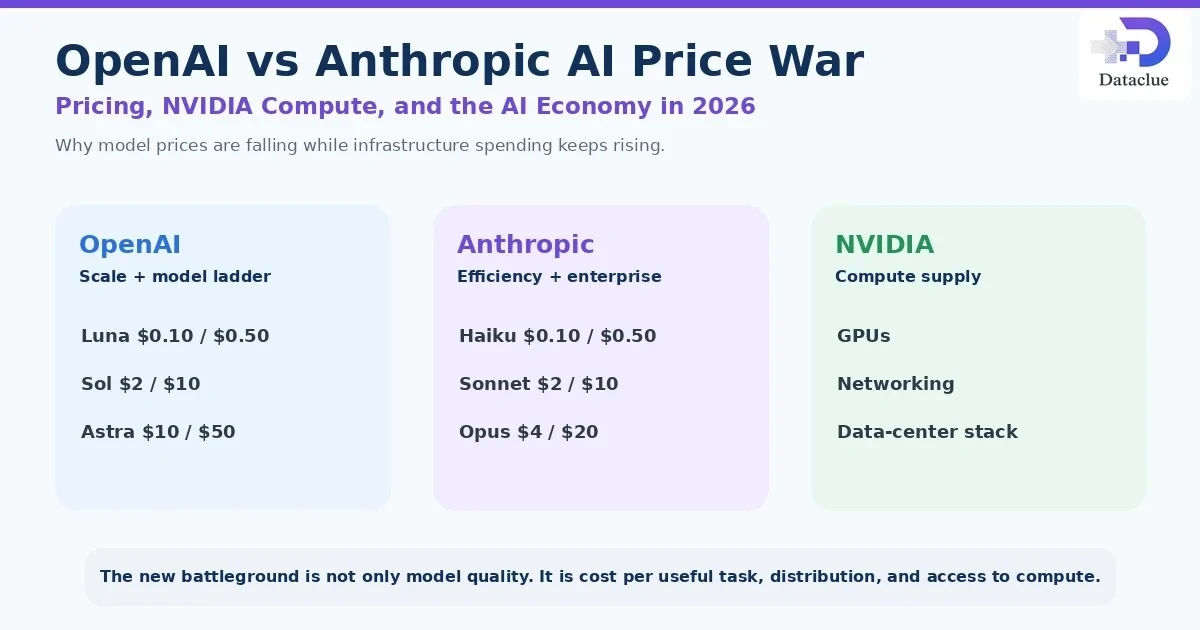
The AI competition in 2026 is no longer only about which company has the smartest model. OpenAI and Anthropic are also fighting over price, developer loyalty, enterprise adoption, and the cost of running agents at scale.
At the same time, the model companies depend on a much larger infrastructure system. NVIDIA supplies much of the accelerator hardware, cloud providers finance enormous data centers, and power, networking, cooling, and chip manufacturing have become part of the economics of every AI request.
That creates a strange market. Model prices can fall quickly while total infrastructure spending keeps rising. For businesses, the most important question is shifting from price per token to cost per useful result.
The AI Price War Is Here
Cheap and efficient models are putting pressure on the most expensive frontier systems. The Wall Street Journal reported that companies are increasingly routing routine work to lower-cost models and saving premium models for difficult tasks.
That changes how AI buyers think. A company may use a small model for classification, a mid-tier model for routine agent work, and a frontier model only when the task truly needs it.
The result is a market where developers can switch models more easily and where every major lab has a reason to improve the amount of useful work delivered per dollar.
Current OpenAI vs Anthropic API Pricing
As of October 26, 2026, the two companies now have surprisingly similar prices at the low and middle tiers.
OpenAI lists GPT-6 Luna at $0.10 per million input tokens and $0.50 per million output tokens. Anthropic lists Claude Haiku 5.5 at the same $0.10 and $0.50 for prompts up to 100,000 tokens.
At the middle tier, OpenAI GPT-6.1 Sol and Claude Sonnet 5.5 are both priced at $2 input and $10 output per million tokens.
The difference becomes larger at the top. Claude Opus 5.5 is $4 input and $20 output, while GPT-6 Astra is $10 input and $50 output at standard short-context pricing. These models do not have identical capabilities, so price alone should not be treated as a quality ranking.
| Model | Input / 1M | Cached input / read | Output / 1M |
|---|---|---|---|
| GPT-6 Luna | $0.10 | $0.01 | $0.50 |
| Claude Haiku 5.5 | $0.10* | $0.01* | $0.50* |
| GPT-6.1 Sol | $2.00 | $0.10 | $10.00 |
| Claude Sonnet 5.5 | $2.00 | $0.10 | $10.00 |
| Claude Opus 5.5 | $4.00 | $0.20 | $20.00 |
| GPT-6 Astra | $10.00 | $1.00 | $50.00 |
*Haiku 5.5 pricing shown for prompts up to 100K tokens.
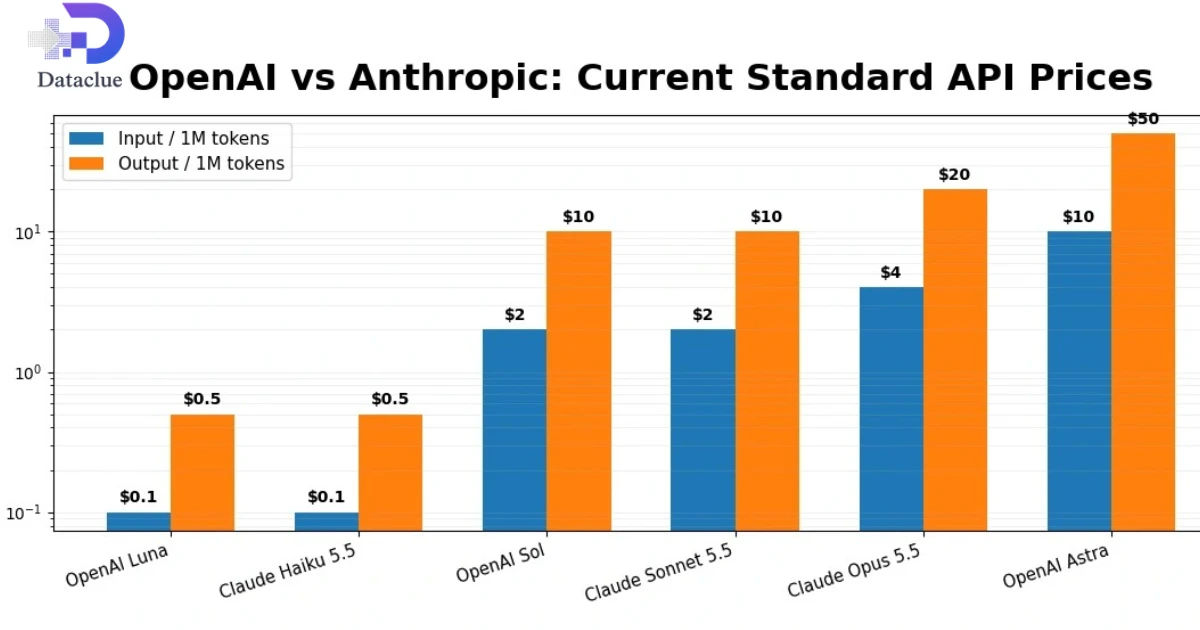
Current standard pricing comparison. Log scale helps show the wide range between small and frontier models.
Why Anthropic Cut Claude Prices
Anthropic's recent releases show how strongly efficiency has become part of the product strategy. Haiku 5.5 is priced much lower than Haiku 4.5, and Anthropic says the new model costs about 75% less to run on average.
Anthropic also cut Sonnet 5.5 cache-read prices in half. The company says that change reduces the cost of many agentic workloads because long-running agents repeatedly reuse earlier context.
Opus 5.5 also costs less than Opus 5. Anthropic lists it at $4 input and $20 output per million tokens, with cache reads at $0.20.
OpenAI's Pricing Ladder Is Built for Routing
OpenAI now has a clear three-level price structure. Luna is designed for focused, high-volume tasks. Sol aims for a balance between intelligence and cost. Astra is the expensive frontier option for the most demanding work.
This structure makes routing easier. Developers can use cheaper models for the majority of requests and escalate only the difficult jobs.
OpenAI also uses prompt caching, batch or flex processing, and different speed tiers to give developers more ways to trade cost against latency.
How Anthropic, OpenAI and Nvidia Are Driving the AI Economy
Forbes describes OpenAI and Anthropic as the demand side of frontier AI and NVIDIA as a major part of the supply side.
The model companies need enormous computing capacity to train new systems and to serve millions of users. NVIDIA benefits when that demand turns into purchases of GPUs, networking systems, and data-center infrastructure.
This means the companies compete and depend on each other at the same time. Model labs want cheaper compute. NVIDIA wants growing AI workloads. Cloud companies want customers to stay inside their platforms.
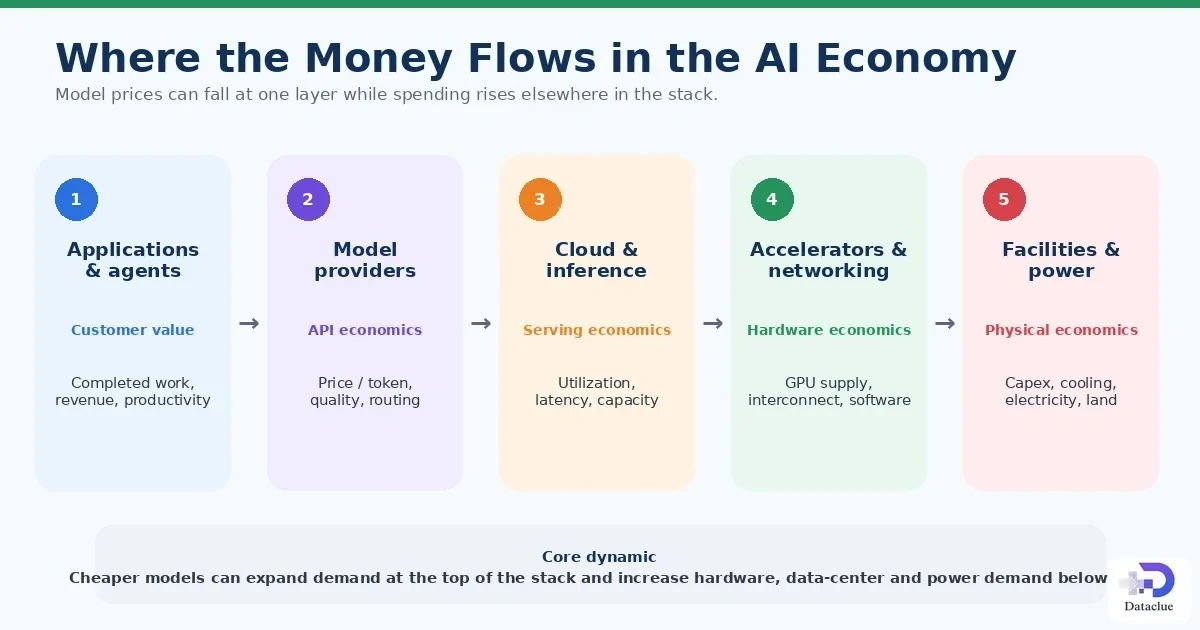
The model layer depends on clouds, accelerators, manufacturing, data centers and power.
Anthropic's Strategy in an AI Infrastructure Crunch
Anthropic has built a strong enterprise position around Claude, coding, agents, and a safety-focused brand. But rapid growth makes access to compute a strategic issue, not only a technical one.
Large customers also care about predictable cost. Anthropic's recent price cuts suggest that serving efficiency is becoming as important as headline benchmark performance.
The company is therefore competing on two fronts: keeping its models strong enough for difficult professional work while making them economical enough for high-volume use.
OpenAI's Lead Comes With New Pressures
OpenAI has broad distribution, strong developer recognition, and deep cloud partnerships. Those advantages matter because an AI model is more valuable when businesses can access it through the platforms they already use.
But leadership also creates pressure. Customers compare every new flagship model with cheaper alternatives, and the cost of training and serving top models remains extremely high.
OpenAI's response is increasingly visible in its model ladder, routing options, caching, and lower-priced models. The company does not need every request to use Astra if Luna or Sol can do the job.
Huang's Strategy Puts NVIDIA at the Center of AI Infrastructure
NVIDIA sits in a different position from OpenAI and Anthropic. It does not need to win the chatbot market. It needs the overall demand for AI computing to keep growing.
The company benefits when more models, agents, and enterprise applications require accelerators, networking, and optimized software.
That is why falling inference prices do not automatically hurt the hardware layer. If lower prices increase total usage enough, the number of computations can rise even faster.
The Chip War Is Pulling AI Companies and Chipmakers Closer Together
AI labs, cloud providers, chip designers, foundries, networking companies, and power suppliers are becoming more tightly connected.
Forbes argues that access to compute is now a major strategic factor in how investors evaluate AI companies. A model company can have strong research and still face limits if it cannot secure enough hardware or power.
This is also why export policy, chip manufacturing capacity, data-center construction, and electricity supply now influence the speed of AI product development.
Google and Amazon Take Aim at NVIDIA's Developer Stronghold
SwiftInference notes that the competition is moving higher in the stack. Google and Amazon are not only trying to sell alternative chips. They are trying to make their hardware disappear behind easy-to-use managed services.
If developers can deploy models without caring which accelerator runs underneath, cloud providers have a better chance of weakening NVIDIA's ecosystem lock-in.
For buyers, more competition in accelerators and managed inference can lead to lower prices, better availability, and less dependence on one supplier.
Inside the Biggest Feud in Artificial Intelligence
The OpenAI and Anthropic rivalry is unusual because Anthropic grew out of OpenAI. The Atlantic traces the split to disagreements over leadership, safety, and how quickly advanced AI should be commercialized.
Those differences still shape the companies' public identities. Anthropic often presents safety and controlled deployment as central to its strategy, while OpenAI has emphasized rapid product expansion and broad distribution.
The rivalry is therefore more than a pricing fight. It is also a disagreement about how frontier AI companies should grow, govern risk, and balance commercial pressure with safety.
Why Token Price Is No Longer Enough
A low token price can be misleading if a model needs more reasoning tokens, more retries, or more human correction.
The Wall Street Journal's reporting points toward a better measure: cost per completed task. Businesses care about whether the work was finished correctly, not only about the number of tokens consumed.
A model that costs twice as much per token can still be cheaper if it solves a difficult task in one attempt while a cheaper model fails repeatedly.
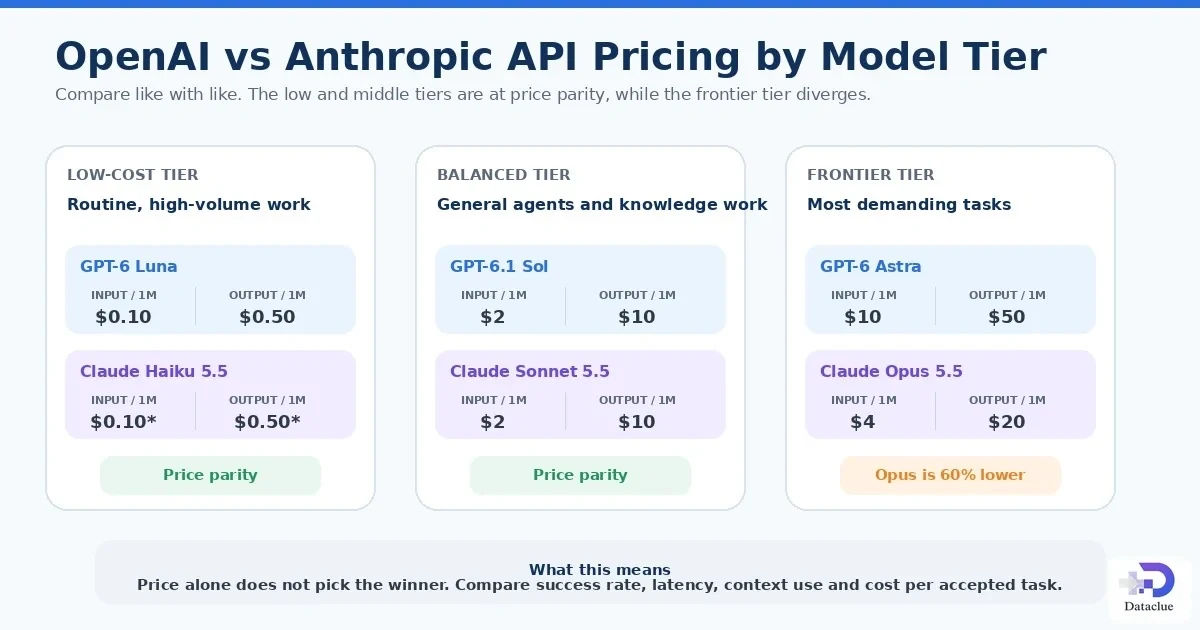
A better buying metric includes success, retries and review cost, not just token price.
Why Cheap Models Do Not Automatically Mean Cheap AI
Agents often send long histories, use tools, browse, write files, and call other models. These workflows can multiply token usage far beyond a simple chat request.
Long context also changes pricing. Some providers charge more when prompts cross context thresholds, while caching can reduce repeated input costs.
Companies therefore need usage monitoring, routing, caching, and task-level evaluation. The cheapest published rate is not necessarily the cheapest production system.
Enterprise AI Pricing Is Starting to Move Beyond Tokens
MindStudio argues that per-token and per-seat pricing do not always match the value a business receives from AI.
A company may care more about a resolved customer case, a completed analysis, or a finished software task than about the exact number of tokens used.
This is pushing the market toward cost-per-outcome thinking. Even when vendors continue billing by tokens, buyers increasingly judge them by business results.
The AI Economy Is Becoming More Model-Agnostic
Many companies no longer want to depend on a single model. They route tasks across multiple providers based on quality, cost, latency, compliance, and availability.
This creates pressure on OpenAI and Anthropic because switching costs can fall when application developers use a common orchestration layer.
It also creates opportunities for cloud platforms and inference providers that can offer many models behind one interface.
What the Price War Means for Developers
Developers should expect model prices to change frequently. Hard-coding one model into every workflow is becoming a business risk.
A better design separates the application from the model provider, keeps evaluation datasets for important tasks, and makes it possible to test alternatives.
Prompt caching, batch processing, smaller models, and task routing can reduce costs without lowering quality when they are used carefully.
What the Price War Means for Enterprises
Enterprises should compare providers using their own workloads. Public benchmarks are useful, but they do not tell you how much human review or retry cost your process will require.
Measure success rate, latency, total tokens, tool-call cost, human correction time, and the final cost per accepted result.
Contracts should also consider data residency, security, support, capacity guarantees, and the ability to switch models if prices or performance change.
What the Price War Means for NVIDIA
At first glance, cheaper models might sound negative for the leading AI hardware supplier. In practice, lower inference costs can unlock new applications and larger usage volumes.
If millions of businesses run more agents because each task becomes cheaper, total compute demand can continue rising.
NVIDIA's bigger long-term risk comes from competition in accelerators, custom cloud chips, and software ecosystems rather than from cheaper model APIs alone.
The Week's Broader Signal
The 2026 AI market is expanding in several directions at once. Model companies are cutting prices, cloud companies are fighting for developer loyalty, and hardware suppliers are racing to support much larger inference workloads.
OpenAI and Anthropic are still competing on capability, but the business contest increasingly includes price, distribution, infrastructure efficiency, safety, and enterprise trust.
The likely winner will not be determined by one benchmark. It will be determined by who can deliver useful intelligence reliably at the best total cost.
How to Compare AI Providers Without Getting Trapped by Marketing
Start with a small set of real tasks from your business. Run the same tasks across several models and measure the same outcomes.
Separate easy tasks from difficult ones. A small model may be excellent for classification and summarization but poor for complex coding or long agent workflows.
Track the full cost, including output tokens, cached input, tool calls, retries, latency, and human review. Then choose the cheapest model that meets the quality requirement for each class of work.
| Metric | Why it matters |
|---|---|
| Success rate | Shows how often the model actually completes the task |
| Cost per accepted result | Combines price, failures and retries |
| Latency | Important for user-facing and agent workflows |
| Human review time | Captures hidden labor cost |
| Tool-call cost | Agents can create costs outside token usage |
| Compliance and data residency | Can matter more than small token-price differences |
Final Thoughts
The OpenAI vs Anthropic price war is a sign that frontier AI is moving from a pure research race into a mature technology market where cost and distribution matter almost as much as capability.
OpenAI is using a wide model ladder. Anthropic is cutting prices and improving serving efficiency. NVIDIA remains central because all of this competition still requires enormous amounts of compute.
For businesses, the best strategy is not to bet blindly on one company. Build around measurable outcomes, keep the ability to route between models, and judge AI by the cost of work that is actually completed.
Animated View: The AI Price War Flywheel
Lower prices can expand usage, which increases inference demand and encourages more infrastructure investment.
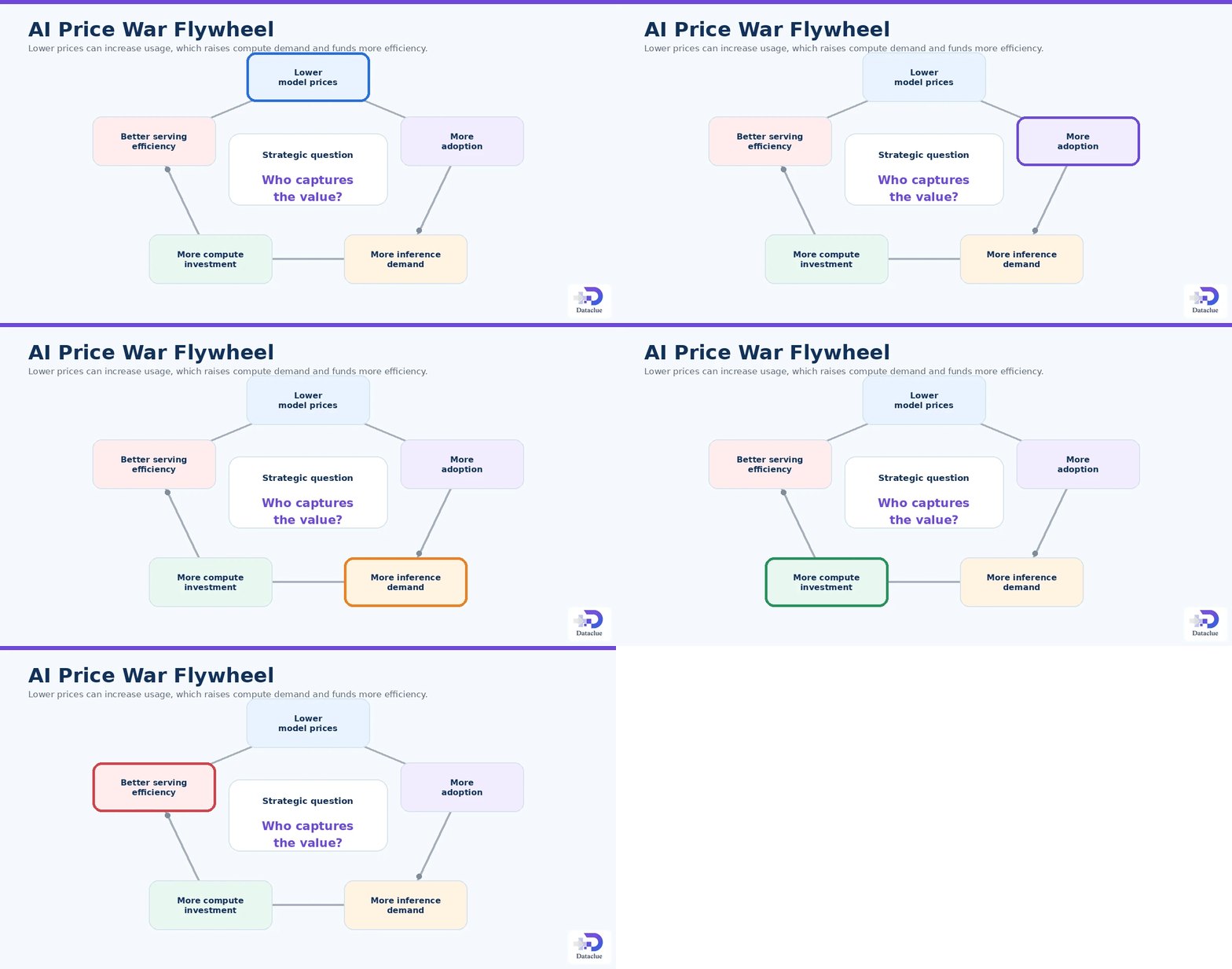
Animated WebP: lower prices, more adoption, more inference, more infrastructure, better serving efficiency.
Frequently Asked Questions
What is the OpenAI vs Anthropic AI price war?
It is the growing competition to deliver stronger AI models at lower cost, especially for developers and enterprises using APIs, agents, and high-volume workloads.
Which is cheaper, OpenAI or Anthropic?
It depends on the model tier and workload. As of October 26, 2026, GPT-6 Luna and Claude Haiku 5.5 have the same $0.10 input and $0.50 output price for Haiku prompts up to 100K. GPT-6.1 Sol and Claude Sonnet 5.5 are also both $2 input and $10 output per million tokens.
How much does Claude Opus 5.5 cost?
Anthropic lists Claude Opus 5.5 at $4 per million input tokens and $20 per million output tokens, with cache reads at $0.20 per million.
How much does GPT-6 Astra cost?
OpenAI lists GPT-6 Astra at $10 per million input tokens and $50 per million output tokens at standard short-context pricing.
Why are AI model prices falling?
Serving efficiency is improving, smaller models are becoming more capable, competition is increasing, and customers are becoming more willing to route routine tasks to cheaper models.
Why does NVIDIA matter in an AI price war?
AI models require accelerators, networking, data centers, and power. NVIDIA is a major supplier of the hardware and software stack that makes large-scale AI training and inference possible.
Does a cheaper token price always mean lower AI cost?
No. Total cost also depends on tokens used, retries, context length, tool calls, latency, and human review. Cost per successful task is often a better metric.
What is prompt caching?
Prompt caching reduces the cost of repeated input when a model can reuse previously processed context, such as system instructions, documents, or code.
Should companies use one AI provider?
Not necessarily. Many businesses benefit from a model-agnostic approach that routes tasks to different models based on quality, cost, speed, and compliance.
Will AI pricing keep falling?
Prices for many workloads are likely to remain under pressure, but premium models, faster processing, long context, and specialized tools may continue to command higher prices.
Sources
- Wall Street Journal: The AI Price War Is Here
- Forbes: How Anthropic, OpenAI and Nvidia Are Driving the AI Economy
- The New York Times opinion link supplied by the user
- SwiftInference: OpenAI, Anthropic, and the GPU Wars Heat Up
- MindStudio: AI Industry Strategy and Compute Economics
- The AI Break: OpenAI vs Anthropic price coverage
- The Atlantic: Inside the Biggest Feud in Artificial Intelligence
- OpenAI API Pricing
- Anthropic: Claude Haiku 5.5
- Anthropic: Claude Sonnet 5.5
- Anthropic: Claude Opus 5.5