
The GPU Gamble: OpenAI vs Anthropic in the AI Vibe War
Anthropic can point to a narrow lead on one major intelligence index. OpenAI can point to lower task costs, wider access, and a much larger public compute pipeline. The real AI race is no longer only about which model thinks best. It is about which system works best for people.
The GPU Gamble: Why OpenAI Is Winning the Vibe War Even When Anthropic Scores Higher
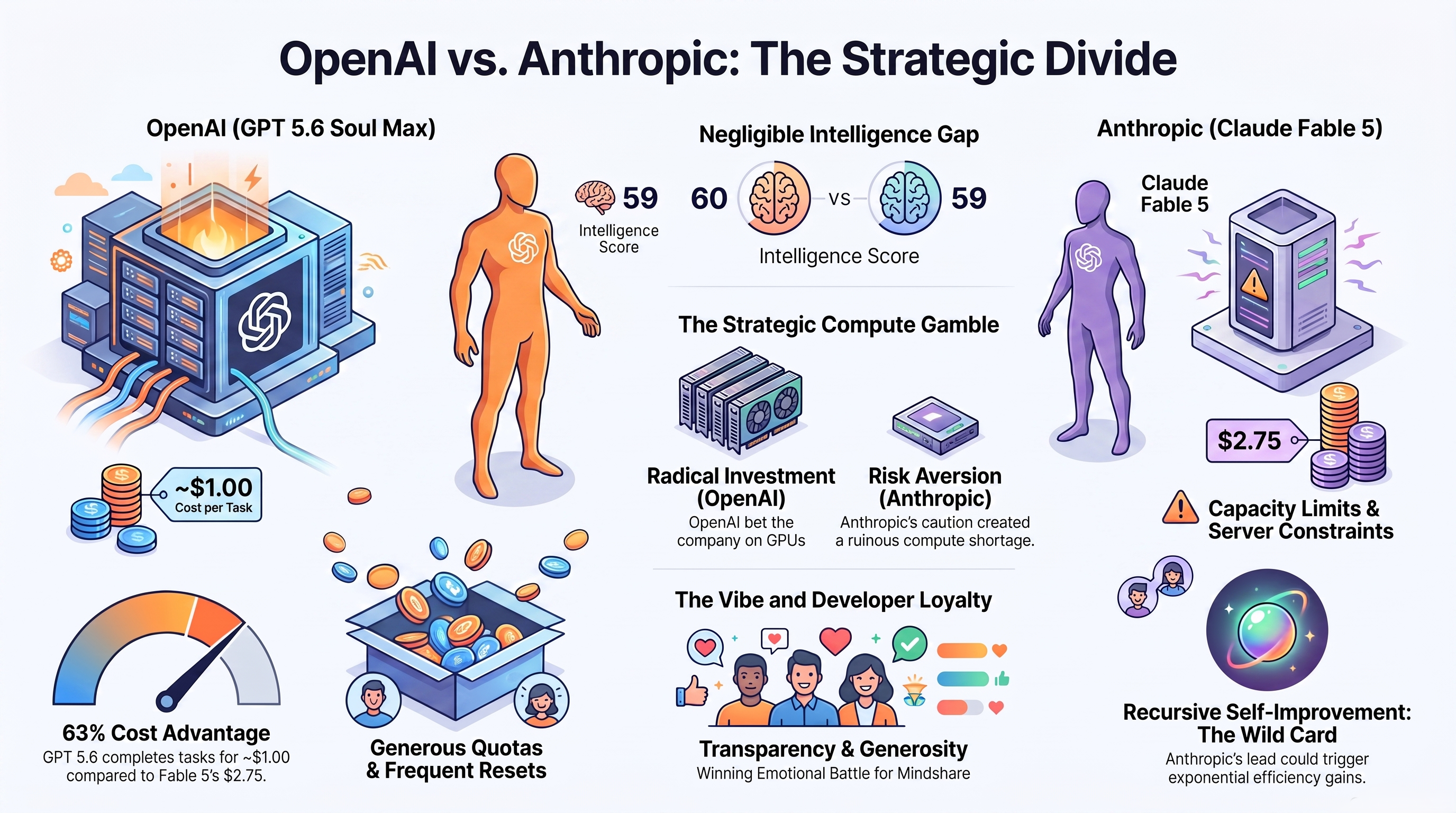
Anthropic can point to a narrow lead on one major intelligence index. OpenAI can point to lower task costs, wider access, and a much larger public compute pipeline. The real AI race is no longer only about which model thinks best. It is about which system works best for people.
- The smartest model does not always feel like the best product
- The compute gamble that split the race
- A one point intelligence lead meets a much wider cost gap
- How access rules become brand perception
- The vibe war is really a product design war
- Developers can move before enterprise contracts do
- The recursive self improvement wild card
- Which lead is more sustainable
- Frequently asked questions
The smartest model does not always feel like the best product
For much of 2026, the OpenAI vs Anthropic race has looked like a paradox. Claude Fable 5 holds a narrow lead on one widely followed intelligence index. GPT 5.6 Sol sits only one point behind. Yet many users may still see OpenAI as the easier platform to choose.
That gap is not mainly about raw intelligence. It is about the full product system around the model. Users feel speed, price, access, limits, reliability, and communication. They do not experience a benchmark score in isolation.
This is the heart of the so called vibe war. The phrase sounds light, but the business effect is serious. A model can be brilliant and still lose attention if people cannot use it when they need it. A slightly weaker model can win loyalty if it feels fast, steady, and fairly priced.
The compute gamble that split the race
The biggest difference between the two companies may have started years before the latest model launch. AI systems need huge amounts of compute for training and daily use. That means long contracts, data centers, power, chips, networking, and careful planning.
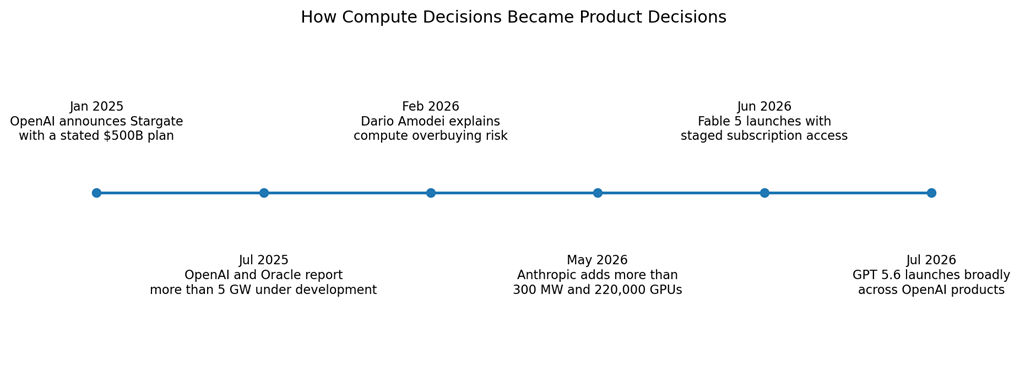
Anthropic chief executive Dario Amodei has explained why the company did not want to buy unlimited future compute. He warned that a lab could face disaster if revenue growth arrived one year late, or grew five times instead of ten times. His point was simple. A company can fail by buying too much capacity too early, even when it believes AI demand will rise.[11]
OpenAI took a more aggressive public path. In January 2025, OpenAI and its partners announced Stargate, with a stated plan to invest $500 billion in United States AI infrastructure over four years and begin with $100 billion. By July 2025, OpenAI and Oracle said more than 5 gigawatts of Stargate capacity was under development, enough to run more than 2 million chips.[1][2]
This does not prove OpenAI has spare GPUs waiting on shelves. In fact, demand for new models can still cause pressure. The safer conclusion is that OpenAI built a larger and faster moving public capacity pipeline. That pipeline gives the company more room to launch models broadly, lower prices, and adjust limits.
Anthropic has also expanded fast. In May 2026, it announced a SpaceX compute agreement that added more than 300 megawatts and over 220,000 NVIDIA GPUs within a month. Anthropic said this new capacity would directly help Claude Pro and Max subscribers.[3]
A one point intelligence lead meets a much wider cost gap
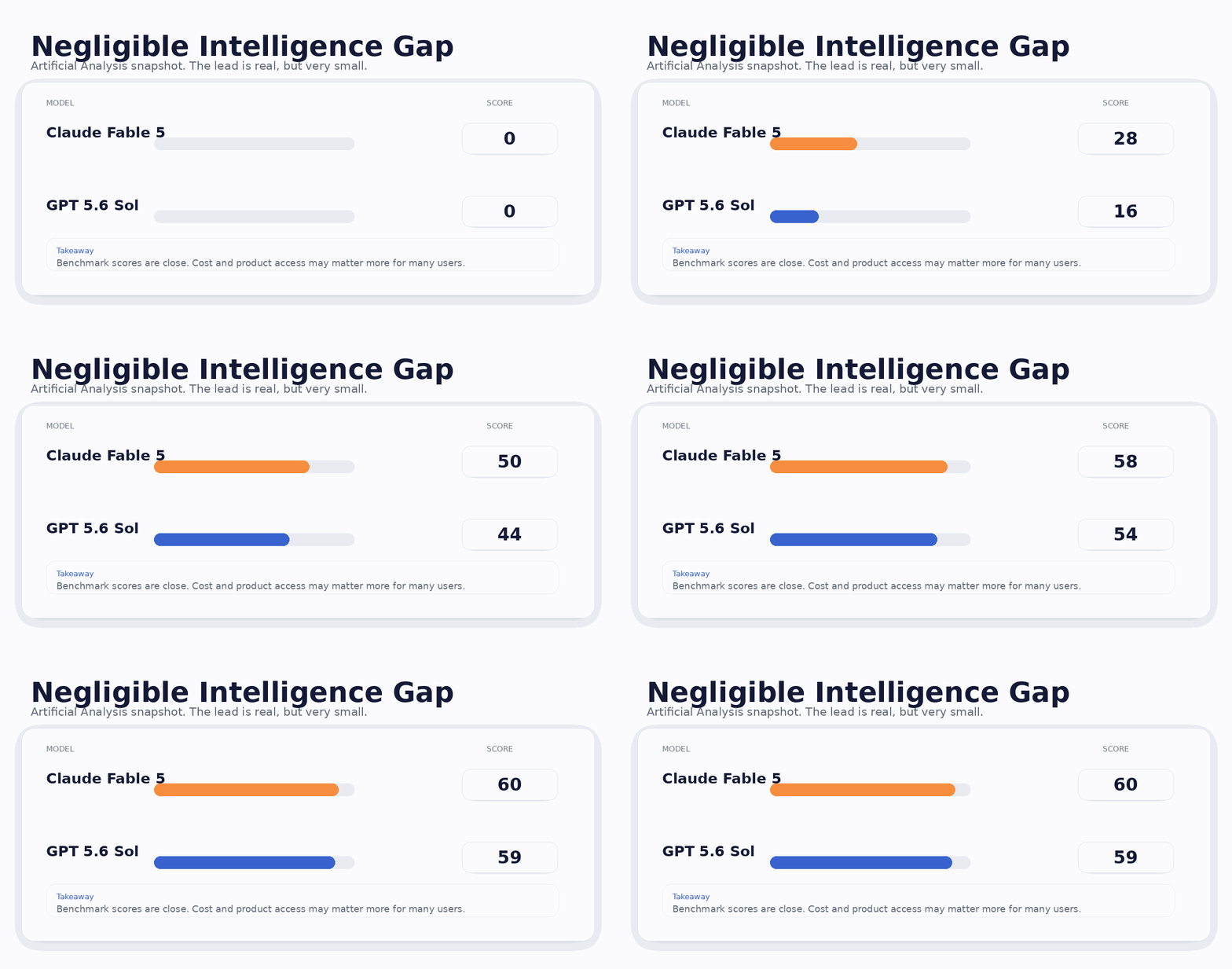
The model comparison is close. Artificial Analysis reported Claude Fable 5 at 60 and GPT 5.6 Sol at 59 on its Intelligence Index snapshot. That is a real lead, but it is a narrow one.[4]
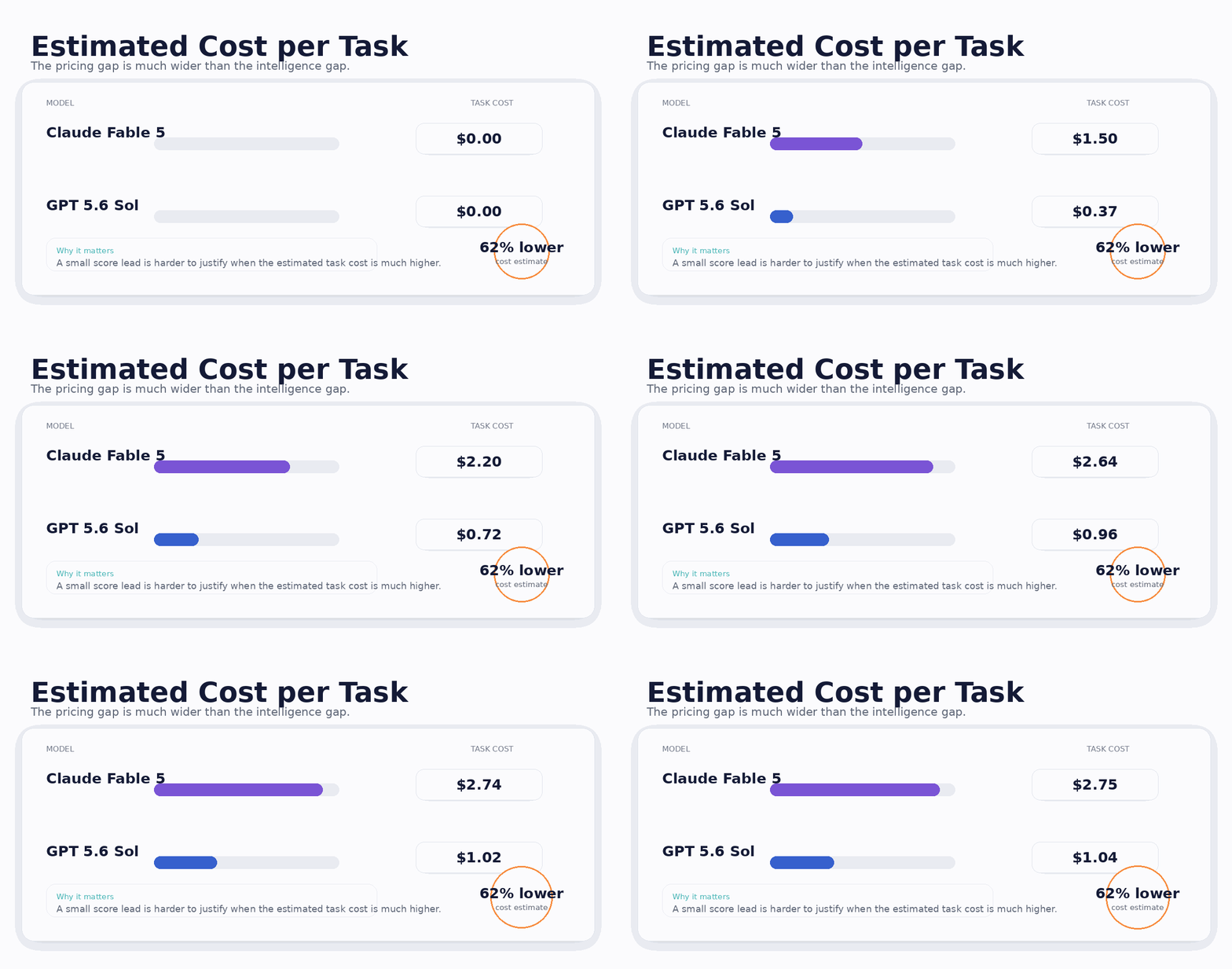
The cost gap is much larger. Artificial Analysis estimated a cost of $2.75 per Intelligence Index task for Fable 5 and $1.04 for GPT 5.6 Sol. In that test, OpenAI delivered almost the same score at about one third of the cost.[4]
Official token prices point in the same direction. Anthropic listed Fable 5 at $10 per million input tokens and $50 per million output tokens. OpenAI listed GPT 5.6 Sol at $5 per million input tokens and $30 per million output tokens.[5][6]
For developers and companies, this difference can matter more than one benchmark point. A small gain in intelligence may be valuable for the hardest research or coding tasks. For routine work at scale, cost, speed, and predictable access often carry more weight.
There is also an important legal and editorial point. Anthropic has not publicly confirmed that Fable 5 has 10 trillion parameters. That number should not be stated as fact. The model can be described as a frontier system without repeating an unverified size claim.
Benchmark snapshot
One point separates the leaders
The economic gap is much wider
How access rules become brand perception
Anthropic has been open about high demand and limited capacity. When Fable 5 launched on June 9, 2026, the company said subscription access would be included only through June 22. After that date, users would need usage credits. Following a temporary suspension and redeployment, Anthropic restored Fable 5 on July 1 and included it for up to half of weekly limits through July 7, after which usage credits would again apply.[7][8]
Each step may have had a clear technical or legal reason. Still, changing access rules create friction. People build habits around tools. When a model moves between included access and paid credits, users must rethink their workflow and budget.
OpenAI has used a different product signal. It launched GPT 5.6 across ChatGPT, Codex, and the API for paid plans. It also introduced banked rate limit resets for eligible Codex users. Those resets remain usable for 30 days.[6][9]
This does not mean OpenAI has no limits or complaints. It does mean the company found a way to turn capacity control into a feature that feels flexible. A banked reset tells the user, in effect, that unused access still has value. That small design choice can shape trust.
The vibe war is really a product design war
The word vibe can sound vague, but product feeling comes from real choices. It comes from how fast the model answers, how often limits appear, how clear the pricing feels, and how a company explains change.
OpenAI currently has a strong story on abundance. Its public infrastructure plans are large. Its new flagship model is close to the top score at a lower estimated task cost. Its product teams have also used quota resets and broad availability to reduce the feeling of scarcity.
Anthropic has a strong story on raw capability and careful deployment. Fable 5 leads the selected Artificial Analysis snapshot, and Anthropic presents it as a model for hard, long running work. But a premium model creates premium expectations. Users expect steady access, clear limits, and fewer surprises.
This is why the OpenAI vs Anthropic debate cannot be settled by one chart. Benchmarks measure useful pieces of intelligence. They do not fully measure patience, trust, workflow fit, or the cost of an interrupted task.
Developers can move before enterprise contracts do
Enterprise sales can make a company look secure for a long time. Large contracts often last months or years. Developer habits move faster. A programmer can test a new model today, change an API next week, and recommend a new tool to a team next month.
That makes developer experience a leading signal. If one platform feels easier to use and cheaper to scale, it can gain mindshare before large buyers change vendors. The reverse is also true. A model with a clear technical edge can pull developers back when it solves problems that other systems cannot.
Anthropic remains a serious competitor. Its capacity expansion shows that it understands the access problem. OpenAI also remains under pressure because fast growth can fill new infrastructure quickly. Neither company has solved abundance forever.
The recursive self improvement wild card
The long term race may change if AI systems help build better AI systems. Anthropic calls the far end of this process recursive self improvement. The company says it is already giving AI systems a growing share of AI development work, though it also says full recursive self improvement has not arrived.[10]
Anthropic reported that its engineers now ship eight times as much code per quarter as they did during 2021 to 2025. That does not mean Fable 5 can redesign itself without humans. It does show that AI can speed up the research loop.
OpenAI is using AI to improve its own research and products too. The key question is whether a small intelligence lead can create a larger efficiency lead later. A model that helps discover better training methods, better chips, or better software could reduce the need for brute force compute.
For now, that outcome remains uncertain. Recursive improvement is a real research direction, not a guaranteed escape from infrastructure limits. Compute, power, data centers, and money still matter today.
Which lead is more sustainable
In the short term, OpenAI appears stronger on the parts of AI that users feel every day. It has a large public infrastructure pipeline, broad GPT 5.6 access, and a lower estimated cost per benchmark task.
Anthropic holds a narrow lead on the selected intelligence snapshot and may have an advantage on certain hard tasks. It is also adding compute quickly. If Fable 5 or its successors improve efficiency, the current access gap could shrink.
The most likely winner will not be the company with only the smartest model or only the friendliest marketing. It will be the company that makes frontier intelligence feel reliable, affordable, and available at the moment people need it.
That is the real GPU gamble. OpenAI bet early on scale. Anthropic bet on caution and capability. The next stage will show whether product abundance can protect a narrow intelligence deficit, or whether raw intelligence can learn its way out of a compute disadvantage.
Quick comparison
| Metric | Claude Fable 5 | GPT 5.6 Sol |
|---|---|---|
| Intelligence Index snapshot | 60 | 59 |
| Estimated cost per task | $2.75 | $1.04 |
| Official input price per 1M tokens | $10 | $5 |
| Official output price per 1M tokens | $50 | $30 |
| Subscription access signal | Staged access and usage credits | Broad paid plan access |
| Public parameter count | Not disclosed | Not disclosed in cited launch material |
Frequently asked questions
Is Claude Fable 5 smarter than GPT 5.6 Sol?
On the Artificial Analysis Intelligence Index snapshot used in this article, Fable 5 scored 60 and GPT 5.6 Sol scored 59. That is a narrow lead on one benchmark, not proof that Fable 5 is better for every task.
Why is GPT 5.6 cheaper in the comparison?
OpenAI prices GPT 5.6 Sol below Fable 5 at the token level, and the model used fewer resources per tested task in the Artificial Analysis estimate. Actual cost depends on prompt size, output length, caching, tools, and reasoning settings.
Does OpenAI really have a GPU surplus?
There is no strong public proof of a permanent GPU surplus. The evidence supports a large OpenAI capacity pipeline through Stargate and other partners. OpenAI can still face demand pressure.
Why did Anthropic limit Fable 5 access?
Anthropic said demand was difficult to predict and used staged subscription access, weekly limits, and usage credits. A separate government directive also caused a temporary suspension in June 2026.
Can recursive self improvement remove the compute gap?
It may improve software and research efficiency, but it is not a guaranteed solution. Anthropic says full recursive self improvement has not arrived, and physical compute still matters.- OpenAI, Announcing The Stargate Project, January 21, 2025
- OpenAI, Stargate advances with 4.5 GW partnership with Oracle, July 22, 2025
- Anthropic, Higher usage limits for Claude and a compute deal with SpaceX, May 6, 2026
- Artificial Analysis, Four frontier launches in eight days, July 17, 2026
- Anthropic, Claude Fable 5 and Claude Mythos 5, June 9, 2026
- OpenAI, GPT 5.6: Frontier intelligence that scales with your ambition, July 9, 2026
- Anthropic, Claude Fable 5 launch availability details, June 9, 2026
- Anthropic, Redeploying Fable 5, June 30, 2026
- OpenAI Help Center, ChatGPT release notes, June 11, 2026
- Anthropic Institute, When AI builds itself
- Fortune, Dario Amodei on compute planning risk, February 14, 2026