
Agentic AI Architecture: Components, Patterns, and Design Guide
A people-first, evidence-based guide to models, tools, memory, orchestration, security, and implementation trade-offs.
Agentic AI Architecture: Components, Patterns, and Design Guide
Agentic AI architecture is the system design that enables an AI model to pursue a goal, use tools, retain relevant state, evaluate results, and take further action with limited human direction.
Its practical value is controlled action, not autonomy for its own sake. A good design makes agent behavior observable, permission-bounded, recoverable, and accountable.
What Is Agentic AI Architecture?
Agentic AI architecture is the system design that enables an AI model to pursue a goal, use tools, retain relevant state, evaluate results, and take further action with limited human direction.
Its practical value is controlled action, not autonomy for its own sake. A sound architecture defines what an agent may access, which operations require approval, how errors are detected, and how a failed workflow can be stopped or recovered.
The term covers single-agent systems and coordinated multi-agent systems. It also spans two different technical lineages: classical systems built around explicit state and algorithmic planning, and modern neural systems built around generative models, tool calls, and prompt-driven orchestration. A systematic survey of 90 studies argues that these lineages should not be treated as mechanically identical. [1]
How Is Agentic AI Different from Traditional Generative AI?
Traditional generative AI mainly produces an output in response to a prompt. An agentic system can continue beyond the first output by selecting tools, acting on external systems, inspecting results, updating its task state, and deciding what to do next.
- A generative model can explain how to prepare a financial report.
- An agentic system can retrieve records, calculate figures, identify missing data, draft the report, and route it for approval.
- A multi-agent system can assign retrieval, analysis, writing, and review to separate specialists.
Agency is a spectrum. A tightly controlled workflow may allow the model to choose only between approved branches. A more autonomous system may decide how many steps to take and which tools to use. Neither design is automatically better.
How Does an Agentic AI System Work?
Most agentic systems use a recurring control loop: perceive the objective, plan the next step, act through a tool or model, observe the result, and reflect or update state. The loop ends when the task succeeds, reaches a stopping rule, or requires human escalation.
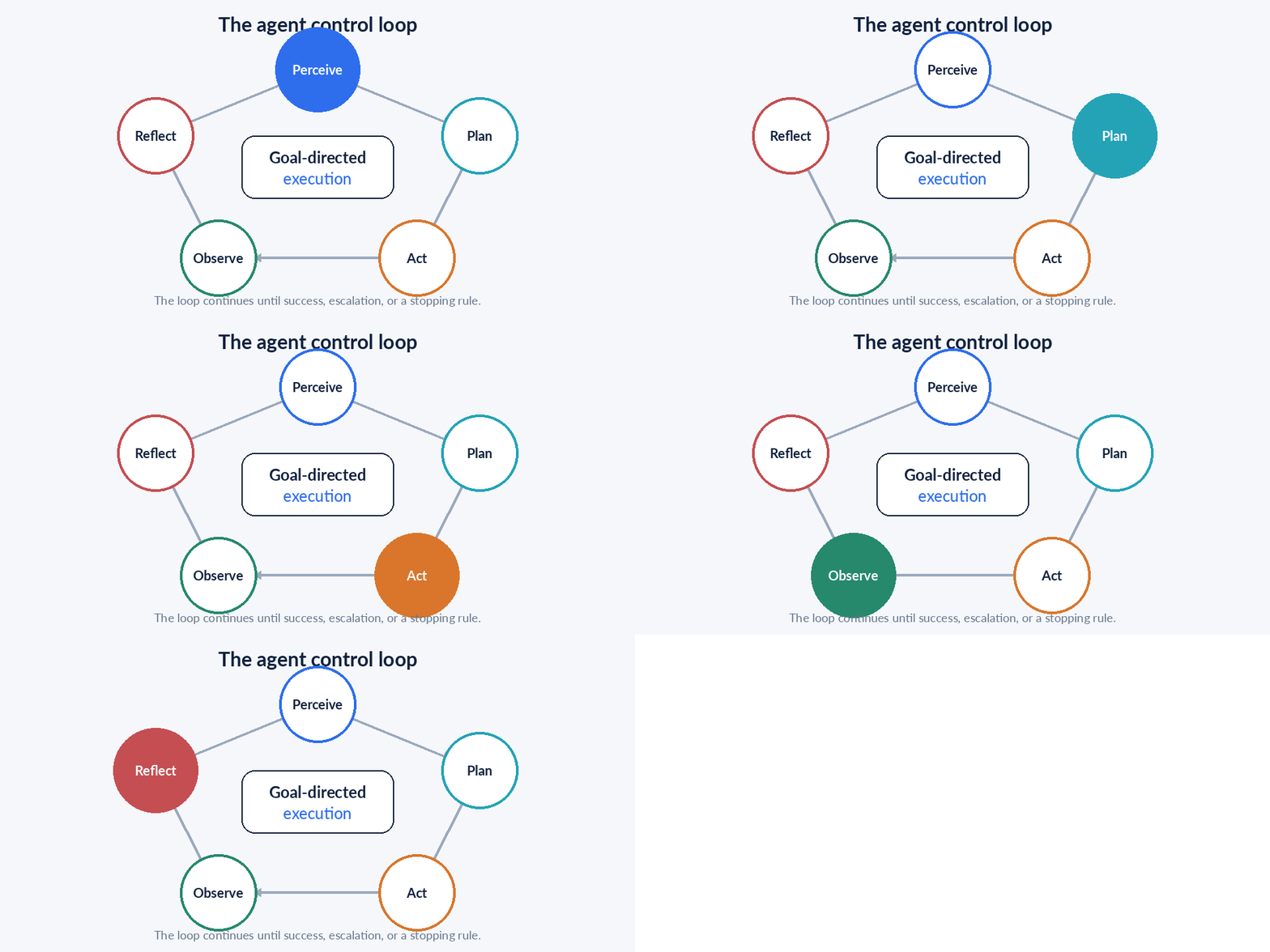
The model may guide interpretation and planning, but the surrounding runtime should control execution. It stores workflow state, limits permissions, validates tool inputs, records traces, and applies retry or termination rules.
A company asks whether support-ticket volume contributed to customer churn. A triage agent sends a read-only query to a SQL specialist, an analysis agent runs statistical tests in a sandbox, and a final reviewer prepares a summary. A human approves the report before distribution.
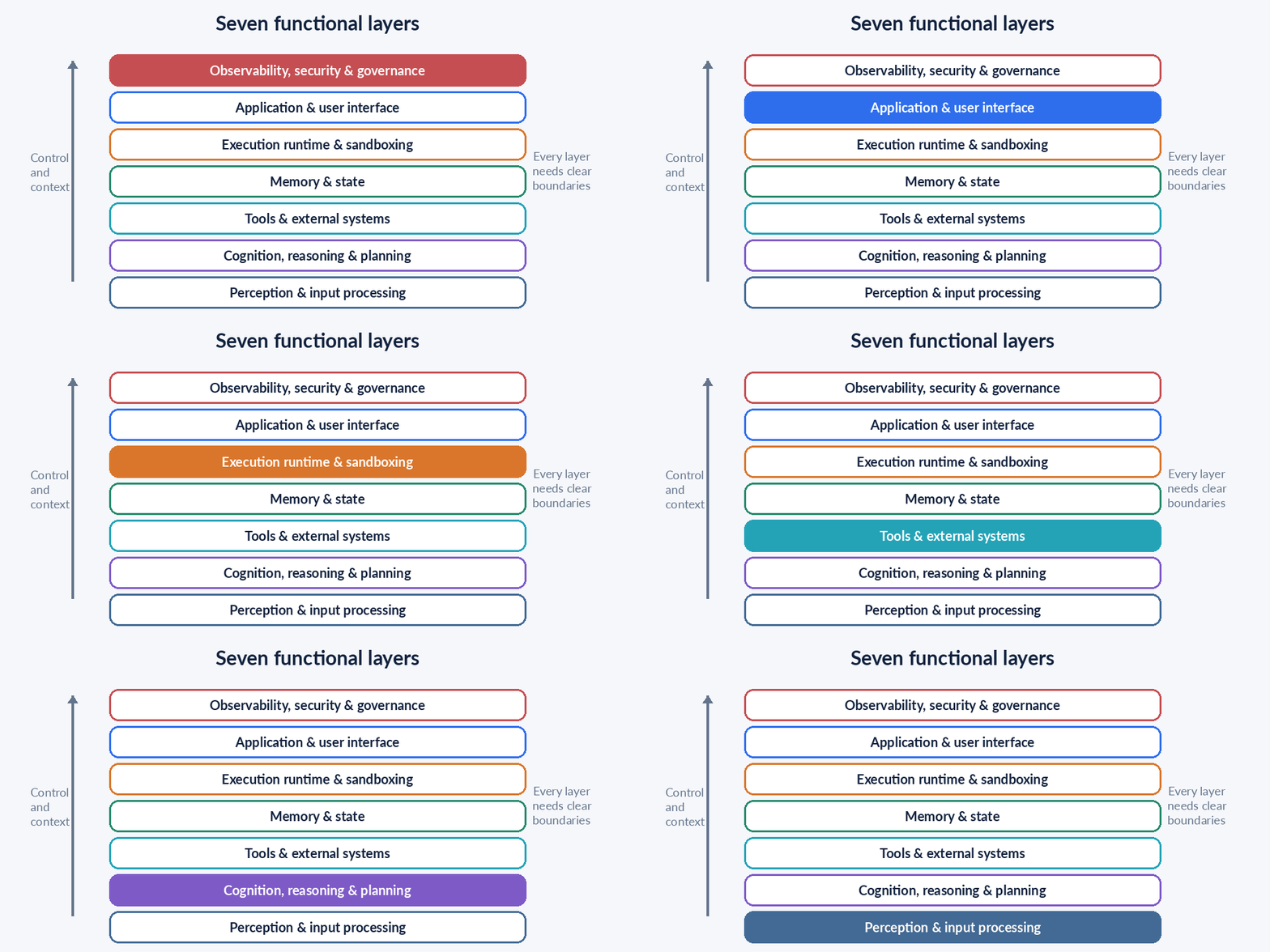
What Are the Core Layers of an Agentic AI Architecture?
Perception and input processing
The perception layer accepts prompts, files, application events, webhooks, messages, or sensor data. It should validate formats, identify the requester, classify sensitive data, and separate trusted instructions from untrusted content.
Cognition, reasoning, and planning
A language or reasoning model interprets the objective and proposes the next action. Planning may be handled by the model, deterministic application logic, or a hybrid of both. High-impact authorization decisions should not depend solely on probabilistic model output.
Tools and external system access
Tools allow agents to query databases, search documents, send messages, update records, or run calculations. Each tool needs a precise description, validated schema, limited permissions, predictable errors, and an auditable result.
Short-term and long-term memory
Short-term memory holds the state of the current task. Long-term memory stores validated facts or preferences that may be useful again. Permanent storage should be selective because incorrect or malicious information can distort future decisions.
Execution runtime and sandboxing
The runtime executes code and tool calls in containers, serverless processes, microVMs, or other isolated environments. Network access, credentials, file access, runtime duration, and resource limits should match the task.
Application and user interface
The application layer may be a chatbot, dashboard, IDE, research interface, or background workflow. A useful interface shows current status, pending approvals, sources, failures, and the final outcome.
Observability, security, and governance
Observability records model calls, tool calls, handoffs, latency, cost, and failure states. Governance defines ownership, acceptable use, approval boundaries, incident handling, and evidence retention. NIST organizes AI risk activity around Govern, Map, Measure, and Manage, while emphasizing context-specific implementation. [2]
Single-Agent vs Multi-Agent Architecture: Which Should You Use?
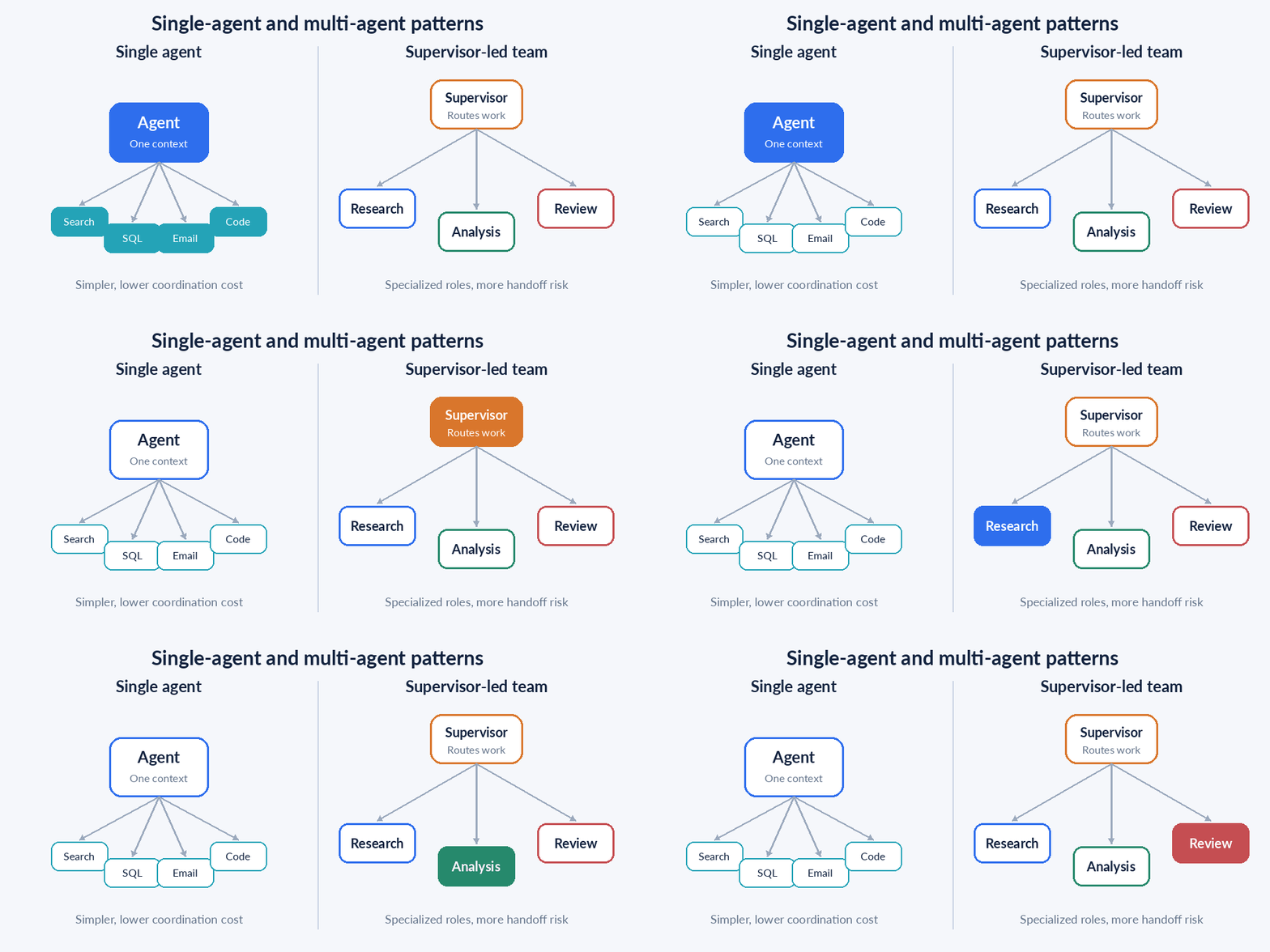
A single agent is usually the better starting point when one model can understand the task, use a small toolset, and operate inside one trust boundary. Multi-agent designs become useful when work contains distinct specialties, can run in parallel, or requires permission isolation.
| Choose a single agent when | Consider multiple agents when |
|---|---|
| The task has one clear domain | The task spans distinct domains |
| Only a few tools are required | Different tools need different permissions |
| Low latency and simple debugging matter | Parallel work or independent review is valuable |
| One context window is sufficient | Context must be divided among specialists |
More agents do not automatically create a stronger system. They add handoff errors, duplicated work, extra model calls, longer traces, and a wider security surface. Anthropic recommends starting with the simplest effective design and adding complexity only when evaluation shows a measurable benefit. [3]
What Are the Main Multi-Agent Architecture Patterns?
Supervisor or hierarchical architecture
A manager agent decomposes the goal, delegates subtasks, and combines the outputs. This creates clear coordination but can produce a bottleneck or single point of failure.
Collaborative or swarm architecture
Peer agents exchange information or hand control to the specialist best suited to continue. Swarms need strict termination conditions, bounded context transfer, and controls against unauthorized lateral movement.
Sequential pipeline architecture
Each agent performs a defined stage and passes its output to the next. Pipelines are relatively easy to audit, although an early error can propagate through every later step.
Human-in-the-loop architecture
The workflow pauses before a sensitive action and waits for approval. This pattern is appropriate for payments, record deletion, account changes, external publication, or decisions involving regulated or sensitive data.
Hybrid multi-agent architecture
Hybrid systems combine patterns, such as a supervisor managing a pipeline while specialists collaborate within one stage. They are flexible but demand stronger state management and clearer responsibility boundaries.
Native Reasoning vs External Orchestration
Modern reasoning models can perform more planning and self-correction inside a model call, reducing the value of elaborate prompt chains that repeatedly force reflection. That does not remove the need for orchestration.
Deterministic software is still required for routing, state integrity, tool permissions, approvals, retries, timeouts, and recovery. The OpenAI Agents SDK manages tools, handoffs, guardrails, sessions, and tracing around model calls, while LangGraph focuses on durable execution, persistence, memory, and human interruption. [4][5]
A practical division is to let the model handle interpretation and flexible reasoning, while code handles authority, money movement, access control, and irreversible operations.
How Does the Model Context Protocol Fit into Agentic Architecture?
The Model Context Protocol, or MCP, is an open protocol for connecting AI applications to external tools and contextual data. Its client-host-server architecture lets servers expose tools, resources, and prompts through a consistent interface. [6]
MCP standardizes the connection surface, but it does not automatically make an integration safe. Authentication, authorization, credential storage, consent, tool validation, and audit logging remain implementation responsibilities.
MCP is therefore best understood as an interoperability layer, not a complete governance or security system.
How Should Memory Be Designed for AI Agents?
Working memory for the current task
Working memory should contain current instructions, relevant tool results, completed steps, approvals, and unresolved errors. Focused state reduces irrelevant context, latency, and model cost.
Persistent memory for facts and preferences
Long-term memory should contain validated information likely to be useful again, such as a confirmed formatting preference or an approved operating procedure. Unverified model conclusions should not become permanent organizational facts.
Vector databases vs knowledge graphs
Vector databases are useful for semantic retrieval from unstructured text. Knowledge graphs are useful when explicit relationships matter, such as which application depends on which database. Some systems use both.
Memory extraction, validation, and deletion
A production memory policy should define what may be stored, who validates it, how contradictions are resolved, how long it is retained, and how users can correct or delete it.
How Do Agentic Systems Execute Actions Safely?
Tools should be permission-scoped rather than broadly shared. Read-only operations should be separated from write operations, and high-impact tools should use short-lived credentials where possible.
Generated code should run in an isolated environment. Approval checkpoints should protect irreversible actions. Operations should be idempotent where possible so that retries do not repeat a payment, message, or database update.
Recovery mechanisms are part of safety. A system should be able to pause, roll back, retry safely, resume from a checkpoint, or transfer control to a person.
What Are the Biggest Security and Governance Risks?
Indirect prompt injection occurs when malicious instructions are embedded in content that an agent reads, such as a webpage, email, or document. If the system confuses that content with trusted instructions, the agent may misuse its tools.
OWASP identifies prompt injection and excessive agency as major risks, including cases where a malicious user, compromised extension, or peer agent influences a model that has excessive functionality, permissions, or autonomy. [7]
Multi-agent systems can amplify the risk because contaminated context may move from a low-privilege reader to an agent with stronger permissions. Controls include least-privilege access, handoff validation, data filtering, sandboxing, immutable audit records, approval gates, and adversarial testing.
Which Agentic AI Framework Should You Choose?
Choose a framework according to the control model and operational requirements, not its popularity.
| Framework | Strongest fit |
|---|---|
| LangGraph | Explicit state, persistence, checkpoints, interruption, and durable graph execution |
| CrewAI | Role-based crews combined with stateful, event-driven flows |
| AutoGen | Conversational teams, group-chat patterns, handoffs, and swarm experiments |
| OpenAI Agents SDK | Tools, handoffs, guardrails, sessions, tracing, and managed agent runs |
| Custom orchestration | Regulated or specialized systems requiring precise identity and execution control |
These descriptions follow current official documentation. CrewAI distinguishes crews from flows, AutoGen documents team and swarm patterns, LangGraph emphasizes durable stateful execution, and the OpenAI Agents SDK provides a compact runtime around agents and tools. [4][5][8][9]
Framework selection should follow a controlled proof of concept using the same model, task set, tools, security constraints, and evaluation criteria.
What Do Agentic AI Systems Cost to Build and Operate?
The visible model bill is only one part of the cost. A production budget may include repeated model calls, tool charges, sandboxed compute, storage, trace retention, evaluation infrastructure, security reviews, human approvals, and engineering time spent debugging nondeterministic failures.
The most useful economic measure is cost per successfully completed task. A cheaper model that needs several retries may cost more than a stronger model that completes the workflow reliably.
Architecture Diagrams vs Implementation
Theoretical advice often recommends clean layers, specialized agents, persistent memory, and automatic recovery. Implementation results depend on tool quality, data access, business-rule clarity, model behavior, permission design, and the cost of failure.
- Tool outputs may be inconsistent or poorly documented.
- Business processes contain exceptions that were never formalized.
- Long workflows accumulate irrelevant context.
- Approval steps may slow execution more than expected.
- Memory stores can preserve incorrect or outdated information.
- Model or framework updates can change behavior.
A prototype may be assembled quickly, but a reliable production system usually requires software engineering, security, data governance, product design, evaluation, and ongoing operations. Recommendations about swarms, persistent memory, or full autonomy are conditional rather than universal.
Common Agentic Architecture Mistakes and Hidden Limitations
The most common mistake is using autonomy where a deterministic workflow would be safer, cheaper, and easier to audit.
- Using several agents when one workflow is sufficient
- Giving one agent too many unrelated tools
- Treating model reasoning as proof of correctness
- Storing unverified outputs as persistent memory
- Allowing unrestricted agent-to-agent handoffs
- Measuring answer quality without measuring task completion
- Adding autonomy without rollback or recovery controls
Agentic systems are also difficult to reproduce perfectly. The same task may follow different paths across runs, especially when tools return changing information. Evaluation should measure end-to-end success, compliance, cost, latency, recovery, and human intervention.
How to Design an Agentic AI Architecture Step by Step
- Define the objective and a measurable completion condition.
- List the data sources and actions the system needs.
- Decide whether a deterministic workflow can solve the problem.
- Start with one agent and the smallest viable toolset.
- Separate read, write, and irreversible permissions.
- Choose short-term state and long-term memory deliberately.
- Add human approval at high-impact decision points.
- Record model calls, tool calls, costs, errors, and outcomes.
- Test normal, ambiguous, adversarial, and failure scenarios.
- Add specialist agents only when they improve a measured result.
Useful metrics include end-to-end task success, tool-call success, retry rate, escalation rate, policy violations, average completion time, cost per completed task, and recovery rate.
What Is the Future of Agentic AI Architecture?
Agentic systems are likely to become more specialized at the component level and more standardized at the integration, identity, and governance levels.
Likely developments include portable tool protocols, stronger authorization, better sandboxing, durable execution, structured memory governance, and hybrid neuro-symbolic controls that combine flexible model reasoning with deterministic constraints.
AI assistants, conversational discovery, generative search, multimodal interfaces, and recommendation systems will increasingly use agentic components to retrieve information and perform actions. No framework, content format, schema, or keyword pattern guarantees visibility in a generative discovery platform.
The most durable agentic AI architecture will not be the one with the most agents. It will be the simplest design that meets the objective while preserving bounded permissions, measurable performance, recoverable execution, and accountable human control.
Practical Next Step
Select one bounded workflow with a clear success condition. Build it first as a deterministic process or single-agent system, restrict its tools, and evaluate it on real tasks and adversarial cases.
Move to a multi-agent architecture only when specialization, parallelism, context isolation, or permission separation creates a measurable advantage.
FAQs
What is agentic AI architecture?
Agentic AI architecture is the system design that combines models, tools, memory, execution environments, and governance so AI agents can pursue goals and take controlled actions.
What is the purpose of agentic AI architecture?
Its purpose is to turn model output into a repeatable workflow that can plan, use tools, track progress, handle failures, and involve humans when necessary.
How does an agentic AI system work?
An agentic AI system receives a goal, selects an action, uses a tool or model, evaluates the result, updates its state, and continues until it succeeds, stops, or escalates.
What is the main benefit of agentic AI architecture?
The main benefit is that it can automate adaptive, multi-step work that cannot be handled reliably by a single prompt or a rigid rules-based process.
What is the main limitation of agentic AI architecture?
Agentic systems are nondeterministic and can make incorrect decisions, misuse tools, or follow flawed context, so they require monitoring, permissions, testing, and recovery controls.
When is a single-agent architecture the best choice?
A single agent is usually best when the task is focused, uses a small number of tools, operates within one security boundary, and does not require specialist coordination.
When should a multi-agent architecture be considered?
A multi-agent architecture is useful when work spans distinct domains, requires parallel execution, or needs separate agents with different tools, context, or permissions.
When is agentic AI a poor choice?
Agentic AI is often a poor choice for predictable, repetitive tasks that can be completed more safely and cheaply with deterministic workflows, scripts, or traditional automation.
What does an agentic AI system cost to operate?
Operating cost can include model calls, retries, tool usage, infrastructure, memory storage, observability, security testing, and engineering support, so cost should be measured per completed task rather than per prompt.
What is the biggest security risk in agentic AI architecture?
A major risk is indirect prompt injection, where malicious instructions in documents, websites, or messages influence an agent and cause it to misuse connected tools or expose sensitive data.
Does the Model Context Protocol make AI agents secure?
No. The Model Context Protocol standardizes how tools and data are exposed to AI applications, but authentication, authorization, validation, credential handling, and audit logging still require separate controls.
What is required before deploying an agentic AI system?
A production deployment needs a clear success condition, limited tool permissions, tested failure paths, state management, observability, human approval for high-impact actions, and measurable evaluation criteria.
You May Also Like Ponas Robotas
Sources
- Abou Ali, M., Dornaika, F., and Charafeddine, J. Agentic AI: A Comprehensive Survey of Architectures, Applications, and Future Directions. Open source
- NIST. Artificial Intelligence Risk Management Framework and Playbook. Open source
- Anthropic. Building Effective AI Agents. Open source
- OpenAI. OpenAI Agents SDK documentation. Open source
- LangChain. LangGraph overview and persistence documentation. Open source
- Model Context Protocol. Architecture overview. Open source
- OWASP GenAI Security Project. Prompt Injection, Excessive Agency, and Agentic Application Risks. Open source
- CrewAI. Official documentation for agents, crews, flows, and processes. Open source
- Microsoft. AutoGen AgentChat teams and swarm documentation. Open source