
Agentic RAG: How It Works and When to Use It
How Agentic RAG Helps AI Find, Check, and Refine Answers
Agentic RAG: How It Works and When to Use It
Contents
- What Is Agentic RAG in Simple Terms?
- How Is Agentic RAG Different from Traditional RAG?
- Why Agentic RAG Matters for Complex AI Tasks
- How the Agentic RAG Workflow Works Step by Step
- What Are the Core Components of an Agentic RAG System?
- How Retrieval Validation and Self-Correction Improve Accuracy
- Common Agentic RAG Design Patterns Explained
- The Reality Layer: Theory Versus Implementation
- When Should You Use Agentic RAG?
- How to Build an Agentic RAG System
- Which Frameworks and Tools Support Agentic RAG?
- What Are the Costs, Risks, and Limitations?
- How Should You Evaluate an Agentic RAG System?
- What Is the Future of Agentic RAG and AI Agents?
- Conclusion: Choose the Least Complex System That Works
Agentic RAG is a retrieval-augmented generation system in which an AI agent decides what information to retrieve, where to find it, and whether the evidence is sufficient. Instead of searching once and immediately generating an answer, it can plan, use tools, evaluate results, and search again.
What Is Agentic RAG in Simple Terms?
Retrieval-augmented generation gives a language model access to knowledge outside its trained parameters. The original RAG formulation combined a generative model with a retrievable non-parametric memory, allowing answers to be grounded in external evidence rather than model memory alone [1]. Agentic RAG adds a decision-making layer around that retrieval process.
How Is Agentic RAG Different from Traditional RAG?
Traditional RAG usually follows a predetermined route: transform the query, retrieve a fixed number of passages, add them to the prompt, and generate an answer. Agentic RAG treats retrieval as an adaptive task. The model can decide whether retrieval is necessary, split the question, choose a source, inspect the result, and retry.
The most important difference is not “more searches.” It is the ability to change the retrieval strategy after observing evidence. More retrieved text is not automatically better because irrelevant or conflicting passages can reduce answer quality, and long-context models may use information unevenly when it is buried inside a large prompt [5].
| Area | Traditional RAG | Agentic RAG |
|---|---|---|
| Workflow | Fixed retrieve-then-generate pipeline | Plan, retrieve, evaluate, and adapt |
| Sources | Usually one configured index | Documents, SQL, APIs, graphs, or the web |
| Validation | Context commonly passes directly to generation | Evidence can be graded, filtered, or rejected |
| Recovery | Limited fallback logic | Can rewrite, reroute, retry, or stop |
| Operations | More predictable cost and latency | Variable cost, latency, and execution paths |
Why Agentic RAG Matters for Complex AI Tasks
A fixed pipeline works well when one reliable collection contains a direct answer. It becomes less dependable when a request combines several information needs, crosses data types, or requires one result to determine the next search.
Hypothetical example: A user asks, “Compare Q3 sales with Q1 performance, explain the change, and identify related risks in the latest filing.” An agentic workflow could query a SQL database for the financial values, retrieve risk disclosures from a document index, verify the reporting periods, and then synthesize the answer. The example illustrates an architecture, not a measured deployment result.
- Multi-hop questions where one finding shapes the next query
- Tasks that combine structured records with narrative documents
- Ambiguous requests that require query decomposition or clarification
- Workflows where weak, stale, or conflicting evidence must be detected
How the Agentic RAG Workflow Works Step by Step
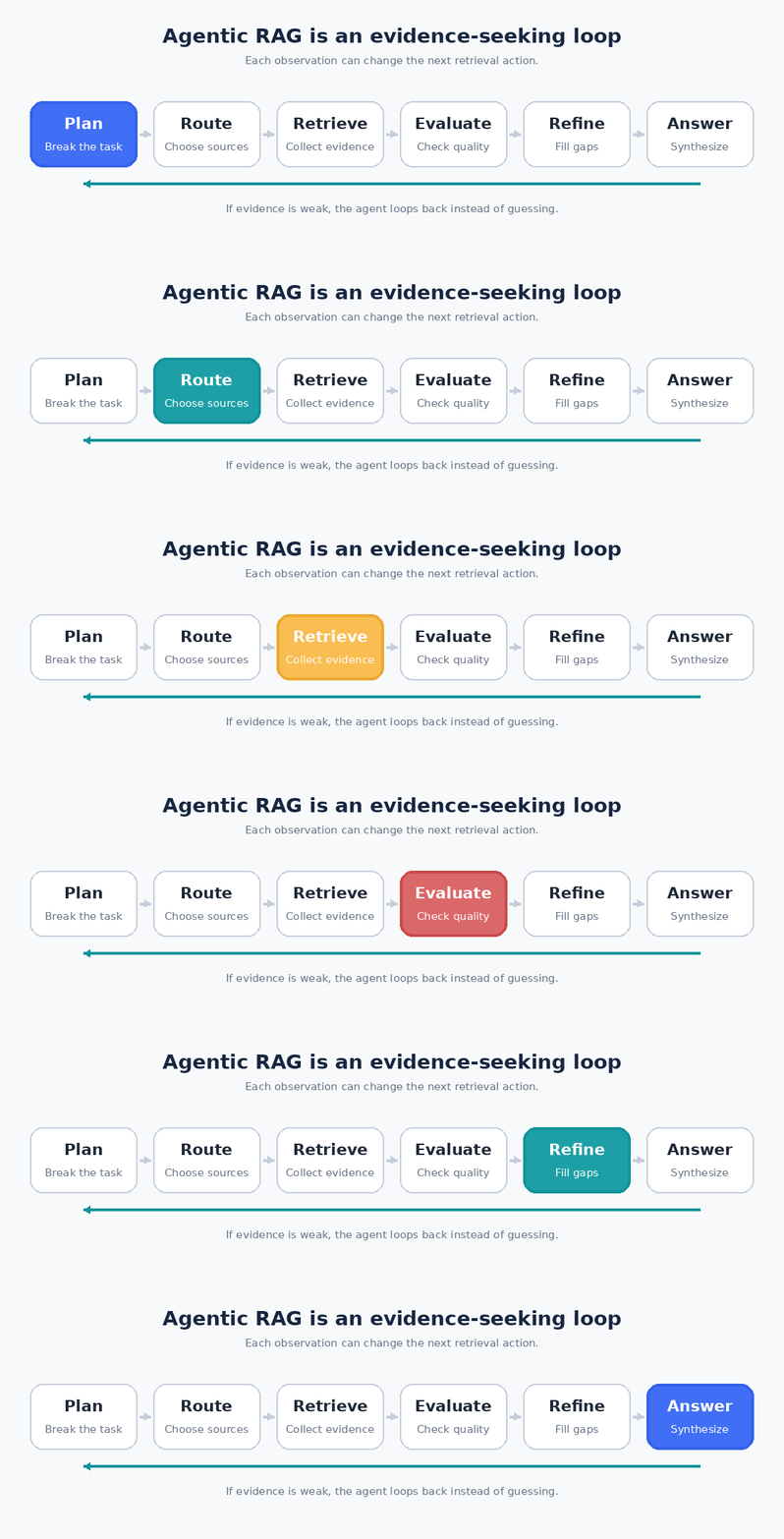
A practical system moves through a controlled loop rather than an unrestricted chain of thoughts. ReAct is an influential pattern that interleaves reasoning and external actions, allowing observations to update the next step [2]. Production implementations should expose tool calls and state transitions without relying on hidden reasoning traces.
- Interpret and plan: Identify the requested output, separate the information needs, and determine dependencies.
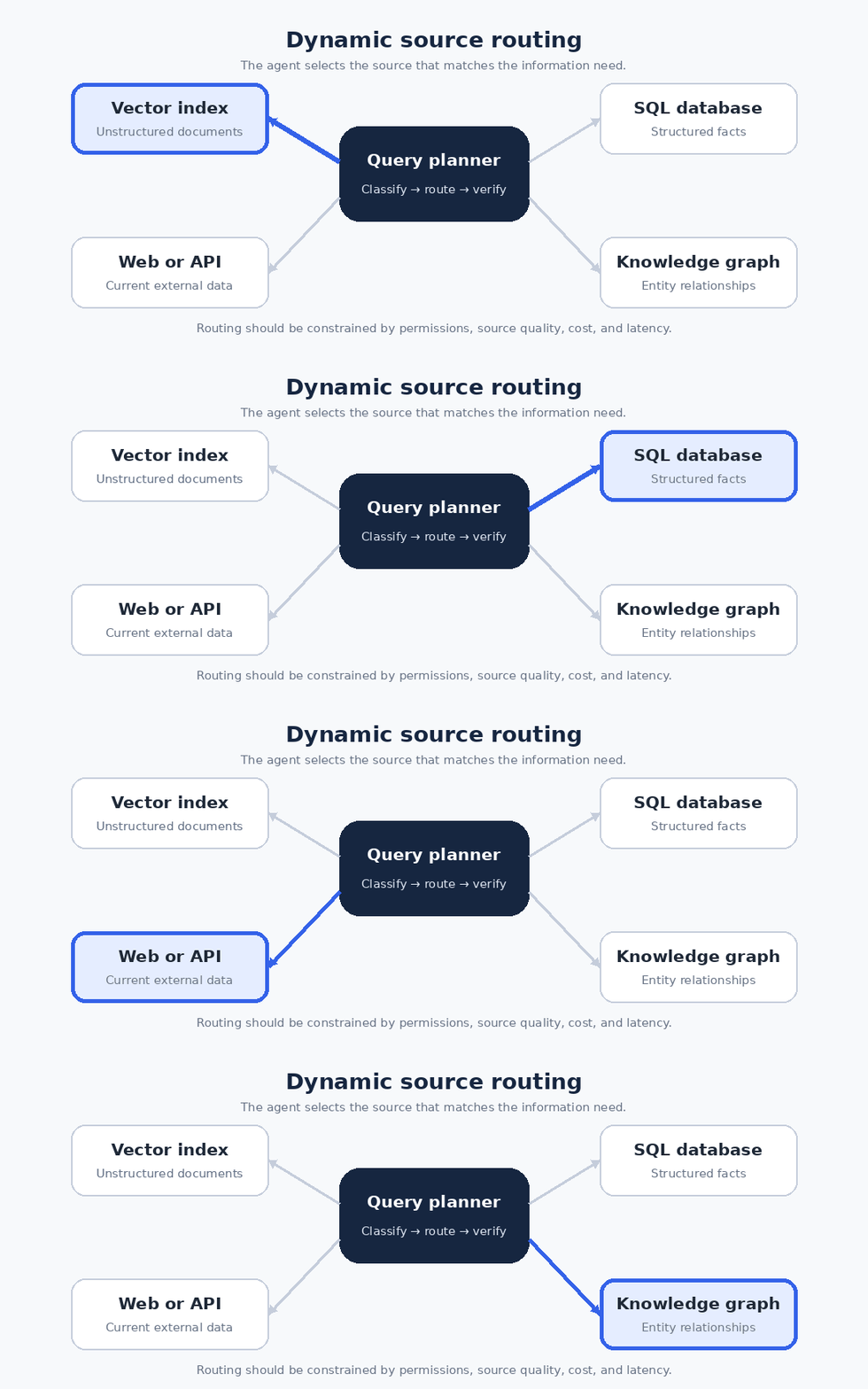
- Select tools and sources: Route semantic questions to documents, exact calculations to structured data, relationship questions to a graph, and time-sensitive requests to a current source.
- Retrieve evidence: Collect passages, rows, entities, calculations, or API results with relevant metadata and permission filters.
- Evaluate quality: Check relevance, coverage, source authority, dates, contradictions, and missing evidence.
- Refine or stop: Rewrite the query, switch tools, or end the loop when evidence thresholds or operational limits are reached.
- Generate and verify: Synthesize the curated context and check that important claims are supported by the retrieved evidence.
What Are the Core Components of an Agentic RAG System?
Agentic RAG does not require a team of agents. One bounded agent can plan, retrieve, validate, and respond. The architecture matters more than the number of autonomous roles.
- A language model that interprets the request and makes bounded decisions
- Retrievers for documents, databases, graphs, APIs, or current web information
- A tool registry with clear schemas, descriptions, permissions, and failure behavior
- An orchestrator that manages state, transitions, retries, and stopping conditions
- An evaluator for relevance, groundedness, completeness, or task success
- Observability for prompts, tool calls, costs, latency, errors, and evidence
- Security controls that enforce user permissions and limit tool arguments
How Retrieval Validation and Self-Correction Improve Accuracy
Corrective RAG evaluates retrieved documents and can trigger different retrieval actions when the initial context is weak [3]. Self-RAG explores adaptive retrieval and model-generated critique signals rather than indiscriminately retrieving a fixed number of passages [4]. These approaches support the broader principle that retrieved text should be treated as evidence to assess, not truth to assume.
The phrase “self-correction” should not imply certainty. A validator is another model, rule, or score and can also fail. Deterministic checks remain preferable for calculations, schemas, access controls, date comparisons, and other requirements that software can verify directly.
Common Agentic RAG Design Patterns Explained
- Router: Classifies the request and directs it to one or more relevant sources.
- ReAct: Alternates model decisions, tool actions, and observations [2].
- Corrective RAG: Grades retrieval and invokes fallback or refinement when evidence is inadequate [3].
- Plan-and-execute: Produces a structured task plan before completing the individual steps.
- Multi-agent RAG: Assigns genuinely distinct responsibilities to specialist agents and an orchestrator.
- Graph-assisted RAG: Uses entity relationships, community structures, or graph traversal for relationship-heavy questions. Microsoft GraphRAG, for example, extracts a knowledge graph and builds community summaries for graph-based retrieval [10].
The Reality Layer: Theory Versus Implementation
Theoretical advice often recommends autonomous planning, repeated retrieval, memory, and specialized agents. Implementation results depend on document quality, metadata, tool reliability, model behavior, permission design, and the team’s ability to evaluate the complete workflow.
The hidden effort usually sits outside the prompt: document ingestion, chunking, index maintenance, source-authority rules, access control, evaluation datasets, tracing, incident review, and regression testing after model or framework changes.
Nuanced conclusion: A simpler RAG pipeline with good data preparation, metadata filters, hybrid retrieval, and reranking can outperform an agentic architecture when the real problem is poor retrieval engineering. Adding an agent does not repair missing data or an unreliable index.
When Should You Use Agentic RAG?
Agentic RAG is often unnecessary for narrow FAQs, stable product manuals, policy lookups, and other single-source tasks with predictable query patterns. A deterministic workflow is also safer when every step must follow a fixed operational or regulatory sequence. Limited agent decisions can still be inserted at carefully chosen points.
- The request regularly requires decomposition or multi-hop retrieval.
- Different query types need different data sources or tools.
- Structured and unstructured evidence must be combined.
- Weak retrieval can be detected and corrected with a defined method.
- The accuracy benefit is valuable enough to justify additional latency and cost.
How to Build an Agentic RAG System
Start with the smallest architecture that addresses a measured failure. LangChain’s official Agentic RAG tutorial demonstrates a retrieval agent that decides whether to use a vector-store tool, while LangGraph supports combining deterministic and model-driven steps in a stateful graph [6][7].
- Establish a baseline: Build and evaluate a conventional RAG pipeline before adding agent behavior.
- Classify failures: Separate data, retrieval, reasoning, generation, and permission problems.
- Add one bounded decision: Begin with routing, query rewriting, or retrieval grading rather than a multi-agent system.
- Constrain execution: Set iteration limits, timeouts, cost ceilings, tool schemas, and safe fallbacks.
- Preserve evidence: Store the passages, records, calculations, and tool outputs used for each response.
- Compare against the baseline: Keep the agentic layer only when representative tests show worthwhile improvement.
Which Frameworks and Tools Support Agentic RAG?
LangGraph is a low-level orchestration runtime for stateful agents, durable execution, human review, and workflows that mix deterministic logic with model-driven decisions [7]. LlamaIndex defines agents around models, memory, and tools, and supports tool-calling loops, query engines, routing, and multi-agent patterns [8]. CrewAI organizes agents into crews and structured flows, with state, execution control, guardrails, memory, and observability [9].
Framework choice should follow the required control model. Low-level orchestration offers flexibility and auditability but requires more engineering. Higher-level abstractions can accelerate prototypes but may make custom failure handling or debugging harder.
What Are the Costs, Risks, and Limitations?
Measure cost per completed task rather than cost per model call. Include embeddings, storage, retrieval, reranking, external services, tracing, evaluation, and human review. Agentic RAG cannot guarantee truth; it can improve how evidence is gathered and checked, but weak sources and unsupported inferences can still produce incorrect answers.
- Variable inference, retrieval, reranking, and external API costs
- Higher latency from repeated model calls and tool execution
- Incorrect routing, query rewriting, or stopping decisions
- Low-value or infinite loops without strict limits
- Exposure of restricted information through overly broad tools
- Inconsistent outputs and difficult failure attribution
- Maintenance burden as models, data, APIs, and frameworks change
How Should You Evaluate an Agentic RAG System?
Evaluation should isolate stages instead of collapsing the system into one answer score. RAGAS formalized separate dimensions for retrieved context, faithful use of that context, and answer quality [11]. Agentic systems add planning, routing, tool use, retries, safety, and operational behavior to the evaluation problem.
- Retrieval precision, recall, evidence coverage, and source freshness
- Routing and tool-selection accuracy
- Faithfulness, citation correctness, and unsupported-claim rate
- Task completion and handling of unanswerable or ambiguous requests
- Retry frequency, tool failures, loop count, and human escalation
- End-to-end latency, token usage, API cost, and security violations
Representative evaluation data matters more than a large generic benchmark. Include misspelled entities, conflicting dates, incomplete questions, unavailable tools, stale documents, and permission boundaries. Document the model, prompts, index configuration, test period, scoring method, and known limitations before interpreting results.
What Is the Future of Agentic RAG and AI Agents?
Agentic retrieval is becoming part of conversational discovery, research assistants, generative search, and multimodal systems that can select among text, tables, images, graphs, and APIs. These capabilities may improve evidence gathering, but no heading format, schema type, or keyword pattern guarantees inclusion in generative search summaries.
Prediction: The strongest production systems are likely to favor controlled autonomy. Better routing, evidence tracking, deterministic safeguards, and stage-level evaluation should create more value than simply increasing the number of agents.
Conclusion
Agentic RAG is useful when retrieval itself requires planning, source selection, adaptation, or validation. Traditional RAG remains the better choice when the retrieval path is predictable and the evidence lives in a well-maintained source.
Begin with real user questions and a measured baseline. Add the smallest agentic capability that addresses a documented failure, constrain its actions, preserve its evidence, and compare the result on accuracy, cost, latency, and governance. The best architecture is not the most autonomous one; it is the simplest system that meets the required standard.
You May Also Like Agentic AI Architecture
FAQs
What is Agentic RAG?
Agentic RAG is a retrieval-augmented generation system in which an AI agent plans searches, selects tools, evaluates evidence, and retrieves again when the initial context is insufficient.
What is the purpose of Agentic RAG?
Its purpose is to help language models answer complex questions that require multiple searches, data sources, or reasoning steps rather than relying on one fixed retrieval pass.
How does Agentic RAG work?
The system typically plans the task, routes subqueries to suitable sources, retrieves evidence, checks its quality, and repeats the process before generating a grounded answer.
What is the main benefit of Agentic RAG?
Its main benefit is adaptability: it can change its retrieval strategy when a query is ambiguous, multi-step, or poorly served by the first search.
What is the main limitation of Agentic RAG?
Agentic RAG adds latency, token usage, engineering complexity, and more possible failure points because each planning, retrieval, and validation step must be executed and monitored.
Is Agentic RAG expensive to implement?
It can be more expensive than traditional RAG because it may require multiple model calls, tool integrations, evaluation systems, tracing, and ongoing maintenance. The actual cost depends on query volume, workflow complexity, and infrastructure choices.
When is Agentic RAG most useful?
It is most useful for tasks involving multi-hop research, several knowledge sources, structured and unstructured data, or questions where the correct retrieval path cannot be predicted in advance.
When is Agentic RAG a poor choice?
It is usually unnecessary for simple FAQs, narrow document search, or predictable single-source queries. In these cases, a well-designed traditional RAG pipeline may be faster, cheaper, and easier to maintain.
What are the main risks of Agentic RAG?
Key risks include incorrect tool selection, unnecessary search loops, weak source validation, permission failures, inconsistent outputs, and higher exposure to prompt or tool-related security problems.
Which tools support Agentic RAG?
Frameworks such as LangGraph, LlamaIndex, and CrewAI can orchestrate agentic workflows, while vector databases, SQL systems, search APIs, and knowledge graphs provide retrieval sources. The best choice depends on control, observability, and integration requirements.
What is required to implement Agentic RAG successfully?
A reliable implementation needs well-defined tools, clean and accessible data, stopping rules, permission controls, evaluation datasets, tracing, and clear metrics for retrieval quality, cost, latency, and task completion.
What is the long-term impact of Agentic RAG?
Agentic RAG can make AI systems more capable of research, enterprise search, and cross-system analysis, but it also creates an ongoing need for monitoring, evaluation, security review, and workflow maintenance.
References
- Lewis et al., “Retrieval-Augmented Generation for Knowledge-Intensive NLP Tasks,” 2020.
- Yao et al., “ReAct: Synergizing Reasoning and Acting in Language Models,” 2022.
- Yan et al., “Corrective Retrieval Augmented Generation,” 2024.
- Asai et al., “Self-RAG: Learning to Retrieve, Generate, and Critique through Self-Reflection,” 2023.
- Liu et al., “Lost in the Middle: How Language Models Use Long Contexts,” 2023.
- LangChain, “Build a custom RAG agent with LangGraph,” official documentation.
- LangChain, “LangGraph overview,” official documentation.
- LlamaIndex, “Agents,” official developer documentation.
- CrewAI, “Introduction” and “Flows,” official documentation.
- Microsoft, “GraphRAG,” official documentation.
- Es et al., “RAGAS: Automated Evaluation of Retrieval Augmented Generation,” 2023, revised 2025.