
AI Agent Memory: Types, Architecture, Tools and Uses
Why Memory Is What Makes an AI Agent Truly Useful
AI Agent Memory: Types, Architecture, Tools and Uses
AI agent memory is an external system for retaining, updating, and retrieving selected information across interactions. It creates continuity, but only when the system controls what is stored, how it is corrected, and who can access it.
What Is AI Agent Memory in Simple Terms?
AI agent memory is the system that lets an AI agent retain, retrieve, update, and use information from earlier interactions. It gives an otherwise stateless language-model application continuity across tasks and sessions.
Memory can improve personalization, workflow consistency, and long-running task performance. It can also preserve mistakes, expose sensitive data, increase latency, and act on information that is no longer true.
A language model does not independently maintain a durable user profile or project history. The surrounding agent architecture must decide what to record outside the model and what to retrieve later. The CoALA research framework describes language agents with working memory and optional long-term semantic, episodic, and procedural memory components. [1]
Hypothetical example: A research assistant could remember that a user prefers peer-reviewed sources, has already rejected a weak search strategy, and wants reports in a particular citation style. The model has not been retrained; the system has preserved useful context and supplied it when relevant.
Why AI Agents Need Memory
Stateless systems work well for isolated tasks. They become frustrating when users return, projects span several sessions, or later decisions depend on earlier outcomes.
Without memory, users repeat preferences, agents lose previous decisions, and multi-stage workflows restart with incomplete assumptions. Memory is most valuable when an agent must continue work, recall prior actions, coordinate handoffs, or adapt its response to stable user or organizational context.
Memory does not automatically make an agent more intelligent. It only makes historical information available. The result improves when the stored information is accurate, the retrieval is relevant, and the agent knows how much weight to give it.
How AI Agent Memory Differs From a Context Window
A context window is the information a model can process during one inference. It may contain the system prompt, recent messages, tool output, retrieved documents, and selected memories.
Persistent memory is the system that determines what survives, where it is stored, and when it should return to the context window. LangGraph distinguishes thread-scoped short-term memory from long-term data stored across conversations and organized by namespaces and keys. [2]
| Dimension | Context window | Persistent memory |
|---|---|---|
| Retention | Temporary; usually bound to the current interaction | Persistent until updated, expired, or deleted |
| Organization | Linear prompt or message sequence | Structured records, events, vectors, or graphs |
| Selection | Often based on recency and prompt assembly | Based on write and retrieval policies |
| Cost pattern | More history increases prompt tokens | Selective retrieval adds storage and retrieval overhead |
| Primary risk | Context overload or truncation | Stale, incorrect, sensitive, or mis-scoped memories |
The Four Main Types of AI Agent Memory
Working memory contains the request, recent conversation, current task state, and immediate tool results. It is fast but temporary and bounded by the model’s active context.
Semantic memory stores facts and generalized knowledge, such as a user preference, project definition, or product rule. Semantic memory describes what is retained; semantic search is only one possible retrieval method.
Episodic memory records particular events: what happened, when it happened, what action was taken, and what outcome followed. It supports continuity and learning from earlier attempts.
Procedural memory represents how the agent should act. It may include workflows, tool-use rules, escalation logic, formatting standards, or reusable skills.
How AI Agent Memory Works
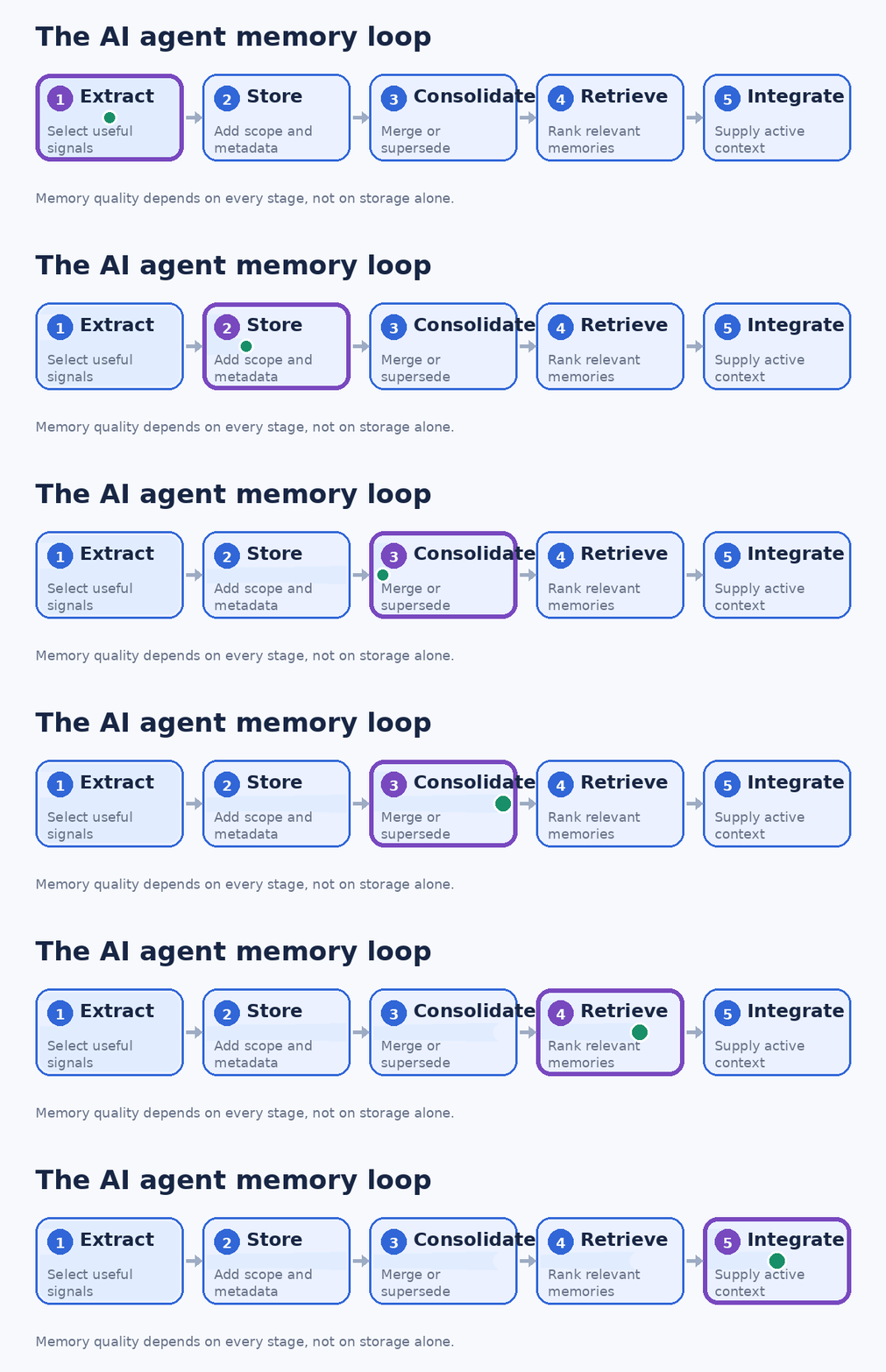
A useful memory system is a controlled pipeline rather than a transcript archive.
Extraction identifies information that may matter later, such as a confirmed preference, decision, correction, unresolved commitment, or task outcome. Storage writes that information with metadata such as scope, source, timestamp, confidence, sensitivity, and expiration.
Consolidation compares new information with existing records. It may merge duplicates, supersede an outdated fact, preserve a time-bounded history, or reject an uncertain claim. Retrieval then ranks candidate memories using semantic similarity, exact terms, metadata, recency, importance, graph relationships, or a combination of methods.
The selected memories are finally integrated into the model’s context or exposed through a tool. The retrieval budget should be limited; more context is not always better.
AI Agent Memory vs. RAG: What Is the Difference?
Retrieval-augmented generation, or RAG, retrieves external information to ground a response. A typical RAG system searches policies, documents, records, or another shared knowledge source.
Agent memory focuses on context accumulated through the agent’s interactions and work. It is often scoped to a user, project, team, or agent and needs rules for writing, updating, correction, and deletion.
Nuanced distinction: RAG is not inherently static or read-only. A RAG corpus can be updated continuously. The practical difference is that an agent memory system treats interaction-derived information as evolving state with ownership, temporal meaning, and lifecycle controls. Many capable systems use RAG for shared knowledge and memory for changing contextual knowledge.
What Should an AI Agent Remember?
A memory is worth storing when it is likely to change a future response or action. Useful candidates include explicit preferences, confirmed facts, important decisions, unresolved commitments, successful procedures, failed attempts, and user corrections.
Before writing a memory, evaluate future usefulness, confidence, sensitivity, recency, expected lifetime, user consent, and access scope. A casual comment should not automatically become a permanent profile attribute, and a preference mentioned once may deserve lower confidence than one repeatedly confirmed.
Good memory design also defines what not to retain. Raw credentials, unnecessary sensitive data, speculative inferences, and information with no future use should normally be excluded.
How AI Agent Memory Is Stored and Retrieved
Vector databases are useful for conceptually similar text. Relational databases are strong when records have clear fields, permissions, and transactional rules. Document stores fit flexible JSON profiles, while event logs preserve actions and outcomes in sequence.
Knowledge graphs represent entities and relationships. Temporal graphs add validity periods so a system can distinguish a current fact from a superseded one. Zep documents a temporal graph model that represents entities, relationships, episodes, and changing validity over time. [3]
Most production architectures benefit from hybrid retrieval: semantic search for meaning, keyword search for exact identifiers, metadata filters for scope, and reranking for final relevance. Database selection should follow the data model and failure risks rather than brand familiarity.
Popular AI Agent Memory Frameworks and Tools
Mem0 provides a dedicated memory layer that extracts, consolidates, and retrieves memories; its published research also evaluates a graph-enhanced variant. [5]
Zep focuses on temporal context graphs and changing relationships. Letta uses persistent, editable memory blocks and supports shared memory across agents. [3][4]
LangGraph supplies thread-level state and long-term stores for orchestrated agent workflows, while LangMem adds utilities for memory extraction, consolidation, search, and prompt improvement. [2]
A managed memory platform can shorten implementation time but may introduce vendor dependency. A custom database offers control, but the team must build write policies, conflict handling, access controls, deletion, evaluation, and observability.
| Option | Primary role | Best fit |
|---|---|---|
| Mem0 | Dedicated extraction, consolidation, and retrieval layer | Teams seeking a packaged memory service or open-source layer |
| Zep / Graphiti | Temporal knowledge graphs and evolving relationships | Tasks where facts change and relationship history matters |
| Letta | Persistent editable memory blocks and agent-managed state | Stateful agents that need explicit, inspectable memory |
| LangGraph / LangMem | Workflow state, long-term stores, and memory utilities | Developers already using LangChain-style orchestration |
| Custom database | Maximum schema and governance control | Teams able to build extraction, retrieval, lifecycle, and evaluation |
How to Design an AI Agent Memory Architecture
Begin with the decisions the memory must support, not with a preferred vector database.
Define the scope first: session, user, project, organization, or multi-agent network. Then define memory types, schemas, write rules, update behavior, retrieval ranking, retention, deletion, and audit requirements.
Store source, timestamp, confidence, and sensitivity metadata. Limit how much retrieved memory enters the prompt. For consequential uses, keep deterministic validation or human approval around sensitive memory writes and actions.
Theory vs. Implementation
Theoretical advice often recommends extracting important facts, embedding them, and retrieving the nearest matches. Actual implementations also require identity resolution, permission boundaries, contradiction handling, retention rules, observability, evaluation data, and recovery from incorrect writes.
Results vary with the extraction model, record age, query wording, embedding and reranking choices, scope filters, context budget, and how frequently the underlying facts change. Cost includes model calls for extraction and consolidation, storage, embedding generation, retrieval, monitoring, and ongoing maintenance.
Inference: For many applications, better write and retrieval policies create more value than replacing one capable database with another. A simple profile table can outperform a graph for stable preferences. A graph becomes worthwhile when relationships, history, and changing validity are central to the task.
Common AI Agent Memory Mistakes and Limitations
Treating full chat history as finished memory is a common mistake. Transcripts contain repetition, speculation, abandoned ideas, and sensitive information that may have no future value.
Other failure modes include memory bloat, stale facts, contradictory records, false extraction, irrelevant retrieval, over-personalization, memory poisoning, and persistent errors. Extraction, embedding, retrieval, and reranking also add latency and cost.
Forgetting is therefore a design feature. Some memories should expire, lose ranking weight, be superseded by newer evidence, or require reconfirmation.
Privacy, Security, and Governance Requirements
Agent memories can contain personal data, confidential business information, health details, financial context, or behavioral profiles. They should be treated as governed data objects, not informal prompt text.
Where the GDPR applies, data-subject rights can include access, rectification, and erasure, subject to the regulation’s conditions and exceptions. [6] California’s 2026 CCPA regulation package includes updated rules and phased obligations concerning risk assessments, cybersecurity audits, and some automated decision-making uses. [7]
A production design may need data minimization, encryption, tenant isolation, access control, retention schedules, user-visible correction and deletion, provenance, audit logs, and incident procedures. Legal requirements vary by jurisdiction and use case; qualified counsel should review regulated deployments.
How to Evaluate an AI Agent Memory System
Evaluation should measure whether memory improves the task, not merely whether the system retrieved something. Useful measures include extraction accuracy, retrieval precision and recall, stale-memory rate, contradiction rate, user correction rate, task completion, latency, token cost, and correct deletion and isolation.
Testing should compare the memory-enabled agent with a stateless or conversation-only baseline using the same model and task set. Letta’s evaluation guidance, for example, separates checking an agent’s response from verifying that corrected information was actually persisted in memory. [4]
Verified research example: The Mem0 project evaluated its architecture on the LoCoMo long-conversation benchmark and reported a 26% relative improvement over an OpenAI memory baseline on its LLM-as-judge measure, with lower latency and token use than a full-context method. [5]
Limitation: This is a framework-authored benchmark, not a universal performance guarantee. Results depend on the dataset, model, retrieval settings, question types, and evaluation method.
When Should You Add Memory to an AI Agent?
Add persistent memory when users return, tasks continue across sessions, preferences materially affect output, prior outcomes guide later choices, or multiple agents need controlled context sharing.
A stateless design may be simpler and safer when tasks are independent, users expect no retention, historical context adds little value, data is highly sensitive, or the team cannot maintain governance and evaluation.
The best memory system is not the one that stores the most information. It is the one that reliably preserves the smallest amount of information needed to improve future decisions.
Practical Next Steps for Building AI Agent Memory
Start with one narrow workflow. Define what the agent should remember, what it must never store, how long each record should last, who can access it, and how users can correct or delete it.
Build a small schema and test realistic conversations. Compare task performance with and without memory. Add vector search, graphs, automated consolidation, or agent-managed writes only when a simpler design no longer meets the requirement.
Deeper implementation topics deserve supporting cluster pages, particularly memory evaluation, privacy and retention, multi-agent access control, framework comparisons, and vector-database-versus-knowledge-graph decisions.
You May Also Like RAG Chunking Strategies
FAQs
What is AI agent memory?
AI agent memory is the external system that allows an AI agent to store, retrieve, update, and use information from previous interactions or tasks.
Why do AI agents need memory?
Memory helps an agent maintain continuity, remember useful preferences, and continue long-running work without requiring the user to repeat the same context.
How does AI agent memory work?
A memory system extracts useful information, stores it with metadata, updates or removes outdated records, and retrieves relevant memories when the agent needs them.
What is the main benefit of AI agent memory?
The main benefit is improved continuity across sessions, especially when previous decisions, preferences, actions, or outcomes affect the current task.
What is the main limitation of agent memory?
Stored information can become incorrect, outdated, irrelevant, or contradictory, so memory requires ongoing filtering, consolidation, and deletion.
Is a context window the same as AI agent memory?
No. A context window contains temporary information available during the current model call, while persistent memory can survive across sessions and must be retrieved when relevant.
Is AI agent memory the same as RAG?
Not exactly. RAG usually retrieves shared external knowledge, while agent memory commonly stores evolving user-specific, task-specific, or agent-specific information.
When is persistent memory most useful?
Persistent memory is most useful for recurring users, multi-session projects, customer support histories, personal assistants, coding agents, and workflows that depend on earlier decisions.
When should an AI agent remain stateless?
A stateless agent may be better for isolated tasks, highly sensitive interactions, anonymous use cases, or situations where historical context offers little practical value.
How much effort does agent memory require?
Implementation effort depends on the use case, but production systems usually need storage, retrieval logic, schemas, access controls, evaluation, monitoring, and deletion processes.
Which tools can support AI agent memory?
Frameworks such as Mem0, Zep, Letta, LangGraph, and LangMem can support memory workflows, but the best choice depends on data structure, framework compatibility, control requirements, and maintenance capacity.
What is the long-term impact of adding memory?
A well-managed memory system can make an agent more consistent and useful over time, but poorly governed memory can accumulate errors, increase costs, and reduce user trust.
References
- Cognitive Architectures for Language Agents (CoALA)
- LangChain documentation: Memory overview and long-term memory
- Zep documentation: Temporal knowledge graph overview
- Letta documentation: Shared and persistent memory
- Mem0: Building Production-Ready AI Agents with Scalable Long-Term Memory
- General Data Protection Regulation, Regulation (EU) 2016/679
- California Privacy Protection Agency: 2026 CCPA regulation package