
RAG Chunking Strategies: How to Choose and Test the Right Approach
RAG chunking strategies determine how documents are divided before they are embedded, indexed, and retrieved. The right approach keeps each chunk focused enough to match a query while preserving enough context for the…
RAG Chunking Strategies: How to Choose and Test the Right Approach
RAG chunking strategies determine how documents are divided before they are embedded, indexed, and retrieved. The right approach keeps each chunk focused enough to match a query while preserving enough context for the language model to answer accurately.
There is no universally best method. Recursive or structure-aware chunking is usually the safest baseline; hierarchical, contextual, semantic, agentic, and late chunking should be introduced when a measured retrieval problem justifies their additional cost and maintenance.
What Are RAG Chunking Strategies?
Retrieval-augmented generation, or RAG, retrieves information from an external knowledge base and supplies it to a language model as context. Chunking is the preprocessing step that converts a long source into smaller retrievable units.
Verified fact: Each unit is normally embedded and stored in a vector index. At query time, a retriever selects candidate chunks, optionally filters or reranks them, and sends the chosen evidence to the model. IBM describes strategy, size, and overlap as core chunking decisions and recommends experimentation rather than a single fixed setting.[1]
Why Chunking Has Such a Large Impact on Retrieval Accuracy
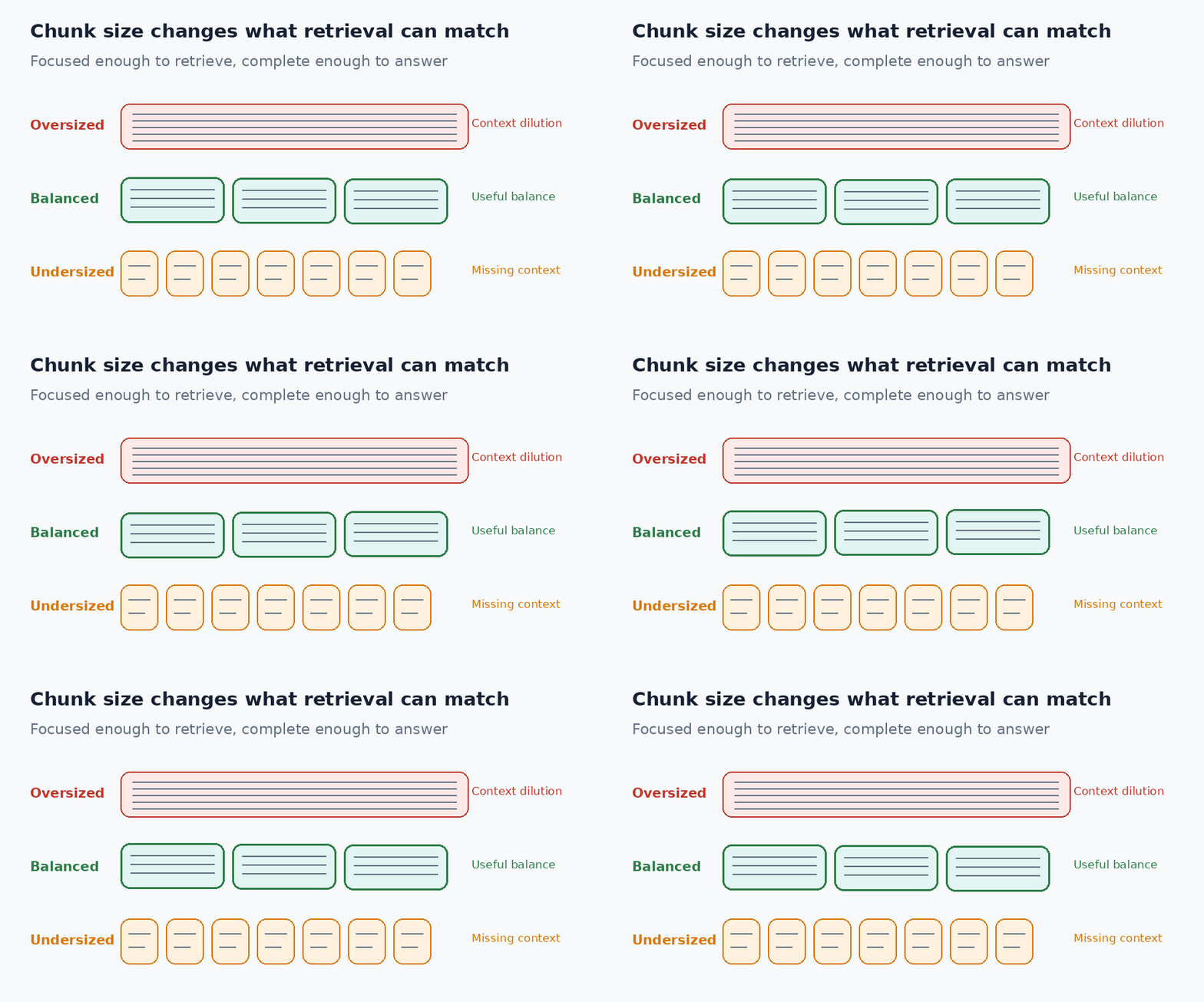
Embedding models compress the meaning of a chunk into a vector. If a chunk contains several unrelated topics, the passage that matters can be diluted by surrounding material. If it is too narrow, it may omit the heading, entity, definition, or earlier sentence needed to interpret it.
Hypothetical example: a retrieved sentence says, “Revenue increased by 3%.” Without the company name, reporting period, or section heading, the statement may match a broad query but fail to answer a specific one. The chunk is relevant at sentence level yet incomplete at decision level.
Chunking therefore balances retrieval precision against context completeness. Smaller units can improve matching, while larger units preserve relationships. A useful pipeline separates these concerns instead of assuming one chunk size must solve both.
How Chunk Size, Overlap, and Boundaries Affect RAG Results
Chunk size is the maximum length of a chunk, usually measured in tokens when model limits matter. Chunk overlap repeats material across adjacent chunks. Boundaries determine where splitting occurs, such as at a paragraph, heading, page, table, code function, legal clause, or semantic topic shift.
Overlap can protect information near a boundary, but it also increases vector count, storage, indexing time, and duplicate retrieval. It should be treated as a test variable, not a default tax that every corpus must pay.
Inference: A practical starting experiment compares 256-, 512-, and 1,024-token chunks with zero overlap and approximately 10% overlap. These are hypotheses, not universal recommendations. The best setting depends on document structure, embedding model, query type, and how much evidence an answer requires.
How the Main RAG Chunking Strategies Compare
| Strategy | How it works | Best suited to | Main limitation |
|---|---|---|---|
| Fixed-size | Splits at a character or token limit | Prototypes and uniform text | Can break natural structures |
| Recursive | Uses ordered natural separators | General prose and documentation | Does not understand meaning |
| Structure-aware | Uses headings, pages, tables, or syntax | PDFs, Markdown, HTML, code | Depends on parsing quality |
| Semantic | Splits where sentence meaning changes | Dense unstructured prose | Extra embeddings and tuning |
| Parent-child | Matches small children, returns larger parents | Long manuals, policies, contracts | More mapping and retrieval logic |
| Contextual retrieval | Adds document-specific context to chunks | Ambiguous passages and entities | Preprocessing cost |
| LLM-based or agentic | Uses a model to select boundaries | Irregular complex documents | Cost and lower determinism |
| Late chunking | Encodes long context before chunk pooling | Context-dependent passages | Requires compatible embeddings |
Recursive Chunking: The Best Baseline for Most RAG Systems
Verified fact: Recursive chunking tries larger natural separators before smaller ones. LangChain’s standard order uses paragraph breaks, line breaks, spaces, and individual characters, with the goal of keeping related text together until a chunk fits. LangChain recommends RecursiveCharacterTextSplitter as the starting point for most generic text use cases.[2]
It works well for articles, emails, reports, and ordinary documentation because it is inexpensive, deterministic, and easy to debug. Its limitation is that formatting is not the same as meaning: one paragraph can contain several topics, and one idea can span several paragraphs.
Structure-Aware Chunking for PDFs, Tables, Code, and Documentation
Structured documents should be parsed before they are split. Useful boundaries include Markdown or HTML headings, PDF sections, tables and captions, code classes and functions, legal clauses, and question-answer pairs.
Verified fact: Docling’s native chunkers operate on a structured document representation. Its hierarchical chunker attaches relevant headers and captions, while its hybrid chunker adds tokenizer-aware splitting and can repeat table headers when a table spans several chunks.[3] This illustrates an important rule: a badly extracted table cannot be repaired by adjusting chunk size.
For multimodal RAG and AI agents, structure and provenance matter beyond retrieval accuracy. Page numbers, captions, source IDs, document versions, and permission metadata help an assistant cite evidence, enforce access rules, and recover the correct parent content.
Semantic Chunking: When Meaning-Based Splits Are Worth the Cost
Semantic chunking divides text into sentences or sentence groups, embeds them, and looks for sharp changes in similarity. It can help with academic papers, transcripts, meeting notes, and dense prose that lacks reliable headings.
The trade-off is additional ingestion work. Every sentence or group may need an embedding, thresholds require tuning, and chunk sizes can become highly variable. Semantic chunking is most defensible when a recursive baseline has exposed repeated topic-boundary failures and the expected retrieval gain is worth the added processing.
Hierarchical Parent-Child Chunking for Long and Complex Documents
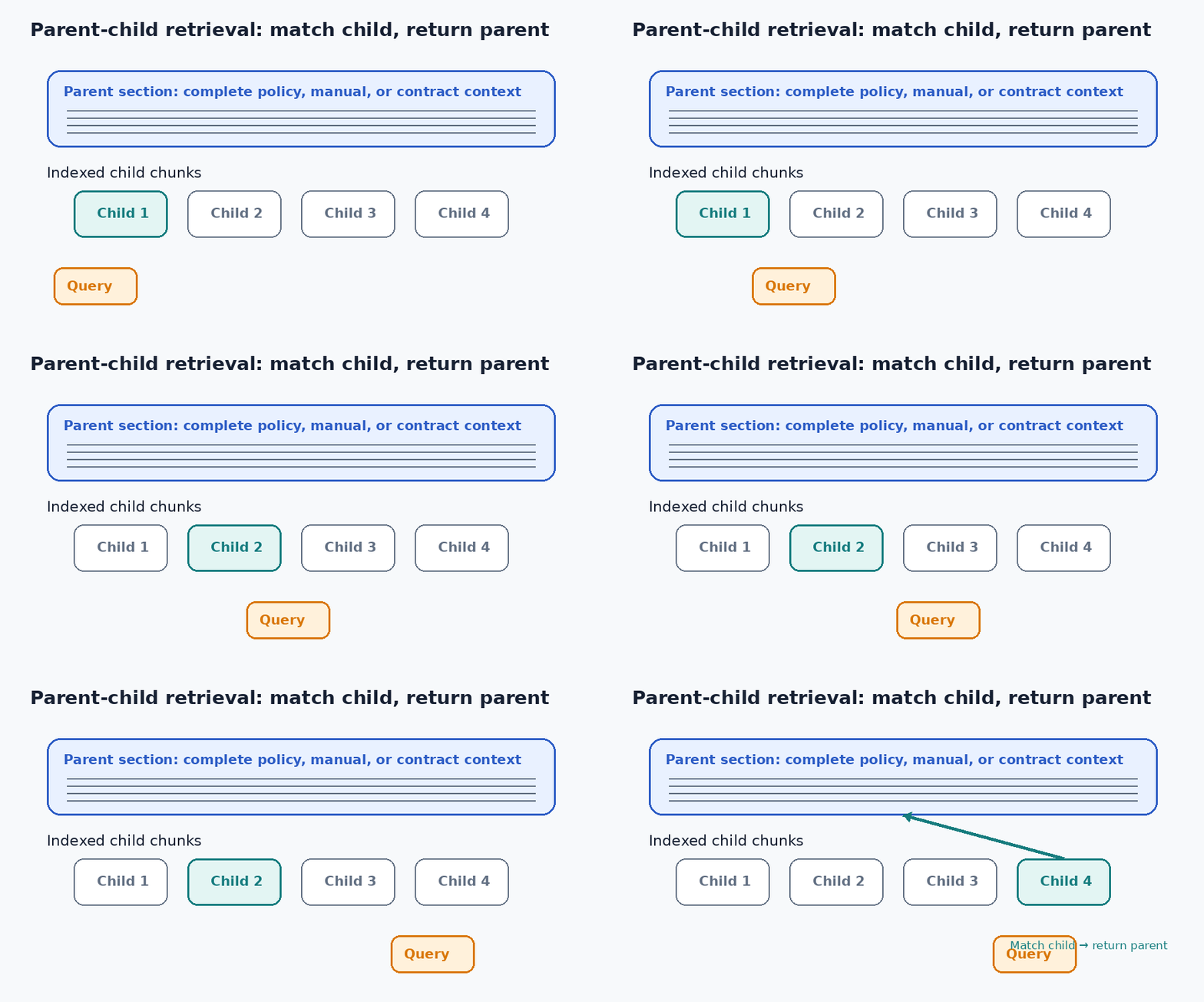
Parent-child chunking creates at least two levels. Small child chunks are embedded and searched; larger parent sections are returned to the model. This can combine precise matching with the broader context needed for generation.
Hypothetical example: a 250-token child chunk matches a query about an exception in a policy manual, while its 1,500-token parent supplies the definitions, scope, and neighboring conditions needed to interpret that exception.
The index must preserve reliable document, parent, child, section, and version identifiers. Parent expansion is not automatically better: when the child already contains a complete answer, returning the parent may add prompt noise and token cost.
How Contextual Retrieval and Metadata Enrichment Improve Chunks
Contextual retrieval adds a short description explaining where a chunk belongs before its embedding and lexical-search representation are created. The added context might identify the document, organization, reporting period, section, or subject of an otherwise ambiguous passage.
Verified fact: in Anthropic’s published experiments, contextual embeddings reduced the top-20 retrieval failure rate from 5.7% to 3.7%. Combining contextual embeddings with contextual BM25 reduced it to 2.9%. These results apply to Anthropic’s tested datasets and configuration, not every RAG system.[4]
Metadata solves a related but different problem. Fields such as title, source, page, section path, date, tenant, access level, and version support filtering, citations, freshness controls, governance, and parent reconstruction. Store metadata structurally; include only the identifiers that improve semantic interpretation in the text sent for embedding.
Theory Versus Implementation
Theoretical advice recommends coherent chunks, modest overlap, intact tables, rich metadata, and systematic evaluation. Implementation is constrained by inconsistent source formatting, poor PDF extraction, limited relevance labels, re-indexing cost, latency budgets, security requirements, and changing corpora.
Verified fact: Results also vary by task. A 2026 research preprint that reproduced and compared several chunking families found that simple structure-based methods outperformed LLM-guided alternatives for in-corpus retrieval, while an LLM-guided approach performed best in a different in-document retrieval setting. The study concluded that optimal chunking is task-dependent.[6]
Nuanced conclusion: a more sophisticated chunker is not necessarily a better production system. Clean parsing, a recursive baseline, useful metadata, hybrid retrieval, and reranking may outperform an expensive semantic or agentic splitter that has not been tuned to the corpus.
Advanced methods also raise maintenance requirements. Context-generating prompts can change, parent mappings can become stale, semantic thresholds may drift with the corpus, and model or tokenizer upgrades can force re-indexing.
Common RAG Chunking Mistakes and Hidden Trade-Offs
The most damaging mistakes are usually architectural rather than numerical:
- Choosing chunk size before studying representative queries.
- Applying one splitter to every document type.
- Breaking tables, code blocks, clauses, or question-answer pairs.
- Adding overlap without measuring duplicate retrieval.
- Dropping headings, source identifiers, permissions, or version metadata.
- Evaluating only generated answers instead of retrieval quality.
- Changing chunking, embeddings, top-k, and reranking at the same time.
A chunking experiment should isolate one major variable at a time wherever possible. Otherwise, an improvement cannot be attributed to the splitter rather than the embedding model, retriever, reranker, or prompt.
How to Test Chunking Strategies with Retrieval and Answer Metrics
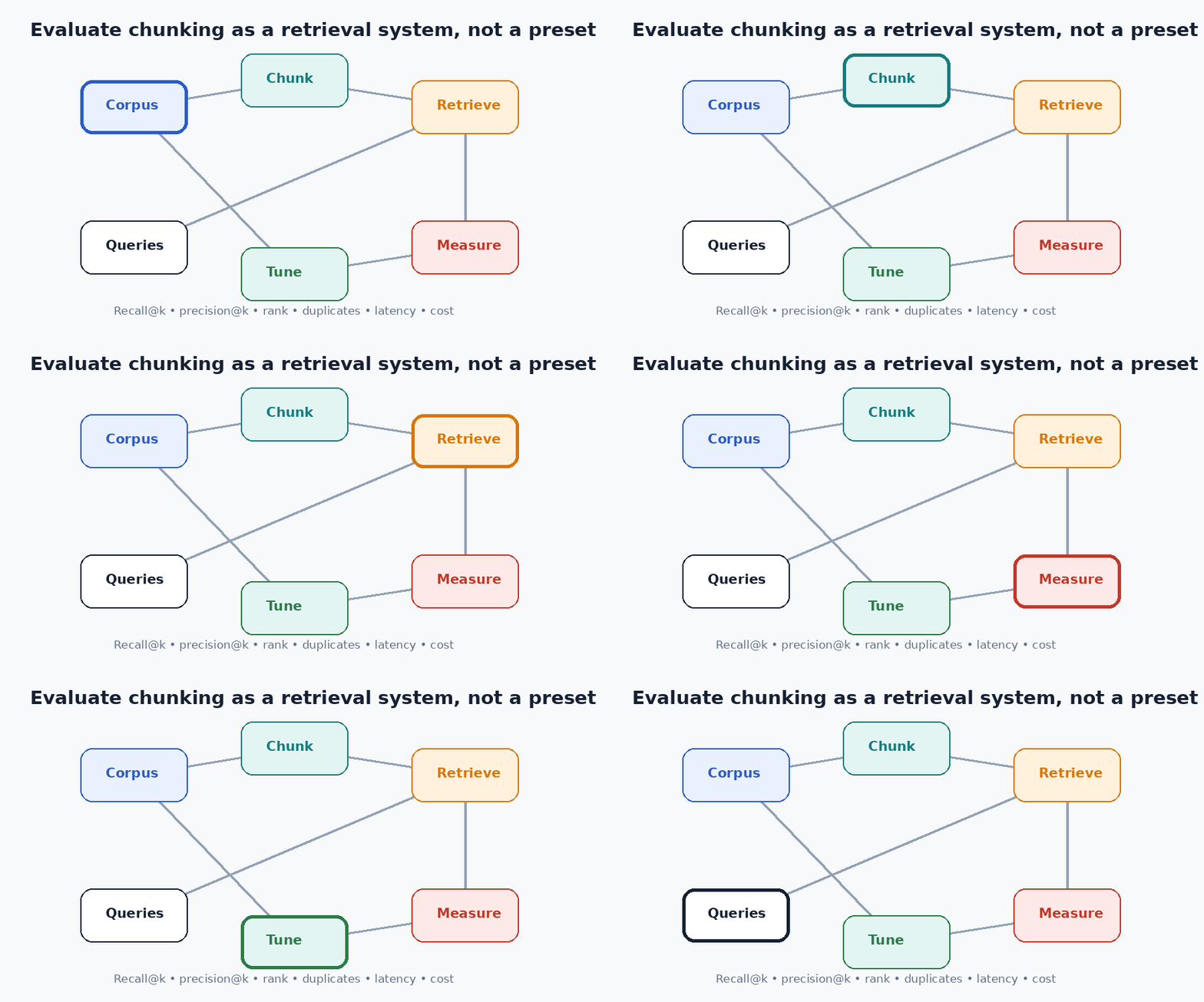
Build an evaluation set from representative questions and identify the source passages needed to answer each one. Measure retrieval before generation so that retrieval failures are not confused with model or prompt failures.
- Recall@k: whether a relevant chunk appears in the first k results.
- Precision@k: how many of the retrieved chunks are relevant.
- Mean reciprocal rank: how high the first relevant result appears.
- Duplicate rate: how often overlap returns repeated evidence.
- Latency and cost: the operational impact of each configuration.
- Faithfulness and answer completeness: whether generation uses the evidence correctly.
Verified fact: Ragas documents context precision, context recall, and faithfulness metrics that can support this workflow, but automated scores should be paired with direct retrieval labels and human review.[7] Better retrieval scores do not always produce better answers because context assembly, conflicting sources, and model behavior still matter.
A Practical LangChain Implementation Workflow
A maintainable workflow separates ingestion, parsing, splitting, metadata, embedding, indexing, retrieval, reranking, and evaluation. This makes it possible to replace one component without rebuilding the entire application.
Begin with RecursiveCharacterTextSplitter using a token-aware length function. Preserve document and section metadata. Index the chunks in a vector store such as Chroma, Qdrant, Pinecone, Weaviate, Elasticsearch, or pgvector. Then test retrieval with a fixed query set before adding semantic chunking, parent expansion, contextual descriptions, or an LLM-based splitter.
Recommended Starting Configurations by Document Type
| Document type | Starting strategy | Initial test configuration |
|---|---|---|
| Articles and general prose | Recursive | 400–600 tokens; test 0% and 10% overlap |
| Markdown and API documentation | Header-aware, then recursive | Preserve heading path; split oversized sections |
| PDFs with tables | Layout-aware parser | Keep headers, captions, tables, and page metadata |
| Legal contracts | Clause-aware parent-child | 200–400-token children with section parents |
| Academic papers | Section-aware recursive | Preserve abstract, methods, results, and citations |
| Codebases | Syntax-aware | Functions or classes as primary units |
| Transcripts | Speaker- and sentence-aware | Preserve speaker, timestamp, and conversation turns |
| Unstructured long-form text | Recursive baseline, then semantic test | Compare meaning-based boundaries against baseline |
Which RAG Chunking Strategy Should You Use?
Start with the simplest method that respects the structure of your documents. Use recursive chunking for ordinary prose, structure-aware parsing for PDFs, tables, Markdown, HTML, and code, and parent-child retrieval when small matching passages need larger explanatory sections.
Verified fact: Test contextual retrieval when chunks repeatedly lose document or entity identity. Consider semantic, LLM-based, agentic, or late chunking only when evaluation shows that a simpler approach is failing in a way the advanced method can address. Late chunking, for example, creates contextual chunk embeddings by encoding a longer text before pooling chunk representations, but it requires a compatible long-context embedding model.[5]
The actionable next step is not to select one “best” chunk size. Build two or three controlled configurations, run them against representative questions, inspect the retrieved evidence, and choose the least complex design that meets the required accuracy, latency, cost, governance, and maintenance targets.
You May Also Like RAG Evaluation Metrics
FAQs
What are RAG chunking strategies?
RAG chunking strategies are methods for dividing documents into smaller units before embedding, indexing, and retrieval. The goal is to preserve enough context for accurate answers without making each chunk too broad to match a query precisely.
Why does chunking matter in a RAG system?
Chunking determines what information the retriever can find and what context the language model receives. Poor boundaries can separate related facts, mix unrelated topics, or return passages that are difficult to interpret.
How does recursive chunking work?
Recursive chunking tries to split text at natural boundaries such as sections, paragraphs, sentences, and words before using smaller separators. It is a practical baseline because it is inexpensive, predictable, and suitable for many forms of general text.
What is the main benefit of structure-aware chunking?
Structure-aware chunking preserves meaningful document elements such as headings, tables, lists, legal clauses, and code functions. It is most effective when the document parser can reliably identify those elements.
When should semantic chunking be used?
Semantic chunking is useful for dense or unstructured text where topic changes do not align with headings or paragraph breaks. It should normally be tested against a simpler baseline because it adds embedding cost, processing time, and threshold-tuning work.
What is parent-child chunking?
Parent-child chunking indexes small child passages for precise matching but returns a larger parent section to the language model. It works well for contracts, manuals, and policies where a relevant sentence depends on definitions, exceptions, or surrounding instructions.
Does chunk overlap always improve retrieval?
No. Overlap can preserve information near chunk boundaries, but it can also increase storage, indexing cost, and duplicate retrieval. The appropriate amount should be measured with representative queries rather than selected as a universal percentage.
What is a good starting chunk size for RAG?
A practical test is to compare several sizes, such as 256, 512, and 1,024 tokens, using the same corpus and query set. The best size depends on document structure, embedding behavior, query complexity, and how much context the final answer requires.
When is advanced chunking a poor choice?
Semantic, agentic, or LLM-based chunking may be unnecessary when documents already have clear sections and a recursive or structure-aware splitter performs well. Added complexity is difficult to justify when it does not produce measurable retrieval or answer-quality improvements.
Which tools support RAG chunking?
LangChain provides recursive, token, Markdown, HTML, and semantic splitters, while LlamaIndex supports sentence, semantic, and hierarchical node parsing. Tools such as Docling and Unstructured can improve results by extracting document layout before chunking begins.
What is required to evaluate a chunking strategy?
Evaluation requires representative user questions, known relevant passages, and consistent retrieval settings. Useful measurements include recall at k, precision at k, ranking position, duplicate retrieval, latency, storage, and final-answer faithfulness.
What is the long-term impact of a chunking decision?
Chunking affects re-indexing cost, storage growth, retrieval latency, source traceability, and maintenance effort as the knowledge base changes. A simpler strategy that is easy to monitor and regenerate may be more sustainable than a complex method with a small initial accuracy advantage.
References
- IBM, “Implement RAG chunking strategies with LangChain and watsonx.ai,” https://www.ibm.com/think/tutorials/chunking-strategies-for-rag-with-langchain-watsonx-ai
- LangChain, “Splitting recursively,” https://docs.langchain.com/oss/python/integrations/splitters/recursive_text_splitter
- Docling, “Chunking,” https://docling-project.github.io/docling/concepts/chunking/
- Anthropic, “Contextual Retrieval in AI Systems,” https://www.anthropic.com/engineering/contextual-retrieval
- Günther et al., “Late Chunking: Contextual Chunk Embeddings Using Long-Context Embedding Models,” https://arxiv.org/abs/2409.04701
- Zhou et al., “Beyond Chunk-Then-Embed: A Comprehensive Taxonomy and Evaluation of Document Chunking Strategies,” https://arxiv.org/abs/2602.16974
- Ragas documentation, retrieval and faithfulness metrics, https://docs.ragas.io/en/stable/concepts/metrics/available_metrics/context_precision/