
AI APA Results Generator: Statistics and Citations
An AI APA Results Generator can turn statistical output into APA-formatted results or create accurate-looking citations and references. This guide explains how these tools work, what they can automate, and which statistical values, source details, privacy issues, and academic requirements researchers must verify before submission.
AI APA Results Generator: How to Create Statistical Results and Citations
An AI APA Results Generator can do one of two jobs: turn verified statistical output into an APA-style Results section, or create APA 7 in-text citations and reference entries. These tasks are related to academic writing, but they use different inputs, solve different problems, and carry different risks.
For statistical reporting, the safest use is to let AI format results that have already been calculated and checked. For referencing, the safest use is to let a citation tool arrange verified source metadata. In both cases, generation should be followed by human verification rather than treated as a substitute for research judgment.
What Is an AI APA Results Generator?
A simple definition
An AI APA Results Generator is a software tool that automates part of research reporting. A statistical version converts values such as means, standard deviations, test statistics, degrees of freedom, p values, confidence intervals, and effect sizes into structured academic prose or tables. A citation version converts bibliographic details into author–date citations and reference-list entries.
Why the term refers to two different tools
In a thesis or journal article, “results” normally means findings produced by data analysis. In a search interface, however, users may also call the references returned by a citation generator its results. That ambiguity explains why the same query can surface statistical-writing tools, citation platforms, or general-purpose generative models.
The distinction should be made immediately: an APA results section generator reports what a study found, whereas an APA citation generator identifies and formats the sources used to support the paper.
Which type do you need?
Choose a statistical results writer when your analysis is complete and you need an APA 7 paragraph, table, or Chapter 4 draft. Choose a citation and reference generator when you need to cite a webpage, book, journal article, report, video, thesis, dataset, or AI system. Use both only when your project genuinely requires both workflows.
How an AI APA Results Generator Converts Statistical Output
Uploading SPSS, R, Stata, Excel, or copied output
A statistical reporting tool may accept raw CSV or XLSX data, copied test output, a formatted table, or an exported document. IBM SPSS Statistics can export output to formats including Word, Excel, HTML, PDF, PowerPoint, and text, although the exact export choices and table behavior depend on the SPSS version and output mode. [4]
Native output files, screenshots, and PDFs are not equally reliable inputs. A clean table or verified set of values is usually easier to audit than a cropped screenshot. Screenshots can hide footnotes or group labels, and image-based extraction can misread minus signs, decimal points, Greek symbols, or superscripts.
Identifying the design, variables, and test
The numbers alone rarely provide enough context. A useful prompt should identify the research question, dependent variable, predictors or groups, sample size, test used, reference category, significance level, and any assumption checks. Without those details, the model may attach the correct value to the wrong group or describe a correlational result as if it established causation.
Converting values into APA 7 prose
The generator maps the supplied values to a reporting pattern. For a t test, that pattern may include group means and standard deviations, the t statistic, degrees of freedom, p value, confidence interval, and Cohen’s d. For regression, it may include model fit, R2, coefficients, standard errors, confidence intervals, and significance tests.
APA’s statistics guidance uses italics for letters used as statistical symbols, and its quantitative reporting standards encourage authors to report effect sizes and confidence intervals or significance levels where appropriate. [1] [2] Formatting these elements correctly improves readability, but it does not validate the analysis.
Generating tables, notes, and export-ready text
An APA table generator can create a first draft with a table number, title, column headings, body, and notes. APA provides sample tables for common designs, including regression displays with confidence intervals. [3] The table still needs review for decimal alignment, abbreviations, duplicated information, unnecessary borders, and consistency with the prose.
Word export is also a practical consideration. SPSS itself provides options for handling pivot-table layers, footnotes, captions, and wide tables during DOCX or RTF export, which shows why document conversion is not a trivial final step. [5]
What Statistical Tests Can the Generator Report?
The exact coverage depends on the tool. A simple formatter may handle almost any test when the user supplies the required values, while an analysis platform must implement the actual statistical procedure and its assumptions.
| Analysis | Typical reported elements | Main verification issue |
|---|---|---|
| Descriptive statistics | Sample size, mean, median, standard deviation, range, frequency, percentage | Whether the summary fits the scale and distribution |
| Independent or paired t test | Group or occasion statistics, t, degrees of freedom, p, confidence interval, effect size | Whether the design and variance assumption were identified correctly |
| ANOVA and repeated-measures ANOVA | F, degrees of freedom, p, effect size, post hoc comparisons | Interactions, corrections, and multiple-comparison procedures |
| Correlation | Correlation type, direction, coefficient, p, confidence interval | Pearson versus Spearman and non-causal interpretation |
| Linear or multiple regression | Model test, R², adjusted R², coefficients, standard errors, confidence intervals | Coding, reference groups, assumptions, and model specification |
| Chi-square | χ², degrees of freedom, p, effect size | Expected counts and the structure of the contingency table |
| Nonparametric tests | Test statistic, sample information, p, effect estimate where appropriate | Correct design and interpretation of ranks or distributions |
| Mediation, moderation, and advanced models | Direct, indirect, interaction, fit, or variance estimates | Estimator choices, model identification, and specialist interpretation |
Advanced analyses are where a polished automated narrative is most likely to create false confidence. A generator may organize coefficients correctly while missing a poor model specification, an invalid reference category, or a failed assumption. In those cases, methodological review matters more than wording.
How to Generate an APA Results Section Safely
Prepare and verify the statistical output
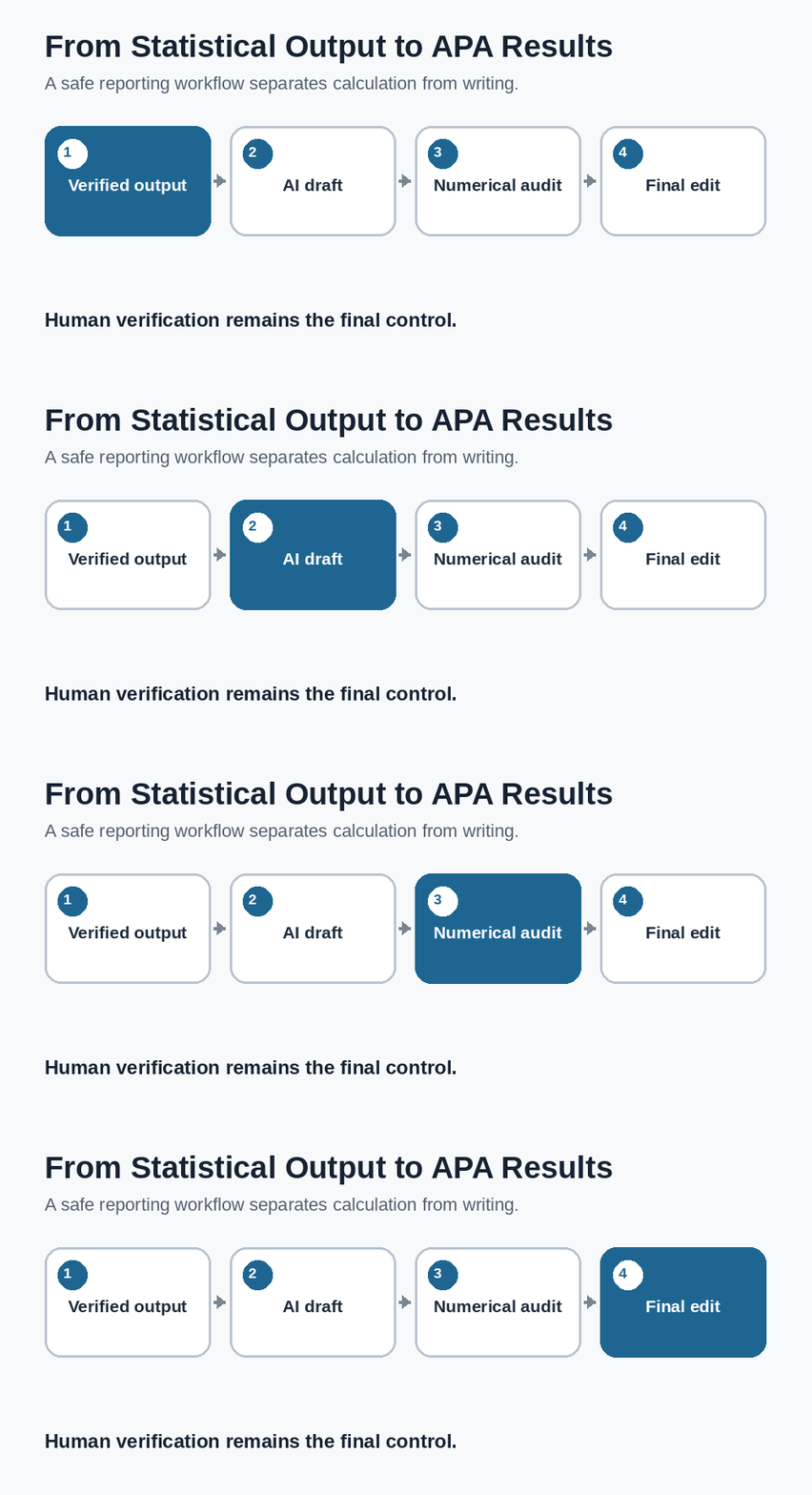
Begin with the original output and analysis syntax. Confirm the sample size, exclusions, variable coding, missing-data treatment, group labels, model settings, and the exact table that answers the research question. If the underlying analysis is unclear, generating prose should wait.
State the research question and hypothesis
Tell the system what was tested in ordinary language. For example: “The analysis examined whether mean assessment scores differed between students receiving Method A and Method B.” This prevents the generator from reporting every value in the output or attaching the result to the wrong hypothesis.
Supply complete values and definitions
Provide the descriptive statistics, test statistic, degrees of freedom, exact p value, effect size, confidence interval, and post hoc results when relevant. Replace codes such as grp1 or dv_total with clear labels, or define them before asking for a paragraph.
Constrain the first draft
A useful instruction is: “Using only the values provided, draft an APA 7 Results paragraph. Do not calculate missing statistics, invent values, explain causes, or add literature. Mark any missing information.” This does not guarantee accuracy, but it reduces the opportunity for unsupported additions.
Run a four-layer check
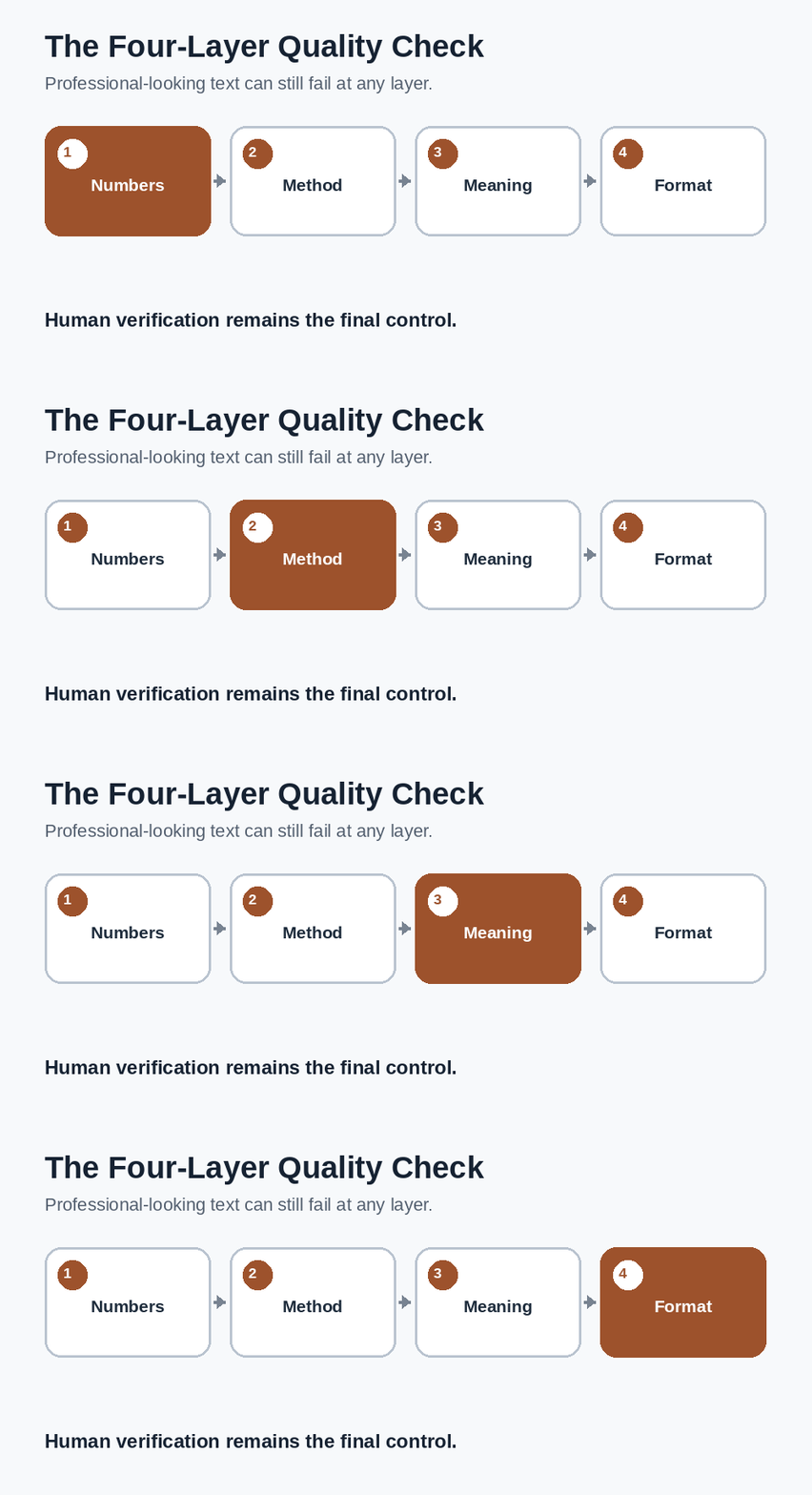
First check the numbers. Then check the method, including the test and assumptions. Next check the meaning of the conclusion. Finally check APA formatting. Reversing that order is a common mistake because polished notation can distract attention from a wrong analysis.
Edit for the institution or journal
APA Style is a general framework, not the only authority governing a submission. A university template, dissertation handbook, supervisor instruction, reporting guideline, or journal author guide may require different headings, table placement, supplementary files, or disclosure language.
Examples of APA-Formatted Statistical Results
The following examples use hypothetical values and demonstrate reporting structure only. They should not be copied as evidence or presented as real findings.
Descriptive statistics
Participants in the intervention group achieved a mean assessment score of 78.40 (SD = 8.10), whereas participants in the comparison group achieved a mean score of 73.20 (SD = 7.50). This sentence describes the observed groups but does not establish that the difference is statistically significant.
Independent-samples t test
An independent-samples t test indicated that assessment scores were higher in the intervention group (M = 78.40, SD = 8.10) than in the comparison group (M = 73.20, SD = 7.50), t(58) = 2.58, p = .012, Cohen’s d = 0.67, 95% CI for the mean difference [1.17, 9.23].
A weak generator may simplify p = .012 to p < .05, omit the effect size, or reverse the group direction. Each change loses information or changes the meaning.
One-way ANOVA
A one-way ANOVA showed that mean scores differed across the three teaching conditions, F(2, 87) = 6.42, p = .003, ηp2 = .13. Tukey-adjusted comparisons indicated that Condition A produced higher scores than Condition C, p = .002; the remaining comparisons were not statistically significant.
The post hoc method and comparison statements must match the analysis. Reporting an omnibus result without the planned or adjusted follow-up comparisons may leave the research question unanswered.
Correlation and regression
A correlation result might read: “Study time was positively correlated with assessment performance, r(98) = .42, p < .001, 95% CI [.25, .56].” The sentence reports an association; it does not claim that additional study time caused the performance difference.
A regression result might read: “The model explained 21% of the variance in assessment performance, R2 = .21, F(3, 96) = 8.51, p < .001. Study time was a positive predictor of performance, β = .38, p < .001.” The researcher would still need to check coefficient type, coding, confidence intervals, diagnostics, and whether the model supports the language used.
What p values, confidence intervals, and effect sizes contribute
A p value does not measure the size, importance, or probability that a hypothesis is true. An effect size describes magnitude, while a confidence interval communicates the precision and plausible range of an estimate. APA’s quantitative reporting standards treat these elements as complementary rather than interchangeable. [2]
How an AI APA Citation Generator Works
Searching by DOI, ISBN, title, author, or URL
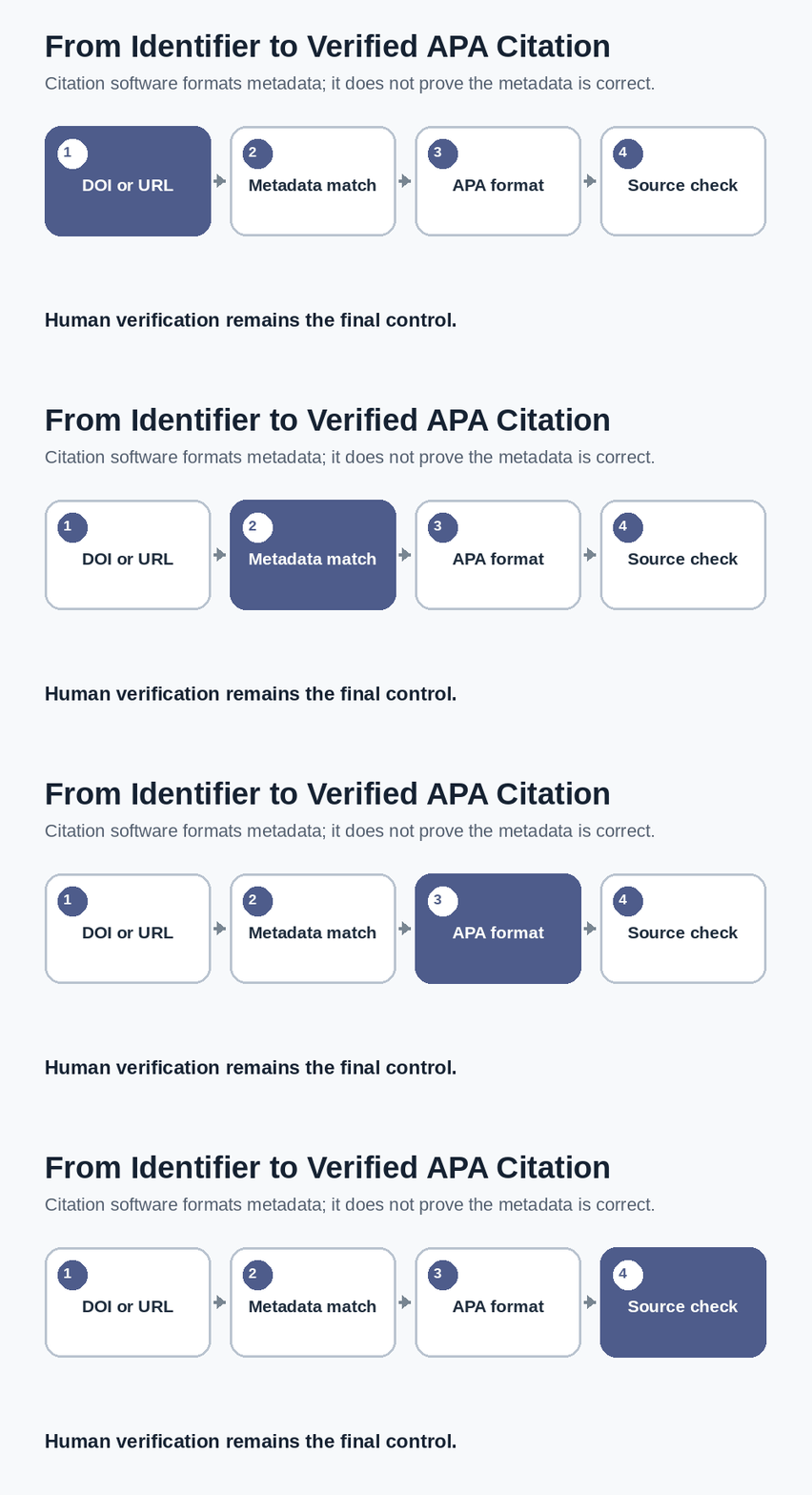
A citation generator accepts an identifier or a description, searches a metadata source, and proposes a matching record. A DOI often narrows the match more effectively than a general title search, but users still need to confirm that the record is the exact version they consulted.
Turning metadata into an APA reference
The system arranges author, date, title, and source information according to the selected source type. Crossref explains that bibliographic metadata supports citation display, DOI matching, and discovery, and that accurate contributors, titles, dates, identifiers, page numbers, and article identifiers are essential. [8]
This creates a useful contrarian insight: a citation generator can format bad metadata perfectly. Correct punctuation does not prove that the cited article, year, author order, or DOI is correct.
Generating narrative and parenthetical citations
APA uses an author–date system. A parenthetical citation places the author and date in parentheses, such as (Smith, 2025). A narrative citation incorporates the author into the sentence, such as Smith (2025). [10]
Exporting to Word or a reference manager
Export reduces retyping but does not remove the need to check capitalization, italics, source type, page or article numbers, and DOI accuracy. A reference manager is most useful when the library itself has been cleaned and maintained.
APA In-Text Citation Rules in Brief
| Source type | Parenthetical form | Narrative form |
|---|---|---|
| One author | (Smith, 2025) | Smith (2025) |
| Two authors | (Smith & Jones, 2025) | Smith and Jones (2025) |
| Three or more authors | (Smith et al., 2025) | Smith et al. (2025) |
| Organization | (American Psychological Association, 2025) | American Psychological Association (2025) |
| Direct quotation | (Smith, 2025, p. 17) | Smith (2025, p. 17) |
| No date | (Smith, n.d.) | Smith (n.d.) |
When an author is missing, the title moves into the author position. When no date can be found, “n.d.” is used. APA provides different adjustments for combinations of missing author, date, title, and source information, so users should check the applicable pattern rather than applying one generic fallback. [9]
APA Reference Examples and Reference-Page Formatting
Common source templates
| Source | APA 7 structural template |
|---|---|
| Webpage | Author, A. A. (Year, Month Day). Title of webpage. Website Name. URL |
| Journal article | Author, A. A., & Author, B. B. (Year). Title of article. Journal Title, volume(issue), pages or article number. DOI |
| Book | Author, A. A. (Year). Title of book. Publisher. |
| Edited-book chapter | Author, A. A. (Year). Title of chapter. In E. E. Editor (Ed.), Title of book (pp. xx–xx). Publisher. DOI or URL |
| YouTube video | Channel Name. (Year, Month Day). Title of video [Video]. YouTube. URL |
| Report | Organization Name. (Year). Title of report (Report No., if available). Publisher. URL |
| Thesis or dissertation | Author, A. A. (Year). Title [Doctoral dissertation or Master’s thesis, Institution]. Database or Repository. URL |
These are templates rather than substitutes for source-specific guidance. A journal article with an article number, a translated book, a chapter with a DOI, and a government report with the same author and publisher may require different details.
Formatting the reference page
The reference list appears after the main text and uses the centered, bold heading “References.” Entries are alphabetized, double-spaced, and formatted with a 0.5-inch hanging indent. [11] Only works cited in the paper normally belong in the list, while non-recoverable personal communications are handled in text rather than as standard reference entries.
Citing generative AI
APA published updated guidance in 2025 on references for generative AI systems and on determining whether AI use is allowed. The correct treatment depends on whether the output is retrievable, how the system was used, and the requirements of the institution, course, journal, or publisher. [6] [7]
A citation generator should therefore not apply one old “ChatGPT reference” template to every AI-assisted task. Using an AI system as a source of generated content, as a search interface, or as a feature integrated into another application may require different documentation.
AI APA Results Generator vs. Citation Generator
| Feature | Statistical results generator | Citation generator |
|---|---|---|
| Primary purpose | Writes or formats statistical findings | Formats in-text citations and references |
| Typical input | SPSS, R, Stata, Excel, CSV, output tables, or test values | DOI, URL, ISBN, title, author, or publication details |
| Typical output | Results paragraphs, tables, figure notes, or Chapter 4 drafts | Parenthetical citations, narrative citations, and reference entries |
| Best use | Reporting an analysis that has already been verified | Formatting a source that has already been identified |
| Main risk | Incorrect test, value, assumption, or interpretation | Incorrect, incomplete, or mismatched metadata |
| Essential check | Compare every statement with original output and syntax | Compare every field with the original publication |
The key decision is not whether AI is involved. It is whether the system is formatting known information or making new analytical decisions. Formatting is usually easier to audit. Test selection, data cleaning, model specification, and interpretation require much more judgment.
What the Generator Can and Cannot Do
Tasks it can automate reasonably well
With complete, verified input, an AI statistical results writer can standardize wording, organize values, draft common test reports, create preliminary tables, and identify missing reporting elements. A citation generator can reduce punctuation and ordering errors when the source metadata is accurate.
Tasks that still require researcher judgment
The researcher remains responsible for research design, data quality, variable coding, exclusions, test suitability, assumptions, model interpretation, source relevance, data privacy, and the accuracy of the final document. A fluent paragraph cannot determine whether the study design answers the research question.
Why statistical significance is not practical significance
Large samples can make small effects statistically significant, while small samples can leave important effects uncertain. The decision should consider effect size, confidence interval, measurement quality, design, and disciplinary context rather than treating a threshold as the entire result.
Why missing results must remain missing
If an effect size, confidence interval, or degrees of freedom is absent, the tool should flag the omission. It should not reconstruct a plausible value. An invented number may be internally inconsistent yet look convincing enough to survive a superficial review.
Best Practice vs. Actual Use
Theoretical best practice is straightforward: clean the data, choose the correct analysis, document assumptions, preserve syntax, report complete estimates, format the output, and obtain expert review. Actual student and practitioner workflows are often constrained by deadlines, limited statistical training, incompatible files, supervisor preferences, and institutional AI rules.
The realistic goal is not perfect automation. It is a controlled workflow in which the tool reduces repetitive work without taking ownership of decisions the researcher cannot verify. The time saving is real only when checking the output requires less effort than rebuilding it.
Free tools may be adequate for a single t test, a simple citation, or a short table. Paid systems may add larger files, cleaner Word exports, advanced models, privacy controls, or human support. None of those features automatically establishes statistical accuracy. Product claims such as “publication ready,” “100% accurate,” or “supports every test” require independent evidence.
The approach may fail when the data are poorly labelled, the design is complex, the screenshot is incomplete, the output combines several models, or the user cannot explain the result. In those situations, consultation with a statistician or methodologist is usually more valuable than another round of prompting.
Common Mistakes and Risks to Avoid
| Failure | Why it matters | Safer response |
|---|---|---|
| Uploading incomplete output | Labels, footnotes, or model settings may be missing | Export the full relevant table and define every variable |
| Skipping assumption checks | The reported test may not be valid for the data | Review diagnostics and use the correct variant or alternative |
| Confusing p values with effect sizes | Significance is presented as magnitude or importance | Report and interpret the appropriate effect estimate |
| Mixing Results and Discussion | The section adds causes, theory, or literature not established by the analysis | Report findings first and reserve interpretation for the Discussion |
| Trusting a polished paragraph | Professional language can conceal wrong numbers or reversed groups | Audit numbers, method, meaning, and format separately |
| Citing a non-existent source | A plausible reference may be fabricated or mismatched | Open the original work and verify its DOI and metadata |
| Uploading identifiable data | The workflow may breach consent, policy, or confidentiality requirements | De-identify data and use only an approved system |
| Submitting unedited AI text | The author may be unable to defend the analysis or comply with disclosure rules | Revise, document use, and obtain appropriate review |
How to Evaluate an AI APA Results Generator
The most useful evaluation starts with a known answer. Give the tool a verified t test, ANOVA, correlation, regression, and non-significant result, then compare its output against the original analysis. Marketing pages cannot replace this benchmark.
| Criterion | Decision question |
|---|---|
| Function | Does the system merely format values, or does it calculate and select tests? |
| Test coverage | Does it support the exact design, correction, estimator, and effect size required? |
| Numerical fidelity | Does every value, sign, label, and degree of freedom match the source? |
| Assumption handling | Does it identify what was checked and what happens when an assumption fails? |
| Transparency | Can the user inspect calculations, settings, and analysis decisions? |
| APA quality | Are notation, rounding, tables, notes, and references consistent with current guidance? |
| File support | Can it reliably read the user’s CSV, XLSX, SPSS export, table, or document? |
| Export quality | Does the DOCX remain usable after opening, editing, and applying track changes? |
| Privacy | Are storage, deletion, training use, subprocessors, and data-location terms clear? |
| Cost | Are the analyses, exports, and privacy features needed for the project included? |
| Human support | Is expert review available when the model cannot resolve uncertainty? |
A general-purpose generative model can often format values supplied in a prompt. A specialist research platform may add file parsing, statistical calculations, assumption checks, and document export. The specialist option is not automatically better; it simply takes responsibility for more stages that must be tested.
Who Should Use It, and Who Should Avoid It?
Appropriate users and situations
Undergraduate students can use a generator to learn the structure of common statistical reports when course rules permit it. Master’s and doctoral researchers may use it to standardize repeated analyses, organize a Chapter 4 draft, or identify missing reporting elements. Research assistants, academic editors, and lecturers may use it for formatting, teaching examples, and quality control.
The tool is most suitable when the analysis has already been verified and the user understands the design well enough to detect a wrong statement.
Situations requiring caution or avoidance
Avoid uploading data when an external service is not approved for confidential participant information. Avoid automated interpretation when the model cannot identify the design, reference groups, repeated observations, estimator, or assumption violations. Avoid relying on the tool alone for clinical, policy, legal, safety-critical, or publication-level decisions.
Institutional and publisher policies may differ. APA’s AI guidance makes clear that permission and disclosure depend on how the system was used and on the rules governing the work. [7]
FAQs
Can AI write an APA Results section?
Yes. AI can draft a Results section from verified output, but the author must confirm the analysis, numbers, notation, and conclusion. The more methodological judgment the system is asked to supply, the greater the need for expert review.
Can I upload SPSS output?
Some tools accept exported Word, Excel, PDF, or text output, while others accept copied tables or raw datasets. Native file support varies. A clean export is often easier to inspect than a screenshot, and identifiable data should not be uploaded without approval.
Does APA italicize statistical symbols?
Letters used as statistical symbols, such as M, SD, t, F, p, and r, are generally italicized. Greek letters, numerals, punctuation, and abbreviations do not all follow the same rule, so the final document should be checked against current APA guidance. [1]
Can AI generate APA tables?
Yes, but generated tables often need manual correction. Check the title, headings, notes, abbreviations, decimal places, width, borders, and agreement with the text.
Are AI-generated citations always accurate?
No. The software may retrieve the wrong source or incomplete metadata. Open the original publication and compare its author order, date, title, journal or publisher, page or article number, and DOI.
Is using an AI APA generator plagiarism?
Tool use is not automatically plagiarism. Problems arise when a person violates assignment rules, conceals required disclosure, submits invented material, or presents analysis they did not perform or understand as their own work.
Should AI use be disclosed?
Disclosure may be required when AI materially contributes to analysis, interpretation, or writing. The correct action depends on current APA guidance and the applicable institutional, course, funder, or publisher policy. [6] [7]
How should generated references be verified?
Open the original source and compare every bibliographic element. A DOI record is helpful, but Crossref notes that citation systems depend on metadata being complete and accurate, so the publication itself remains the final check. [8]
Is an AI APA Results Generator Worth Using in 2026?
For many students and researchers, the answer is yes—but only as a reporting and quality-control assistant. It can reduce repetitive formatting, turn verified output into a readable first draft, and expose missing elements before submission.
Its main limitation is also its most important risk: incorrect findings can be made to look professionally written. The conventional promise that AI simply “saves time” is incomplete. The tool saves time when the analysis is sound, the input is clear, and the user can verify the output. It may waste time when the data, method, or source metadata are uncertain.
A free tool is often sufficient for straightforward formatting or common citations. Specialist statistical support is more appropriate when the design is complex, assumptions are disputed, results conflict, data are sensitive, or the author cannot independently explain the model.
Authoritative Sources
[1] APA Style: Numbers and Statistics Guide, 7th Edition
[2] APA Journal Article Reporting Standards: Quantitative Research
[4] IBM SPSS Statistics: Export Output
[5] IBM SPSS Statistics: Word/DOCX and Word/RTF Export Options
[6] APA Style: Citing Generative AI, Part 1—Reference Formats
[7] APA Style: Citing Generative AI, Part 3—Is AI Allowed?
[8] Crossref: Bibliographic Metadata Best Practices
[9] APA Style: Missing Reference Information
[10] APA Style: Author–Date Citation System
[11] APA Style: Reference List Format
[12] Google Search Central: AI Features and Your Website
[13] Google Search Central: Guidance on Generative AI Content
You May Also Like Agentic AI vs Generative AI: Key Differences, Use Cases, and Future