
AI Data Analysis for Researchers: Tools & Workflow
AI data analysis for researcherscan reduce the time spent cleaning files, exploring patterns, generating code, coding transcripts, and producing charts. It is most reliable when used as a transparent analytical…
AI Data Analysis for Researchers: Tools, Methods, and Best Practices
AI data analysis for researchers can reduce the time spent cleaning files, exploring patterns, generating code, coding transcripts, and producing charts. It is most reliable when used as a transparent analytical assistant, while the researcher retains control of method selection, privacy, validation, interpretation, and reporting.
The practical question is not whether artificial intelligence can produce an answer. It is whether that answer can be traced, checked, reproduced, and defended in a thesis, report, peer review, or institutional audit. This guide explains how to build that kind of workflow without overstating what current tools can do.
What Is AI Data Analysis for Researchers?
Direct answer: AI data analysis for researchers is the use of artificial intelligence to help prepare, explore, visualize, model, code, and summarize research data. It accelerates repetitive work, but researchers still need to verify the method, calculations, assumptions, interpretation, privacy controls, and reporting.
AI Data Analysis in Simple Terms
Traditional research software expects the user to work through menus, formulas, statistical syntax, or programming code. AI-assisted tools add a natural-language interface. A researcher can describe the question in ordinary language, and the system may translate it into Python, R, SQL, spreadsheet formulas, statistical procedures, charts, or qualitative codes.
For example, a researcher might ask for a comparison between intervention and control groups, an assumption check, an effect estimate, and a confidence interval. The system can execute those steps quickly, but speed does not establish that the design supports the comparison or that the chosen test is appropriate.
How AI-Assisted Analysis Differs From Traditional Data Analysis
The main difference is the interface and the degree of automation. SPSS, NVivo, R, and Python make the analytical structure relatively explicit. Conversational systems can hide several decisions behind one prompt, which lowers the learning barrier but can also conceal incorrect filters, defaults, transformations, or assumptions.
This creates a more useful distinction than “AI versus traditional software.” The real choice is between an opaque answer and a verifiable workflow. A familiar statistical package can be misused, and an AI system can produce valid code. What matters is whether the researcher can inspect and defend the path from raw data to final claim.
The Researcher’s Role in an AI-Assisted Workflow
The researcher remains responsible for the research question, study design, measurement quality, sample, method, ethical acceptability, and interpretation. The tool can propose an analysis, but it cannot take scholarly responsibility for the inference or the consequences of publishing it.
Human oversight is especially important when the study involves causal language, small or unbalanced samples, sensitive participant data, complex qualitative interpretation, or results that may influence health, education, policy, employment, or legal decisions.
Why AI Data Analysis Matters for Researchers in 2026
Faster Data Preparation and Exploration
Modern systems can identify empty cells, duplicate records, inconsistent labels, unexpected types, suspicious values, and potential outliers. ChatGPT can analyze uploaded structured files and create tables or charts, while Gemini in Sheets and Copilot in Excel support spreadsheet analysis, formulas, charts, PivotTables, summaries, trends, and outlier exploration. [1][3][4]
The realistic limitation is that automated cleaning can make consequential choices look routine. Removing a row, replacing a missing value, merging categories, or recoding a scale can change the result. The system should first describe every proposed change, identify the affected records, and explain the analytical consequence before modifying the dataset.
Easier Access to Statistical and Qualitative Methods
Natural-language analysis makes quantitative and qualitative techniques more accessible to researchers who do not code. It can explain an unfamiliar statistical output, suggest a provisional codebook, or translate a research question into executable code.
Accessibility is valuable, but it is not the same as competence. A tool may correctly run the test it was asked to run while failing to challenge an invalid design. Researchers need enough methodological understanding to recognize when the output is plausible but inappropriate.
Reduced Dependence on Complex Scripting
Tools such as ChatGPT and Julius AI can generate code-backed analyses, while spreadsheet copilots can produce editable formulas and visualizations. Julius describes workflows for file analysis, statistics, visualization, and code generation through natural-language requests. [5]
In actual use, generated code still requires review. Common failure points include the wrong column, a hidden complete-case filter, unsuitable default parameters, inconsistent labels, and a chart that aggregates at the wrong level. The code is evidence of what the tool did, not proof that it did the right thing.
Better Support for Mixed-Methods Research
AI can work across numerical survey results, open-ended responses, transcripts, and documents. It may help a researcher compare quantitative subgroups with qualitative themes or build an initial joint display connecting the two evidence streams.
However, producing a statistical table and a thematic summary does not by itself constitute mixed-methods analysis. The researcher must explain whether the qualitative findings confirm, explain, expand, or contradict the numerical results, and how that integration follows the study design.
More Time for Interpretation and Academic Writing
The best return often comes from reducing mechanical work so that researchers can spend more time on theory, contradictory evidence, uncertainty, limitations, and implications. That benefit is real only when verification is planned from the beginning. A report generated in minutes may still take substantial time to audit if the platform hides its logic.
What Types of Research Data Can AI Analyze?
| Research data | Useful AI-assisted tasks | Suitable tool category | Essential validation |
|---|---|---|---|
| Surveys and questionnaires | Cleaning, frequencies, cross-tabulations, charts, open-text grouping | Spreadsheet assistant or file analyst | Check coding, skip logic, scales and missing values |
| Experimental and observational data | Descriptive analysis, group comparison, regression and visualization | Statistical assistant or code-generating platform | Verify design, assumptions, model and interpretation |
| Interview and focus-group transcripts | Provisional coding, themes, summaries and subgroup comparison | Qualitative analysis platform | Trace every theme and quotation to source context |
| Audio, video and documents | Transcription, extraction, organization and subsequent analysis | Transcription or document-analysis platform | Review transcription, layout and extraction errors |
| Publications and citation networks | Research discovery, trend mapping and bibliometrics | Research-intelligence platform | State database coverage, filters and date range |
| Mixed-methods projects | Joint displays and integrated summaries | Mixed-methods platform or hybrid toolchain | Show how the evidence streams were integrated |
Survey and Questionnaire Data
AI survey analysis can summarize response distributions, compare demographic groups, visualize Likert items, and categorize open-ended responses. Before analysis, the researcher should check reverse-coded questions, missing-value labels, skip patterns, duplicate submissions, and whether ordinal responses are being treated as continuous without justification.
Experimental and Observational Datasets
For structured numerical data, AI can assist with descriptive statistics, hypothesis testing, regression, clustering, forecasting, and visualization. The limits often appear outside the calculation itself. Confounding, measurement validity, sample selection, repeated observations, and causal assumptions depend on the study, not merely the data table.
Interview Transcripts and Open-Ended Responses
Qualitative systems can suggest codes, group passages, identify recurring ideas, and compare participant groups. ATLAS.ti’s Intentional AI Coding lets researchers guide the coding perspective and then review and refine the generated codes against the underlying material. [6]
Automated coding should usually be treated as a provisional analytical layer. Frequency is not equivalent to importance, and a rare account may carry more theoretical or ethical significance than a commonly repeated statement.
Audio, Documents, and Unstructured Text
AI can transcribe recordings, extract tables from documents, and organize text-heavy files, but performance depends on audio quality, accents, speaker overlap, technical terms, page layout, and scan quality. Quotations should be checked against the original recording or document before they are used as evidence.
Literature, Citation, and Publication Networks
Research-intelligence platforms address a different job from primary data analysis. Dimensions links publications with grants, datasets, clinical trials, patents, and policy documents, which supports discovery, bibliometric mapping, and research-landscape analysis. [9]
Database coverage is a methodological choice. A publication trend or citation network may change when the researcher switches database, document type, language coverage, field classification, or date range.
Mixed-Methods Research Data
AI can help combine a survey table with interview themes, but the system may understand the files without understanding the design. A convergent study, a sequential explanatory study, and a sequential exploratory study integrate evidence differently. The researcher must specify that logic rather than asking the tool to “combine everything.”
Core Capabilities of AI Research Data Analysis Tools
Automated Data Cleaning and Preparation
The safest sequence is diagnosis before alteration. Ask the system to list suspected errors, affected rows, proposed actions, and possible consequences without changing the file. After review, apply approved transformations to a working copy and retain the untouched original.
A data dictionary is one of the highest-value inputs. It explains variable meanings, units, missing-value codes, allowed categories, derived fields, and relationships between tables, reducing the chance that the model invents a plausible but incorrect interpretation.
Exploratory Data Analysis and Pattern Detection
AI can summarize distributions, surface correlations, propose visualizations, and highlight unusual observations. This is useful for discovering what deserves attention, but exploratory findings should not be presented as though they were pre-specified hypotheses.
A practical safeguard is to separate an “exploration log” from the confirmatory analysis. New hypotheses generated during exploration should be labeled as such and, where possible, tested on fresh data.
Statistical Testing and Modeling
Depending on the platform, researchers can request descriptive statistics, t-tests, chi-square tests, ANOVA, correlation, linear or logistic regression, nonparametric procedures, time-series models, clustering, and other analyses. Execution is only one part of validity; the tool should explain why the method fits the design, variables, sample, and intended inference.
Current benchmarks support a cautious view. AIDABench, a 2026 preprint evaluating realistic end-to-end analytics tasks, reported that the best model passed 59.43 percent of tasks on the first attempt. A separate scientific-agent benchmark found that agents contributed more reliably to well-specified workflows than to open-ended exploration or novel insight generation. [17][18]
Qualitative Coding and Theme Development
AI qualitative analysis can produce initial codebooks, theme matrices, sentiment labels, and cross-group summaries. The result becomes more defensible when every code or theme can be traced to original passages and the researcher can revise, merge, reject, or memo the suggestions.
Theoretical importance, cultural meaning, reflexivity, contradictory cases, and participant context remain human analytical responsibilities. A tool that produces neat themes without source traceability may be fast but difficult to defend.
Automated Charts and Research Visualizations
Charts can be generated quickly, but researchers must verify axes, units, category order, aggregation level, sample size, missing observations, uncertainty, and accessibility. A visually polished figure can still be wrong if the system grouped repeated measurements as independent observations or used an inappropriate scale.
Research Summaries and Report Drafting
AI can turn tables and themes into a draft findings section, but generated prose often sounds more certain than the evidence. A defensible report separates what was observed, what the model estimated, what the researcher inferred, and what remains uncertain.
The phrase “publication-ready” should describe formatting at most. Methodological and scientific readiness require validated data, a justified procedure, reproducible output, ethical compliance, and interpretation grounded in the research context.
How to Analyze Research Data With AI
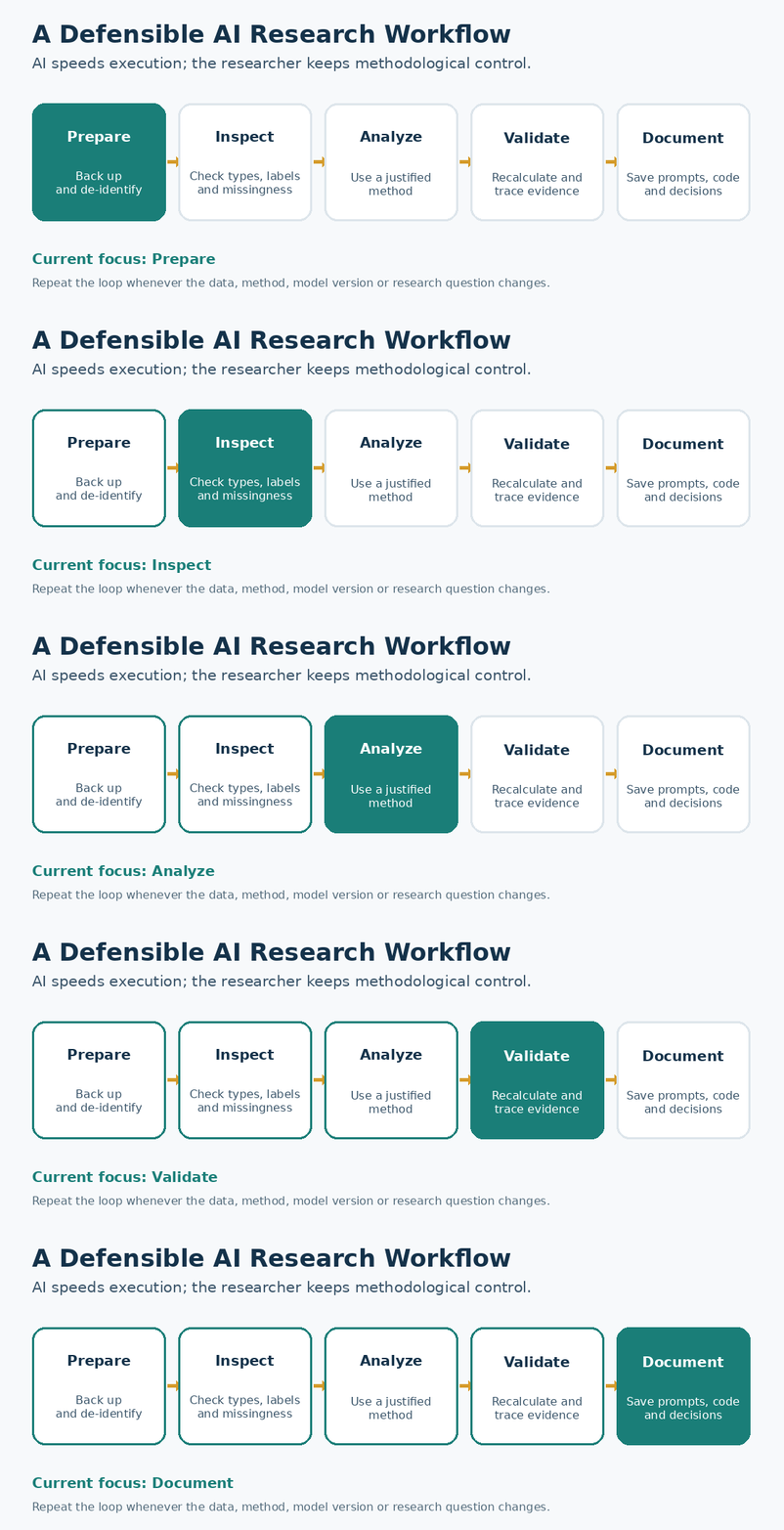
Prepare and De-Identify the Dataset
Keep an unchanged master copy and work from a duplicate. Remove direct identifiers that are not required, then examine combinations of indirect identifiers such as exact age, rare occupation, location, dates, and distinctive quotations that could still reveal a participant.
Ask the AI to Describe the Data Structure
Before requesting findings, ask for file names, worksheets, row and column counts, variable names, detected types, categories, units, missing-value codes, possible identifiers, and relationships between tables. Stop if the description does not match the actual dataset.
Check Variables, Formats, and Missing Values
Confirm that numbers were not imported as text, dates were interpreted in the intended locale, category labels were not split by capitalization or spelling, and codes such as 99 or minus one were not treated as genuine measurements.
Explore Trends, Outliers, and Sampling Problems
Request descriptive statistics and plots before inferential analysis. Ask the tool to distinguish a possible data-entry error from a valid extreme observation, a subgroup, or a distributional feature. Outliers should not be removed simply because they change the result.
Define the Research Question and Hypotheses
A weak instruction such as “analyze this file” gives the system too much freedom. A stronger instruction identifies the population, design, variables, outcome, comparison, and permissible language. It may also state that causal claims are not allowed unless the design supports them.
Select the Appropriate Analysis Method
Ask the system to propose a method and explain alternatives, assumptions, variable requirements, sample requirements, and consequences of violations. The researcher should make the final choice. Complex designs, unfamiliar methods, and consequential decisions warrant review by a statistician or methodology specialist.
Run the Analysis and Review the Underlying Logic
Prefer platforms that expose code, formulas, SQL, procedural settings, or source-linked coding. Check the selected variables, filters, reference categories, missing-data handling, transformations, model parameters, and output labels before interpreting the result.
Validate the Results Independently
Recalculate the central findings in a trusted environment such as SPSS, R, Python, or another approved research platform. Independent validation should prioritize the numbers and themes that support the paper’s main claims rather than duplicating every exploratory output.
Interpret Findings in the Research Context
Statistical significance does not establish practical importance. Association does not automatically establish causation. A frequently occurring theme does not necessarily represent all participants. Interpretation must consider theory, prior evidence, study design, measurement quality, uncertainty, and alternative explanations.
Document the Process for Reproducibility
Record the tool, model or version when available, date, files, prompts, generated code, transformations, rejected outputs, corrections, validation steps, and human decisions. A future researcher should be able to understand both what the system did and how the research team changed it.
The DIG Framework for AI Data Analysis
Description: Confirm How the AI Reads the Data
The first stage is descriptive rather than analytical. Ask the system to explain rows, columns, units, categories, missingness, and table relationships. This catches basic errors before they become sophisticated-looking results.
Introspection: Explore Before Testing Claims
Use exploratory analysis to identify distributions, anomalies, possible subgroups, and questions worth investigating. Keep those observations separate from pre-specified tests so that post-hoc patterns are not presented as confirmatory evidence.
Goal Setting: Connect the Method to the Research Question
State the analytical objective, population, variables, study design, desired output, and method constraints. A clear goal makes it easier to detect when the system has drifted into an irrelevant analysis or silently changed the question.
Human Validation: Verify Before Using the Findings
Review calculations, code, assumptions, charts, codes, themes, quotations, and narrative interpretation. Human validation is not a final ceremonial check; it is part of the analytical method.
Best AI Data Analysis Tools for Researchers
The comparison below is based on current product documentation, not a controlled hands-on benchmark. Features, limits, pricing, privacy terms, and model behavior can change. Researchers should verify the current version and test it with a known, non-sensitive dataset before adoption.
| Tool or platform | Best fit | Transparency and evidence | Main limitation |
|---|---|---|---|
| ChatGPT | Flexible file exploration, code-backed analysis, tables, charts and explanation | Generated code and structured outputs can be reviewed | Requires the researcher to impose a disciplined workflow |
| Julius AI | Researcher-friendly quantitative and statistical file analysis | Code-backed workflow and natural-language analysis | Easy execution can obscure weak method selection |
| DataLumio | Combined qualitative, quantitative, PDF, cleaning and reporting tasks | Workspace-oriented outputs; verify each method and source claim | Independent academic performance evidence remains limited |
| Evidano | Transcript, document and cross-segment qualitative analysis | Emphasizes source-linked evidence and researcher review | Vendor performance claims require independent confirmation |
| ATLAS.ti | Structured qualitative coding and project management | Codes can be reviewed and refined against source material | Licensing and a specialist learning curve |
| Dimensions | Literature, citation and research-intelligence analysis | Connected scholarly entities and filters | Not a primary survey or transcript analysis tool |
| Databricks Genie Code | Large technical datasets and multi-step institutional analysis | Code, notebooks, lineage and governed data assets | Requires technical infrastructure and expertise |
| Snowflake Cortex Analyst | Natural-language analysis over governed Snowflake data | Generated SQL, semantic models and verified-query workflows | Requires warehouse setup and semantic modeling |
Julius AI for Quantitative and Statistical Analysis
Julius is designed for natural-language analysis of uploaded files and can support statistics, visualization, and code generation. [5] It is a practical option for researchers who want a lower-friction route into quantitative analysis while retaining access to the computational steps.
Its main risk is not lack of power but misplaced confidence. Researchers should require a method justification, assumption checks, visible code, and independent reproduction of the principal result.
DataLumio for Mixed Research Files
DataLumio presents itself as a no-code workspace for cleaning data, analyzing spreadsheets and PDFs, working with qualitative material, creating dashboards, and producing reports. [7] This broad workflow may suit students, consultants, and researchers handling several file types in one project.
The breadth also makes verification important. A report that combines extraction, analysis, and writing can hide which stage introduced an error. Review the cleaned file, calculations, source passages, and final narrative separately.
Evidano for Interview and Qualitative Analysis
Evidano, formerly associated with the AILYZE name, focuses on qualitative and document analysis, including thematic, frequency, and cross-group workflows. [8] It is most relevant when researchers need rapid exploration of interviews, open-ended responses, or policy documents.
Source-linked evidence is useful, but no interface can remove interpretive responsibility. Vendor accuracy claims should be tested against manually reviewed samples, especially when the analysis involves ambiguity, culture, minority viewpoints, or sensitive narratives.
ChatGPT for Flexible File Exploration and Interpretation
ChatGPT can analyze uploaded structured files, execute code, and produce tables or charts. [1] It is strongest as a flexible analytical workspace that can move between data inspection, coding, explanation, visualization, and drafting.
Because it is not a specialist research-governance platform, the researcher must create the structure: describe the data first, constrain the method, inspect the code, verify the result, and keep a record outside the conversation.
ATLAS.ti for Academic Qualitative Coding
ATLAS.ti combines established qualitative project functions with AI-assisted coding. Its Intentional AI Coding workflow lets researchers state a research intention, generate relevant coding questions, apply codes, and then review or refine the result. [6]
It is a better fit than a general chatbot when the project requires persistent sources, codes, quotations, memos, code hierarchies, and an auditable qualitative workspace.
Dimensions for Literature and Citation Analysis
Dimensions is appropriate for discovery, bibliometric mapping, and research-intelligence questions involving publications, grants, datasets, patents, clinical trials, and policy documents. [9] It should not be compared directly with a spreadsheet analyst because it addresses a different research job.
Enterprise and Warehouse Tools for Large Research Data
Databricks Genie Code can generate and run code, work with notebooks and dashboards, and use cataloged tables and lineage inside the Databricks environment. [10] Snowflake Cortex Analyst lets users ask natural-language questions about structured Snowflake data and uses semantic models to improve text-to-SQL accuracy. [11]
These platforms make sense when an institution already has governed data infrastructure and technical support. They are usually excessive for a single student spreadsheet and do not replace specialist qualitative methodology.
Which AI Tool Is Best for Your Research Method?
Best Fit for Quantitative Research
For small and medium spreadsheets, ChatGPT or Julius AI can accelerate inspection, code generation, visualization, and explanation. For advanced, regulated, or heavily scrutinized analysis, SPSS, R, Python, or another established environment should remain part of the verified workflow.
Best Fit for Qualitative Research
ATLAS.ti and NVivo provide structured qualitative workspaces with coding, source management, queries, cases, memos, and mixed-methods functions. NVivo’s current platform also includes an AI Assistant alongside its established QDA features. [13] Evidano or a general model may be useful for a rapid first pass, but specialist platforms are better suited to long, iterative projects that need traceability.
Best Fit for Mixed-Methods Research
A combined workspace such as DataLumio may reduce switching between files, while a hybrid workflow can use a statistical environment for numerical analysis and a qualitative platform for transcripts. The decisive factor is whether the researcher can build and defend the integration, not whether one dashboard displays both outputs.
Best Fit for Literature and Citation Analysis
Use a research-intelligence platform such as Dimensions for citation networks and connected research outputs. A systematic review still requires a documented search strategy, screening process, eligibility criteria, extraction protocol, and risk-of-bias method.
Best Fit for Students and Individual Researchers
Students often need a tool that accepts familiar files, explains the method, exposes code, and exports reusable tables or charts. An institutionally licensed platform may provide better support and governance than a separate consumer subscription. The easiest interface is only useful when the student can verify what happened.
Best Fit for Research Teams and Institutions
Teams should prioritize access controls, data-processing terms, retention, audit logs, collaboration, versioning, integrations, semantic definitions, and repeatability. Large projects should also measure error rates and validation effort, not just adoption or the number of prompts submitted.
AI Data Analysis Compared With SPSS, NVivo, R, and Python
| Evaluation factor | General AI tools | SPSS or NVivo | R or Python |
|---|---|---|---|
| Learning curve | Low to moderate | Moderate | Higher |
| Natural-language interaction | Native strength | Increasingly available | Usually added through an assistant |
| Customization | Platform-dependent | Strong within product scope | Very high |
| Transparency | Ranges from visible code to black box | Procedural output or project structure | Full code control |
| Reproducibility | Depends on saved prompts, code and model stability | Generally strong when syntax or projects are preserved | Very strong when code and environments are preserved |
| Best use | Rapid exploration, explanation and assistance | Structured statistical or qualitative workflows | Advanced, custom and automated analysis |
AI Tools and SPSS
SPSS is an established statistical platform for testing, regression, predictive modeling, forecasting, and data preparation. Current SPSS versions also include an AI Output Assistant for natural-language explanation, showing that AI and traditional software are becoming integrated rather than remaining separate categories. [12]
Conversational tools may be faster for ad hoc exploration. SPSS may be easier to defend when the project requires standardized procedures, persistent metadata, familiar output, institutional support, or saved syntax.
AI Tools and NVivo
A chatbot can summarize a transcript quickly. NVivo is built to maintain sources, codes, cases, attributes, memos, queries, and visualizations through an iterative qualitative project. [13] For a few short interviews, a general tool may support exploration. For a dissertation with many sources and formal audit requirements, specialist software is usually more realistic.
AI Tools and R or Python
R is a free environment for statistical computing and graphics, and Python supports a broad analytical and automation ecosystem. [14] Both require more technical learning but provide control over transformations, modeling, diagnostics, visualization, and reproducibility.
AI can make these environments more accessible by drafting code. That does not turn generated code into a disposable detail. The script is part of the research method and should be reviewed, saved, and rerun.
When a Hybrid Workflow Works Better
A strong hybrid approach uses AI to inspect data, explain choices, and draft code; runs the verified analysis in an established environment; returns the output to AI for plain-language explanation or formatting; and checks the final narrative against the actual result.
This challenges the common assumption that the researcher must choose one platform to replace all others. In many real projects, the safest gain comes from combining conversational speed with established analytical controls.
How to Choose the Right AI Data Analysis Tool
Match the Platform to the Data and Method
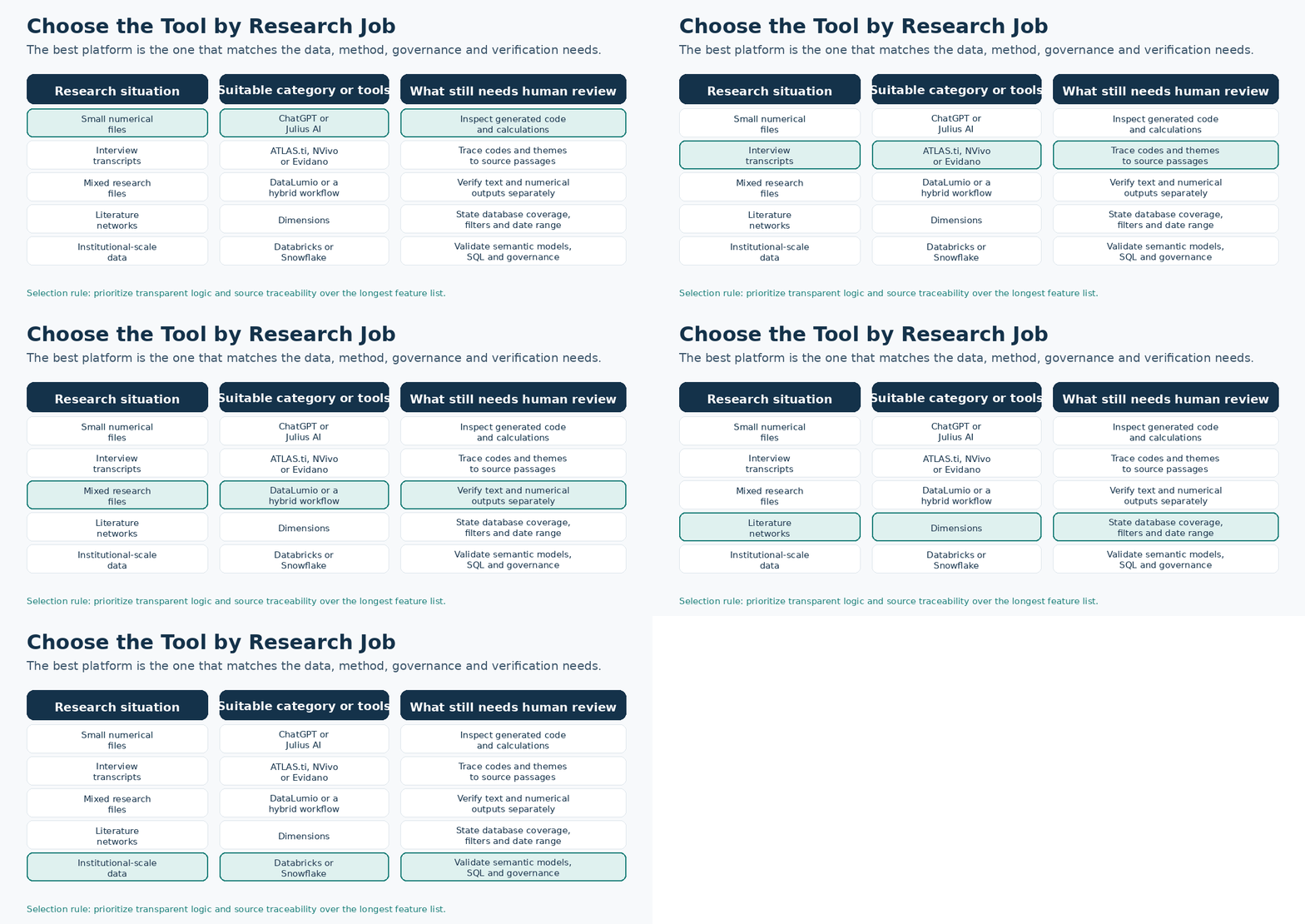
Begin with the research job. A spreadsheet assistant may be enough for a small survey, a qualitative platform is better for complex coding, a research-intelligence database is appropriate for citation analysis, and a warehouse-native system suits institutional data already governed in that environment.
Check Real Dataset Size and Complexity
A published file-size limit does not reveal whether the system can manage multiple related tables, long transcripts, embedded formulas, repeated measurements, or thousands of open-ended answers. Test the actual structure rather than relying on the upload limit.
Require Visible Logic and Source Traceability
Prioritize code, formulas, generated SQL, statistical settings, transformation logs, and links from themes to original passages. An answer without traceable logic may be convenient for brainstorming but difficult to use as research evidence.
Review Privacy, Storage, and Model-Training Policies
Account type matters. OpenAI provides user-level data controls and additional controls for business, enterprise, and education workspaces. [2] Similar distinctions can exist across other platforms. Researchers should review the exact plan, contract, retention terms, data location, sub-processors, and model-training policy instead of making a product-wide assumption.
Confirm Specialized Analytical Capabilities
A platform that says it “analyzes data” may not support multilevel models, survival analysis, repeated measures, intercoder comparison, deductive coding, mixed-methods integration, or source-linked quotations. Confirm the specific procedure needed for the study.
Evaluate Export, Integration, and Long-Term Access
Useful outputs include cleaned data, scripts, SQL, codebooks, tables, vector figures, project backups, source links, prompt histories, and audit logs. A result trapped inside a temporary chat is difficult to maintain or reproduce.
Compare Price With Validation Effort
Subscription cost is only part of the decision. A low-cost tool that hides its process may require more review than a specialist platform with clearer outputs. Measure the time to a defensible result, including correction and validation, rather than the time to the first answer.
Test With a Small Non-Sensitive Dataset
Create a test file with known answers and deliberate problems: a duplicate record, a reversed item, inconsistent labels, a missing-value code, an extreme value, and a misleading column name. Observe what the tool detects, what it changes, and whether it explains uncertainty.
What AI Can and Cannot Do in Academic Research
What AI Can Do Well
AI often performs well on bounded, checkable tasks such as organizing files, explaining variables, drafting code, producing descriptive summaries, formatting tables, suggesting provisional codes, and creating exploratory visualizations. These tasks are valuable because the researcher can inspect the result directly.
What AI Cannot Reliably Decide
AI cannot independently establish whether the research question is theoretically meaningful, the measure is valid in the population, the design supports causation, a qualitative interpretation is culturally appropriate, or the evidence is sufficient for publication. These are disciplinary and ethical judgments tied to accountability.
Why AI-Generated Results Are Not Automatically Publication-Ready
A publication-ready finding must be methodologically justified, reproducible, ethically obtained, accurately reported, and appropriately interpreted. Generative models can produce polished prose before those conditions have been met, so fluency must never be used as a proxy for validity.
When to Use a Statistician or Methodology Expert
Expert support is warranted when the design is complex, the sample is small or unbalanced, missingness may be informative, causal claims are planned, methods are unfamiliar, models disagree, or findings may affect high-stakes decisions. The need is even stronger when the researcher is using AI because they cannot independently evaluate the method.
Research Ethics, Privacy, and IRB Compliance
Remove Identifiers Before Uploading Data
Remove unnecessary names, addresses, account numbers, and contact details, then examine indirect identifiers. A distinctive quotation, rare diagnosis, exact date, workplace, and demographic combination may identify a participant even when the name is absent.
Check Institutional Policy, Consent, and Ethics Approval
The proposed AI workflow should fit the consent language, data-management plan, institutional policy, funder requirements, and ethics approval. NIH guidance links AI-related research with established protections for participant welfare, privacy, autonomy, informed consent, data management, and responsible sharing. [15]
Understand Where and How the Platform Processes Data
Review storage location, retention period, deletion behavior, access controls, sub-processors, model-training terms, and available institutional agreements. A general security page does not prove that a specific account, contract, and workflow are suitable for a particular study.
Use Approved or Local Systems for Sensitive Research
Medical, genomic, education, employment, criminal-justice, and trauma-related data may require an approved institutional environment or local processing. “HIPAA-ready” or similar language should not be treated as blanket permission; contractual, technical, and organizational conditions still matter.
Disclose Material AI Use When Required
Journal and publisher policies vary, so researchers should keep records even when the final disclosure format is unknown. COPE states that AI tools cannot qualify as authors because they cannot take responsibility for submitted work. Human authors remain accountable and should be transparent about material AI use. [16]
Maintain an Audit Trail
The audit trail should show what was uploaded, what the system was asked to do, what it produced, what the researcher rejected, what was corrected, what was independently reproduced, and what appeared in the final report.
Common AI Data Analysis Mistakes and Risks
Beginning With a Vague Prompt
“Find insights” invites uncontrolled exploration. A useful prompt defines the question, population, variables, design, analytical limits, and expected output. It should also tell the system not to modify data or use causal language without justification.
Allowing the Tool to Select a Method Without Review
A recommendation is not a decision. Require the system to explain alternatives, assumptions, and failure conditions. When the choice is consequential, obtain expert review.
Accepting Fabricated or Unsupported Findings
Every statistic, quotation, theme, citation, and participant claim should be traceable to source data or a verified calculation. A confident explanation is not evidence that the value exists in the file.
Confusing Association With Causation
Generative writing can drift toward causal verbs because they sound decisive. Unless the design and analysis justify causality, use language such as “associated with,” “related to,” or “predicted.”
Ignoring Statistical Assumptions
A regression can be computed correctly and still be unsuitable because of dependence, nonlinearity, multicollinearity, influential observations, or model misspecification. Assumption checks should be explicit and independently reviewed.
Losing Qualitative Context
Automated coding may flatten nuance, merge distinct concepts, miss sarcasm, or underrepresent minority views. Review themes against full passages rather than isolated snippets and preserve contradictory evidence.
Failing to Preserve Reproducible Records
Model behavior can change after an update, a new conversation, or a prompt revision. Save files, code, settings, outputs, and decisions outside the platform so the project does not depend on a transient interface.
Uploading Sensitive Data to an Unapproved Tool
This is one of the highest-consequence errors. Convenience does not override consent, confidentiality, institutional rules, or applicable regulation.
How to Validate AI-Generated Research Findings
Inspect Code, Formulas, and Procedures
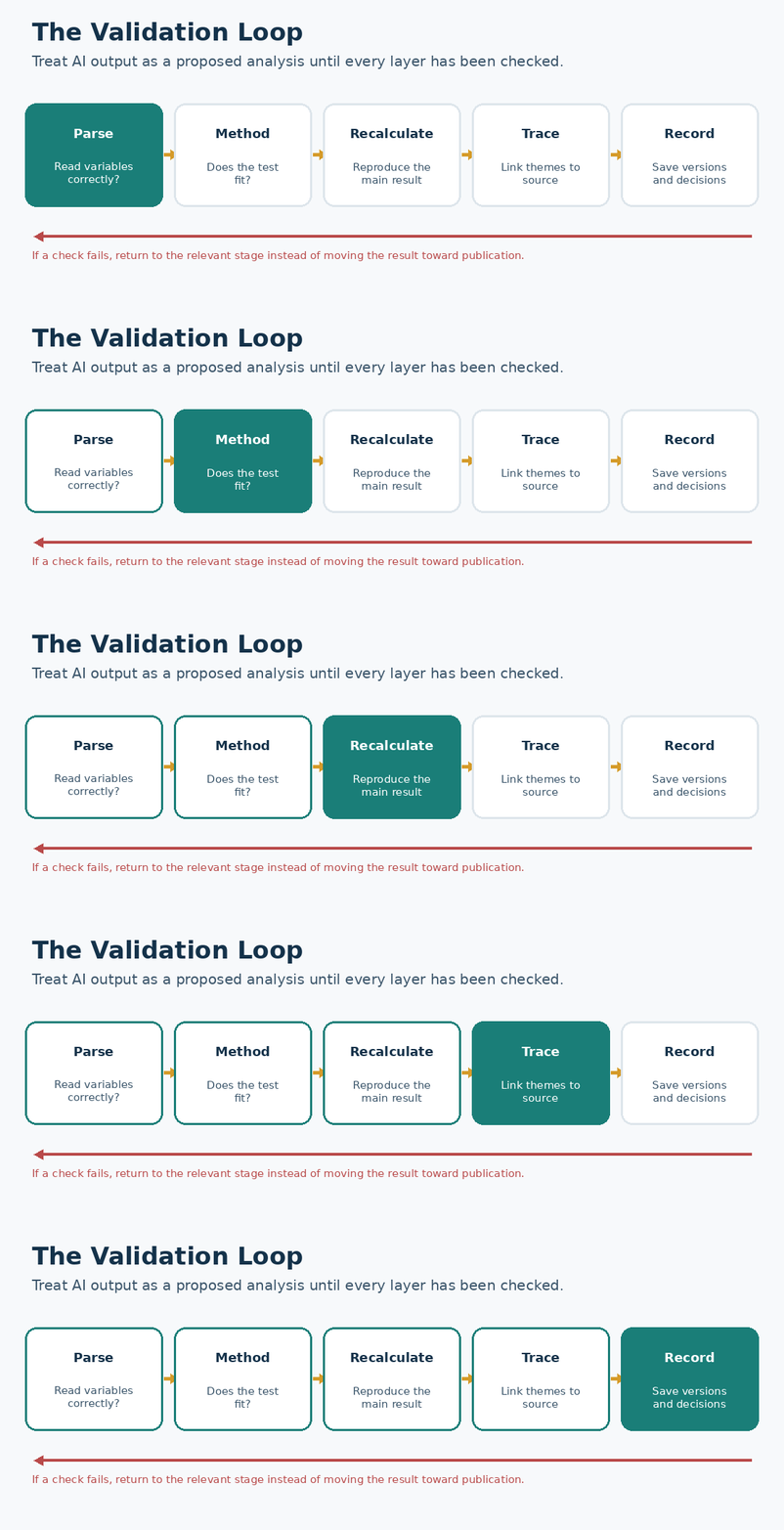
Check every transformation and calculation against the research plan. When the code is unfamiliar, ask for a line-by-line explanation and obtain qualified review before using the output.
Recalculate the Main Results
Independently check sample sizes, means, percentages, effect estimates, confidence intervals, p-values, model coefficients, theme frequencies, and quotations that support the central claims.
Compare With Established Research Software
Reproduce the principal quantitative analysis in SPSS, R, Python, or another approved platform. For qualitative work, compare the AI codebook with a manually reviewed sample and inspect whether the same passages support the same themes.
Check Assumptions and Sample Requirements
Ask the tool to list each assumption, how it was assessed, the result, and the consequence of a violation. Verify those checks rather than accepting a generic statement that assumptions were met.
Review Themes Against Participant Responses
For each major theme, inspect several supporting passages, contradictory examples, minority perspectives, and omitted material. Confirm that quotations are exact and still mean the same thing in context.
Use Appropriate Qualitative Trustworthiness Procedures
Depending on the methodology, this may include member checking, reflexive memos, peer debriefing, negative-case analysis, intercoder discussion, or an audit trail. AI assistance should not bypass the quality procedures that fit the study.
Obtain Supervisor or Specialist Review
A clear AI explanation can still be wrong. Expert review is especially important when the researcher cannot independently evaluate the method, the project is high stakes, or the result is likely to face close peer review.
Record Versions, Corrections, and Final Decisions
The final record should distinguish AI suggestions from researcher decisions. This prevents the misleading impression that the analysis emerged automatically and supports later replication.
You May Also Like Best AI Tools for Statistical Analysis
FAQs
Can AI Analyze Research Data Accurately?
AI can perform many bounded tasks accurately when the file is clean, the method is specified, and the output can be checked. Reliability falls when the system must infer the design, choose among complex methods, join messy tables, or interpret ambiguous evidence. Important outputs should remain provisional until verified.
What Is the Best AI Tool for Research Data Analysis?
There is no universal best tool. ChatGPT and Julius suit flexible quantitative file work, ATLAS.ti and NVivo suit structured qualitative projects, Dimensions suits research-intelligence analysis, and Databricks or Snowflake suit governed institutional data. The choice depends on method, sensitivity, transparency, scale, and reproducibility.
Can AI Replace SPSS or NVivo?
AI can replace some routine actions, but it does not automatically replace the persistent project structure, established procedures, specialist diagnostics, or reproducibility controls of SPSS and NVivo. A hybrid workflow is often more defensible than a complete replacement.
Can ChatGPT Analyze Excel and CSV Research Data?
Yes. ChatGPT can analyze uploaded structured files, execute code, and create tables or charts. [1] Researchers should first confirm how the file was parsed, then inspect the generated code and independently verify the main result.
Can AI Perform Regression and Statistical Tests?
Many platforms can generate and execute regression, t-tests, ANOVA, chi-square tests, correlations, and other procedures. The researcher still needs to confirm that the design, variable types, sample, missing-data treatment, and assumptions support the method.
Can AI Analyze Interview Transcripts?
Yes. AI can suggest codes, themes, summaries, and cross-group comparisons. Specialist qualitative platforms offer stronger source management and coding structure. Researchers must review the output against the full transcripts and retain responsibility for context and interpretation.
Is It Safe to Upload Participant Data?
Not automatically. Safety depends on consent, data sensitivity, institutional approval, account type, vendor terms, retention, storage location, access controls, and legal requirements. Use de-identified test data until the exact workflow has been approved.
Can AI Choose the Correct Statistical Test?
AI can recommend a test, but it should not be the sole decision-maker. Require a design-based justification, alternatives, assumptions, and failure conditions. Seek statistical review for complex or consequential choices.
Can AI Create Charts and Tables for a Research Paper?
Yes, but every value, label, unit, category, scale, caption, sample size, and uncertainty indicator must be verified. Journal formatting and accessibility requirements may require further editing.
Should Researchers Disclose AI Use?
Researchers should follow the current policy of the journal, institution, funder, or professional body. Material use in analysis, coding, interpretation, figure creation, or manuscript preparation should be documented even when the eventual disclosure format is uncertain.
Are AI-Generated Findings Accepted by Journals?
Journals assess methodology, transparency, ethics, reproducibility, and accountability rather than accepting findings simply because a particular tool generated them. Policies vary, and human authors remain responsible for the final claims.
How Can Researchers Reduce AI Hallucinations?
Use code-backed calculations, source-linked quotations, explicit uncertainty, and independent checks. Do not ask the system to fill missing evidence. Separate observed data from interpretation and retain a complete record of prompts and corrections.
Is AI Data Analysis Worth Using for Research in 2026?
Who Benefits Most
AI is most useful for researchers who need help translating questions into code, cleaning repetitive files, producing exploratory visualizations, understanding technical output, or organizing moderate volumes of open text—and who can verify the result or obtain review.
When to Use It Cautiously
Caution is necessary when data are identifiable, the sample is small, the design is complex, causal inference is planned, the method is unfamiliar, the platform hides its logic, or the result may influence high-stakes decisions.
When Traditional or Specialist Analysis Is Better
Traditional tools remain preferable when the project requires advanced diagnostics, regulated or institutionally standardized procedures, stable syntax, complex qualitative project management, long-term reproducibility, or a specialist method that the AI platform does not support transparently.
The Most Effective Human-and-AI Workflow
The most defensible approach is collaborative: the researcher defines the question and method; AI assists with preparation, exploration, code, or provisional coding; the researcher inspects the process; central findings are independently verified; and the final interpretation and documentation remain human responsibilities.
Key Takeaways and Next Steps
Start by classifying the research data, its sensitivity, and the method required to answer the question. Choose a platform because it supports that workflow and exposes evidence, not because it promises the fastest report.
Verify how the tool reads the data before analysis. Review the code, calculations, statistical assumptions, themes, quotations, and narrative claims. Reproduce the central findings in an established environment or through specialist review, then preserve prompts, versions, transformations, corrections, and decisions.
Used this way, AI data analysis for researchers is worth adopting in 2026. Its strongest role is to accelerate transparent, reproducible work while the researcher remains the final authority on methodology, ethics, interpretation, and publication.
Sources
- OpenAI Help Center. Data analysis with ChatGPT.
- OpenAI Help Center. Data Controls FAQ.
- Google Docs Editors Help. Collaborate with Gemini in Google Sheets.
- Microsoft Support. Get data insights with Copilot in Excel.
- Julius AI. Frequently asked questions and supported workflows.
- ATLAS.ti. Intentional AI Coding.
- DataLumio. About DataLumio.
- Evidano. AI qualitative data analysis software.
- Dimensions. Research intelligence platform.
- Databricks Documentation. Genie Code.
- Snowflake Documentation. Cortex Analyst.
- IBM. SPSS Statistics.
- Lumivero. NVivo qualitative data analysis software.
- The R Project. What is R?.
- NIH Office of Science Policy. Artificial Intelligence and research participant protections.
- Committee on Publication Ethics. Authorship and AI tools.
- Yang et al., arXiv preprint. AIDABench: AI Data Analytics Benchmark.
- Liu et al., arXiv preprint. Benchmarking AI Agents for Addressing Scientific Challenges Across Scales.