
GraphRAG vs RAG: Differences, Use Cases, and Trade-Offs
RAG Finds Relevant Facts. GraphRAG Connects the Dots.
GraphRAG vs RAG: Differences, Use Cases, and Trade-Offs
GraphRAG and RAG both connect large language models to external information, but they retrieve context in different ways. Standard RAG usually finds semantically similar text passages, while GraphRAG uses entities and relationships to assemble connected context.
RAG is often the better choice for direct document questions because it is simpler to build and maintain. GraphRAG becomes more useful when answers depend on relationships, dependencies, corpus-wide themes, or facts distributed across several sources.
GraphRAG vs RAG: What Is the Difference?
Retrieval-augmented generation, or RAG, combines a language model with an external knowledge source. Instead of relying only on information learned during model training, the system retrieves relevant material and provides it to the model before an answer is generated.
The original RAG research described models that combine parametric memory in a language model with non-parametric memory in a dense vector index. Modern production systems use the term more broadly, but the central idea remains the same: retrieve evidence first, then generate an answer from that evidence.[1]
GraphRAG is an umbrella term for retrieval architectures that use graph-structured information. A graph represents entities as nodes and relationships as edges. Depending on the implementation, GraphRAG may combine graph traversal with vector search, keyword search, source passages, community summaries, or several retrieval methods.
Microsoft GraphRAG, one prominent implementation, extracts entities and relationships from source documents, detects communities of related entities, creates community reports, and uses those structures during retrieval.[2]
How Standard RAG Retrieves and Generates Answers
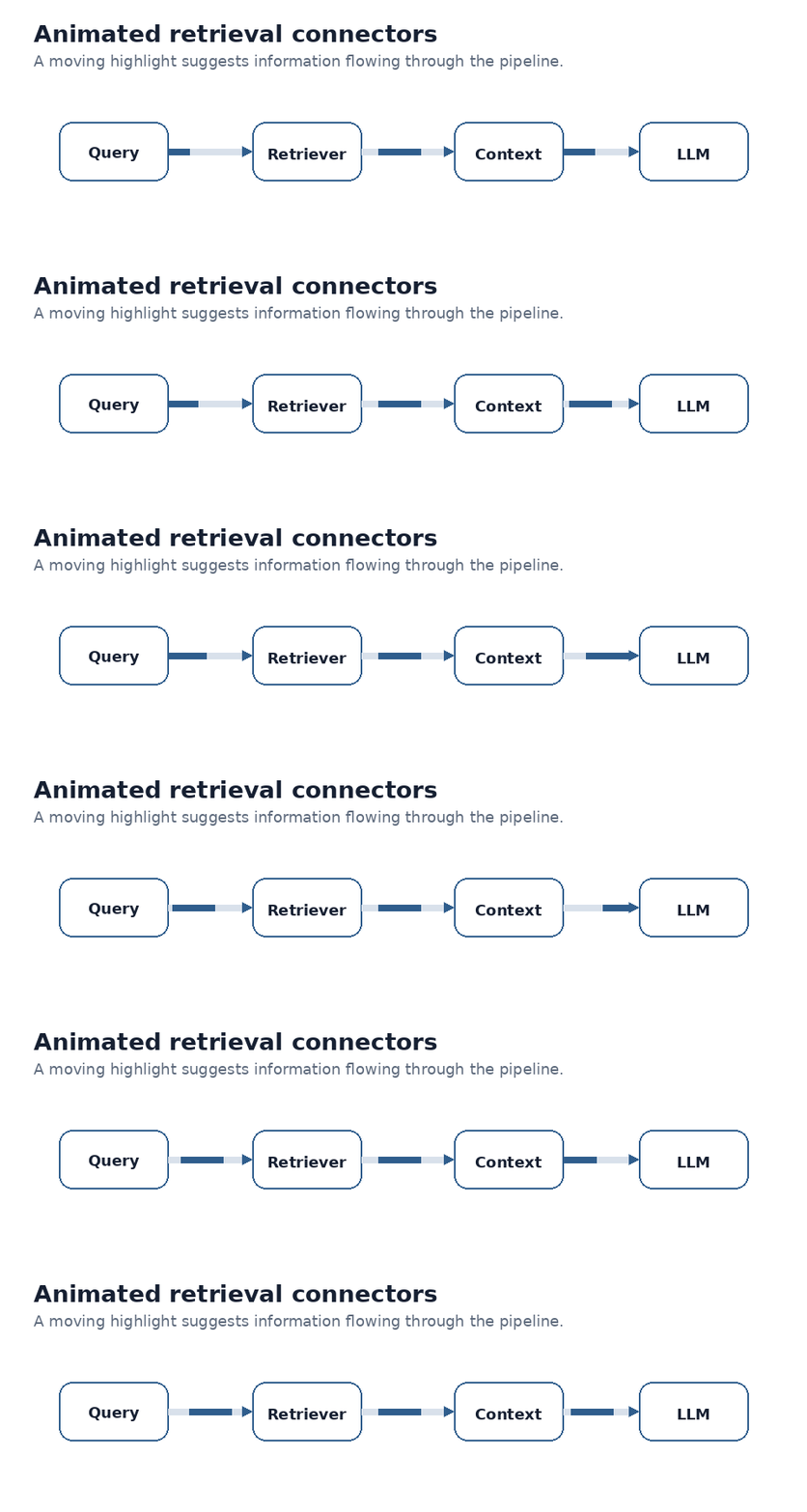
A typical RAG pipeline cleans source documents, divides them into chunks, converts those chunks into embeddings, and stores the embeddings in a searchable index. When a user submits a question, the system retrieves the most relevant passages and adds them to the model’s context.
- Ingest and clean documents.
- Split content into retrievable chunks.
- Create vector embeddings and index the chunks.
- Retrieve and optionally rerank relevant passages.
- Generate an answer grounded in the retrieved material.
This approach works well when the answer appears clearly in one or more passages. A policy assistant, for example, can retrieve the section of an employee handbook that explains parental leave and summarize it.
Standard RAG is not inherently limited to a single passage or retrieval step. Advanced systems may use hybrid search, metadata filters, reranking, query expansion, and query decomposition. The important distinction is that relationships between facts are not usually represented as first-class objects that can be traversed directly.
How GraphRAG Uses Entities, Relationships, and Graph Traversal
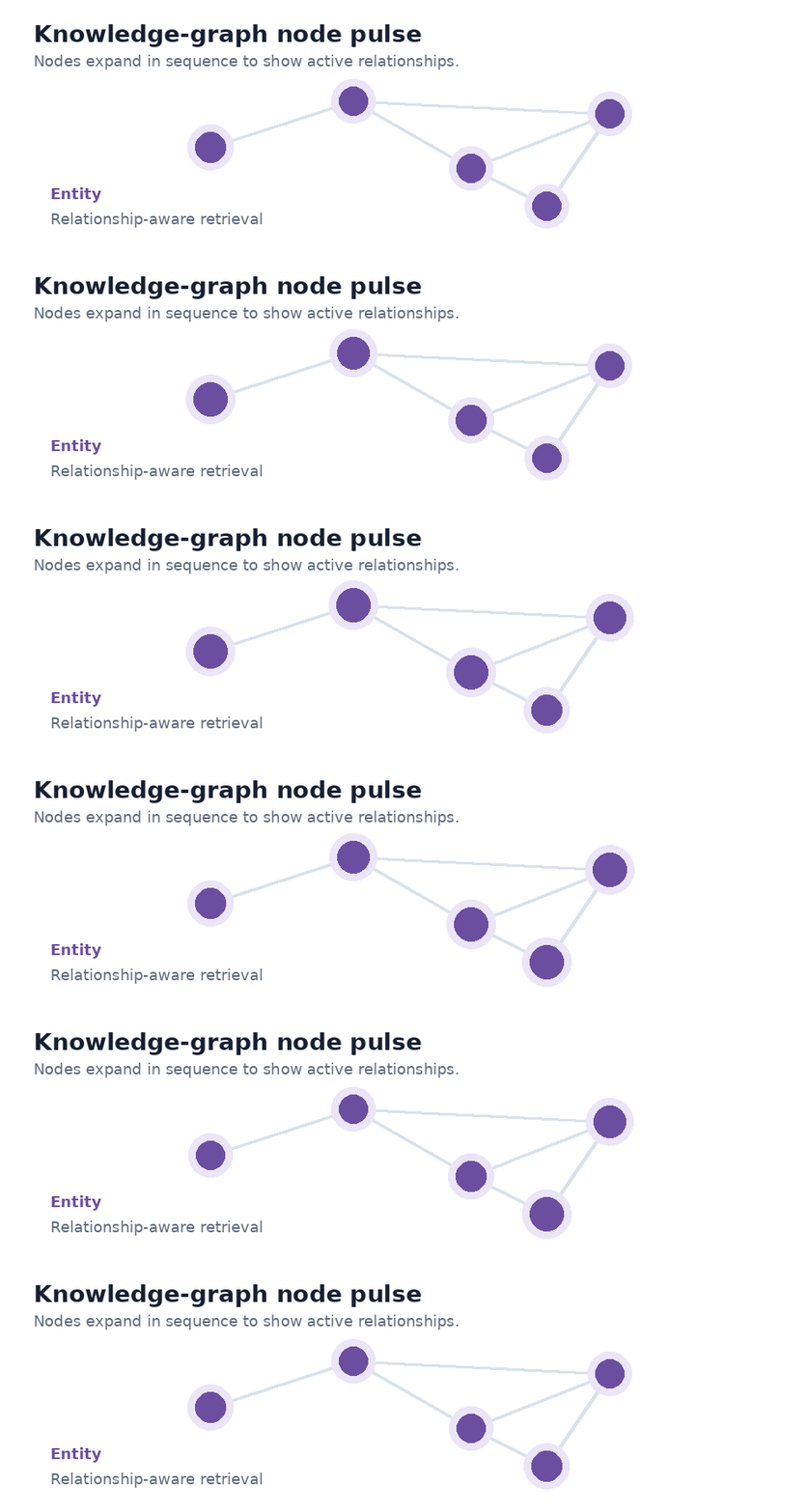
GraphRAG adds a structured representation between the source material and the generated answer. During indexing, the system may identify people, organizations, products, locations, contracts, diseases, events, and other domain entities. It then records relationships such as supplies, owns, depends on, treats, mentions, or conflicts with.
At query time, relevant entities become entry points into the graph. The system can follow their connections and retrieve a subgraph containing related entities, relationships, source passages, and higher-level summaries.
Microsoft GraphRAG illustrates several retrieval modes. Local search combines structured graph information with unstructured source text for questions about particular entities. Global search uses community reports in a map-reduce process for questions requiring an overview of the corpus. DRIFT search adds community context to iterative local exploration.[3][4][5]
RAG vs GraphRAG Architecture Compared
| Area | Standard RAG | GraphRAG |
|---|---|---|
| Primary representation | Text chunks, embeddings, metadata | Entities, relationships, source text, and often communities |
| Common retrieval | Vector, keyword, or hybrid search | Graph traversal plus vector, text, or hybrid retrieval |
| Best context | Directly relevant passages | Connected, relational, or corpus-level context |
| Typical question | What does this policy say? | Which policies affect this supplier and its subsidiaries? |
| Indexing effort | Relatively low | Higher because graph extraction and resolution are required |
| Updating | Re-embed changed chunks | Update chunks, entities, edges, provenance, and summaries |
| Main risk | Missing or irrelevant passages | Incorrect entities, duplicate nodes, or misleading edges |
These are common patterns rather than rigid categories. A sophisticated RAG system can perform multi-step retrieval, while a poorly constructed graph may provide less useful context than a strong vector baseline.
Where Traditional RAG Performs Well
Traditional RAG is usually sufficient when a question maps directly to identifiable text. Strong use cases include product documentation, internal policy search, frequently asked questions, customer support, report summarization, direct contract-clause retrieval, and technical troubleshooting.
It also provides a faster path to value. Teams can improve retrieval incrementally through better chunking, metadata, embeddings, reranking, and prompts without introducing a separate graph-construction and maintenance layer.
Where RAG Falls Short on Connected and Multi-Step Questions
Standard retrieval can struggle when no single passage contains the complete answer. One document might identify a supplier, another might report a factory disruption, and a third might list products that depend on the affected component.
Vector retrieval may find all three passages, but success depends on query wording, chunk boundaries, retrieval depth, and the model’s ability to combine the evidence correctly. The relationships themselves are not guaranteed to be explicit in the retrieval index.
Corpus-wide questions create another challenge. Microsoft’s GraphRAG research evaluated global questions over datasets of roughly one million tokens and reported better comprehensiveness and diversity than a naive RAG baseline in that test setting. This is evidence for a specific class of summarization tasks, not proof that GraphRAG is universally more accurate.[6]
When GraphRAG Produces More Useful Context
GraphRAG is most useful when relationships are part of the answer rather than incidental background. Relevant domains include supplier dependency tracing, cross-contract analysis, research discovery, ownership networks, biomedical evidence mapping, compliance investigations, and organizational knowledge management.
Hypothetical exampleA manufacturer asks: “Which products could be delayed if Supplier A loses access to Material B, and which approved suppliers offer substitutes?” A standard RAG system may retrieve passages mentioning the supplier, material, products, and alternatives. A GraphRAG system can start from those entities and traverse relationships connecting suppliers, materials, products, approvals, and manufacturing sites. The graph does not guarantee a correct answer. Its value is that the retrieval process mirrors the dependency structure of the question.
RAG vs GraphRAG for Multi-Hop Reasoning and Explainability
Multi-hop reasoning combines several facts through a sequence of connections. A graph supports this naturally because the retrieval layer can follow an explicit path such as Supplier → provides → Material → used in → Product → manufactured at → Facility.
Graph paths can improve evidence provenance by showing why particular facts were included. However, an extracted edge is not sufficient evidence by itself. The system should preserve links to the original passages because automated extraction can misunderstand, merge, or oversimplify a relationship.
Verified factMicrosoft’s local-search documentation states that the method combines structured knowledge-graph data with unstructured data from the input documents.[3] Nuanced conclusionGraphRAG can make retrieval paths easier to inspect, but it does not automatically make a generated answer factual. Source quality, extraction quality, retrieval configuration, and model behavior remain decisive.
GraphRAG Limitations: Cost, Complexity, and Maintenance
GraphRAG introduces substantial work before the first useful query is answered. A production system may require entity and relationship definitions, extraction prompts or models, entity resolution, graph design, provenance tracking, update workflows, retrieval-depth controls, evaluation, and permission rules.
Microsoft estimates that graph extraction accounts for roughly 75% of indexing cost in its standard GraphRAG method. Its open-source repository also warns that indexing can be expensive and recommends starting with a small dataset.[7][8]
Maintenance is a continuing cost. New documents may create entities, change relationships, contradict older information, or require community reports to be regenerated. A graph can also reveal connections that are not obvious in individual documents, so access control may need to operate at the entity and relationship level rather than only at the document level.
The Reality Layer: Architecture Diagrams vs Implementation
Theoretical advice often recommends building a clean graph and traversing it for complete relational context. Implementation results depend on whether entities and relationships can be extracted consistently from the available data.
Names may be ambiguous, two records may describe the same organization differently, and relationships may change over time. A sentence can imply a temporary or conditional connection that should not become a permanent edge.
Teams also tend to underestimate evaluation effort. It is not enough to check whether an answer sounds correct. Retrieval quality, omitted evidence, path validity, groundedness, citation accuracy, latency, token use, and indexing cost should be evaluated separately. RAGAS was proposed around this principle, separating dimensions such as context relevance, answer relevance, and faithfulness.[9]
When to Use RAG, GraphRAG, or a Hybrid Approach
Choose standard RAG when answers usually exist in clear passages, relationships are secondary, updates are frequent, latency matters, or the team needs a relatively simple first deployment.
Choose GraphRAG when users repeatedly ask relational, multi-document, or corpus-level questions and the organization can maintain a reliable entity model.
Choose a hybrid architecture when semantic search is useful for locating the starting point but graph traversal is needed to expand the context. Neo4j’s VectorCypherRetriever follows this pattern by performing vector similarity search and then executing a Cypher traversal from the retrieved nodes.[10]
A hybrid system can also route questions to different retrievers. Direct policy questions may use vector RAG, while dependency, network, or corpus-level questions use graph retrieval.
How to Evaluate RAG and GraphRAG for Your Data
Do not begin by asking which architecture is more advanced. Begin with the questions users actually need answered.
- Build a representative set of direct, multi-document, relational, corpus-wide, ambiguous, and unanswerable questions.
- Compare retrieval recall, context precision, answer correctness, faithfulness, citation accuracy, latency, and cost.
- For GraphRAG, also inspect entity accuracy, relationship accuracy, path relevance, graph coverage, and update behavior.
- Use human review for high-stakes domains and for cases where automated evaluators disagree.
The most informative comparison is performance by query type. An average score can conceal the fact that a system excels at direct lookup but fails on dependency questions, or handles global themes well but adds unacceptable latency to simple requests.
Practical Next Steps for Choosing the Right Retrieval Architecture
Start with a limited pilot rather than graphing the entire knowledge base. Select 30 to 100 representative questions and identify which ones fail with a well-configured RAG baseline.
Improve chunking, metadata, hybrid search, and reranking before assuming a graph is required. For the remaining failures, determine whether the missing element is genuinely relational. If the answer depends on stable, meaningful connections, prototype a small graph around one domain.
Conclusion
RAG retrieves relevant evidence efficiently, while GraphRAG adds an explicit structure for retrieving connections. The practical decision is not which architecture sounds more intelligent, but which one reliably answers the required questions at an acceptable cost and maintenance burden.
Use the simplest retrieval architecture that works. Add graph structure only when relationship-aware retrieval produces measurable value that a strong RAG baseline cannot deliver.
You May Also Like AI Agent Memory
FAQs
What is the difference between RAG and GraphRAG?
RAG retrieves relevant text passages, while GraphRAG also uses entities and relationships to gather connected context. GraphRAG is more suitable when the answer depends on how facts relate across documents.
What is the main purpose of RAG?
RAG gives a large language model access to external information before it generates an answer. Its purpose is to improve relevance and grounding without retraining the model on every document update.
How does standard RAG work?
Standard RAG splits documents into chunks, creates embeddings, retrieves the passages most similar to a query, and sends them to the language model. The result depends heavily on chunk quality, retrieval settings, and source relevance.
How does GraphRAG work?
GraphRAG extracts entities and relationships from source data, stores them in a graph, and retrieves connected nodes, edges, and source passages. Some systems also use vector search to find the starting point before graph traversal begins.
What is the main benefit of GraphRAG?
GraphRAG can retrieve relational context that ordinary semantic search may miss. This is useful for multi-step questions involving dependencies, ownership, influence, or connections across several sources.
What is the main limitation of standard RAG?
Standard RAG may retrieve individually relevant passages without representing the relationships between them. It can still answer complex questions, but success may depend on query decomposition, reranking, and the model’s ability to combine fragmented evidence.
What is the main limitation of GraphRAG?
GraphRAG is only as reliable as the graph it builds. Incorrect entity extraction, duplicate nodes, missing relationships, or outdated edges can produce misleading context.
Is GraphRAG more expensive than RAG?
GraphRAG usually requires more engineering, indexing, storage, evaluation, and maintenance than a standard RAG system. The additional cost is justified only when relationship-aware retrieval solves important questions that simpler retrieval cannot answer reliably.
When is GraphRAG the best choice?
GraphRAG is a strong option for supply chains, compliance investigations, biomedical research, contract networks, and other domains where relationships are central to the question. It is most valuable when those relationships are stable enough to model and maintain.
When should GraphRAG not be used?
GraphRAG is often unnecessary for FAQs, product documentation, policy lookup, and other tasks where answers appear in clear passages. A well-configured RAG system is usually faster to deploy and easier to operate for these cases.
What tools are commonly used for GraphRAG?
GraphRAG systems may use graph databases such as Neo4j or Memgraph, vector systems such as Weaviate or Qdrant, and orchestration frameworks such as LangChain or LlamaIndex. Tool choice should follow the retrieval requirements rather than drive the architecture decision.
What should be tested before choosing RAG or GraphRAG?
Test both approaches on representative direct, multi-document, relational, ambiguous, and unanswerable questions. Compare retrieval quality, answer faithfulness, citation accuracy, latency, cost, and maintenance effort by query type rather than relying on one overall score.
Sources
- [1] Lewis et al., Retrieval-Augmented Generation for Knowledge-Intensive NLP Tasks.
- [2] Microsoft GraphRAG documentation: Indexing overview.
- [3] Microsoft GraphRAG documentation: Local Search.
- [4] Microsoft GraphRAG documentation: Global Search.
- [5] Microsoft GraphRAG documentation: DRIFT Search.
- [6] Edge et al., From Local to Global: A Graph RAG Approach to Query-Focused Summarization.
- [7] Microsoft GraphRAG documentation: Indexing methods and estimated cost distribution.
- [8] Microsoft GraphRAG GitHub repository guidance.
- [9] Es et al., RAGAS: Automated Evaluation of Retrieval Augmented Generation.
- [10] Neo4j GraphRAG Python documentation: VectorCypherRetriever.